

The Best Winter Containers From Outdoor Planters to Window Boxes
Celebrate the season by using hardy plants and fresh-cut boughs
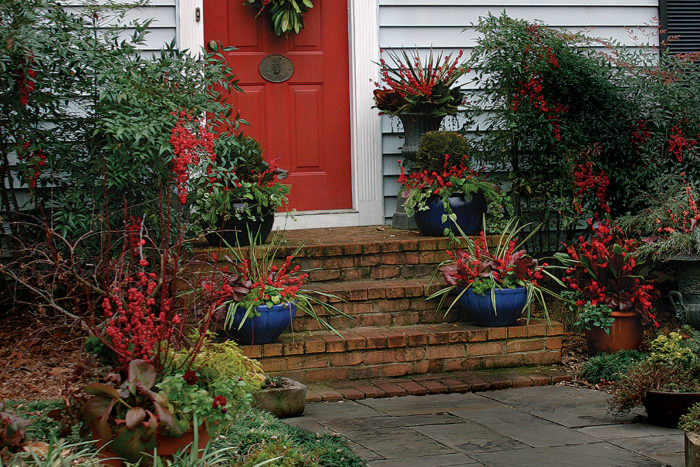
Container gardening doesn’t have to stop when the growing season is over. Taking advantage of strong plants and seasonal cuttings keeps your pots going into spring.
During the cold months of January and February, when the setting is bleak and the sky is gray, winter containers can cheer up the soul and provide a colorful punch to the landscape. Many gardeners give up on their potted creations in the fall, but that can be a horrible waste because winter is when color and interest are most vital.
Creating a winter design is not difficult. The general rule for container-plant survival through the winter is to use plants hardy to at least two zones colder than your USDA Hardiness Zone; this, however, is not always a steadfast rule. Many trees, shrubs, and perennials that are hardy in your zone will live and even thrive in containers through all four seasons. In this case, a frostproof pot with a drainage hole is important. Fiberglass, lead, iron, heavy plastic, and stone are the best weather-resistant containers to use; terra-cotta will eventually expand and crack with repeated freezing and thawing.
Assemble your designs early enough that the plants have time to acclimate to their new pots before the hard freeze. Also, winter containers usually need to be checked only monthly for water to make sure they haven’t dried out; when the soil eventually becomes frozen solid, watering is no longer necessary. Apply an antidesiccant such as Wilt-Pruf to broad-leaved evergreens and to branches of cut greens to protect against drying winter winds. When it comes to design, I like to use a mix of live plants, cut branches, colorful berries, and interesting evergreen foliage to dress up the pots for maximum seasonal appeal.
By following these simple guidelines, you may find winter a whole lot brighter, and maybe you’ll even be a little less anxious for spring.
Gold highlights seasonal colors
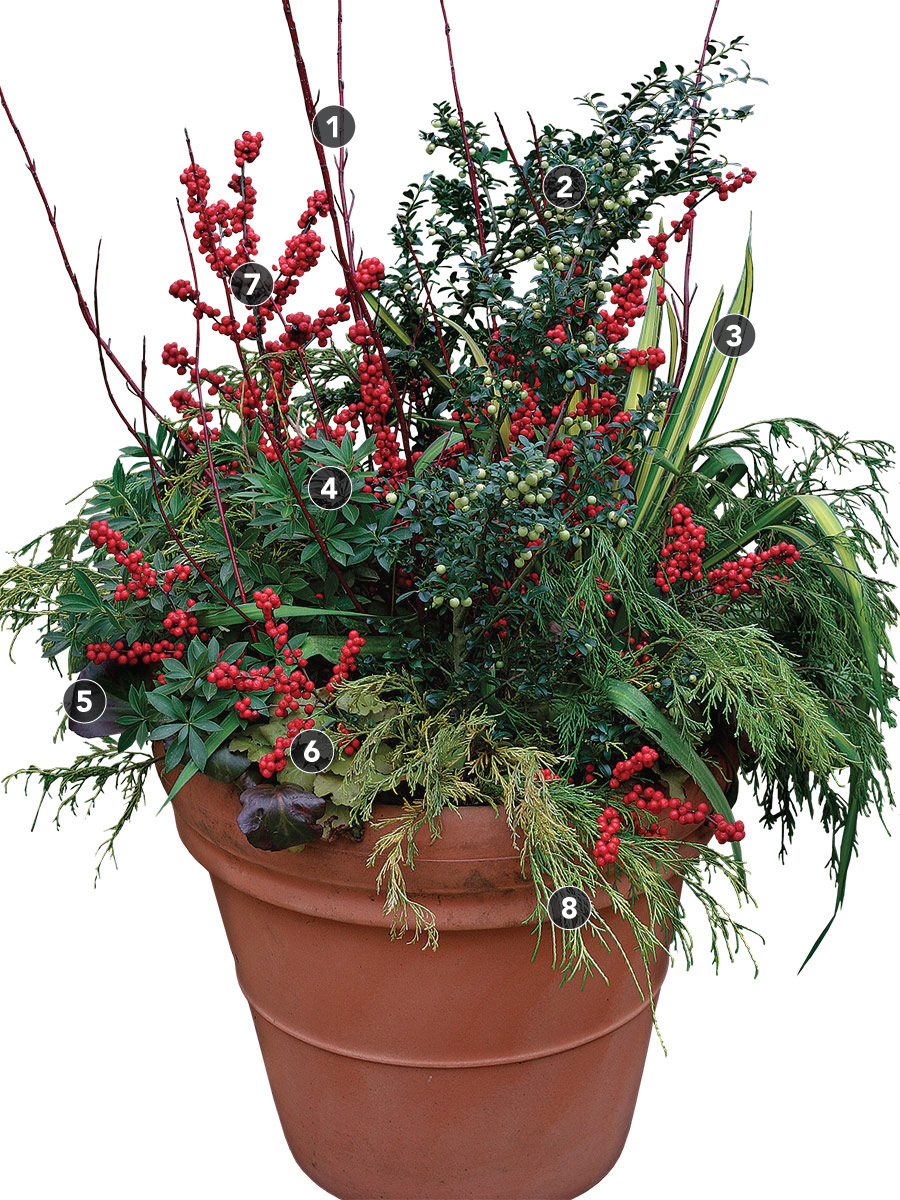
The vibrant colors of this container planting set it apart. Redtwig dogwood’s scarlet stems are strikingly prominent and add a structural component to the container. To highlight them, it helps to have a solid evergreen background so that the thin branches stand out. Surrounding the base of the dogwood are two small Japanese pieris, whose glossy, dark green leaves provide bulk and texture to the design. The lemon yellow foliage of ‘Golden Sword’ yucca complements the dogwood. Two perennials, ‘Bressingham Ruby’ bergenia and ‘Caramel’ heuchera, are tucked around the bottom of the pot to add an additional punch of color. The ‘Ivory Tower’ Japanese hollies on each side of the dogwood add more color interest with their creamy yellow berries. Branches of gold-thread sawara echo the yellow tones from the holly berries. The result is a colorful explosion dynamic enough to brighten the grayest of winter days.
Hardy plants
1. ‘Elegantissima’ redtwig dogwood (Cornus alba ‘Elegantissima’, Zones 2–8)
2. ‘Ivory Tower’ Japanese holly (Ilex crenata ‘Ivory Tower’, Zones 5–7)
3. ‘Golden Sword’ yucca (Yucca filamentosa ‘Golden Sword’, Zones 4–11)
4. Japanese pieris (Pieris japonica, Zones 6–8)
5. ‘Bressingham Ruby’ bergenia (Bergenia ‘Bressingham Ruby’, Zones 4–8)
6. ‘Caramel’ heuchera (Heuchera ‘Caramel’, Zones 3–8)
Fresh-cut boughs
7. ‘Winter Red’ winterberry (Ilex verticillata ‘Winter Red’, Zones 5–8)
8. Gold-thread sawara cypress (Chamaecyparis pisifera ‘Filifera Aurea’, Zones 4–8)
Dress up a beautiful pot
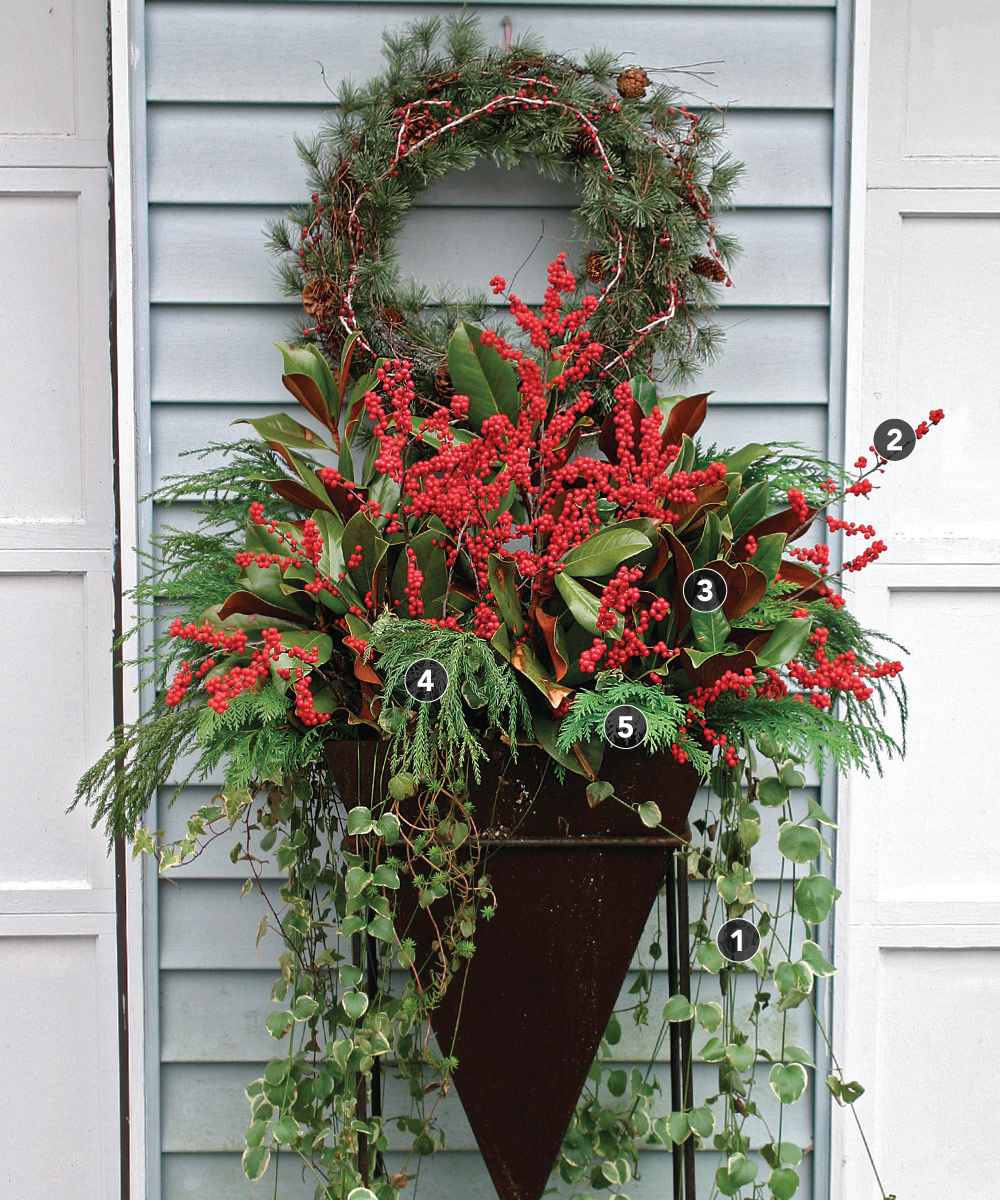
If a container is striking on its own, then winter is the perfect time to show it off. The rust color of this container is echoed in the russet brown undersides of the southern magnolia branches, which provide mass and bold texture with their glossy, wide foliage. Trailing variegated vinca vine accentuates the height of this container and takes the eye up and down the 5-foot-tall pot. Three other types of cut branches polish off this arrangement. Winterberry branches add a splash of color, while the fine texture of Japanese cedar and Lawson false cypress soften the overall look of the arrangement. When you want the container itself to shine, it is best to keep the plant palette simple.
Hardy plants
1. Variegated vinca vine (Vinca major ‘Variegata’, Zones 7–9)
Fresh-cut boughs
2. ‘Winter red’ winterberry (Ilex verticillata ‘Winter Red’, Zones 5–8)
3. Southern magnolia (Magnolia grandiflora, Zones 7–9)
4. Japanese cedar (Cryptomeria japonica, Zones 6–9)
5. Lawson false cypress (Chamaecyparis lawsoniana, Zones 5–9)
Rely on strong forms that stand out in snow
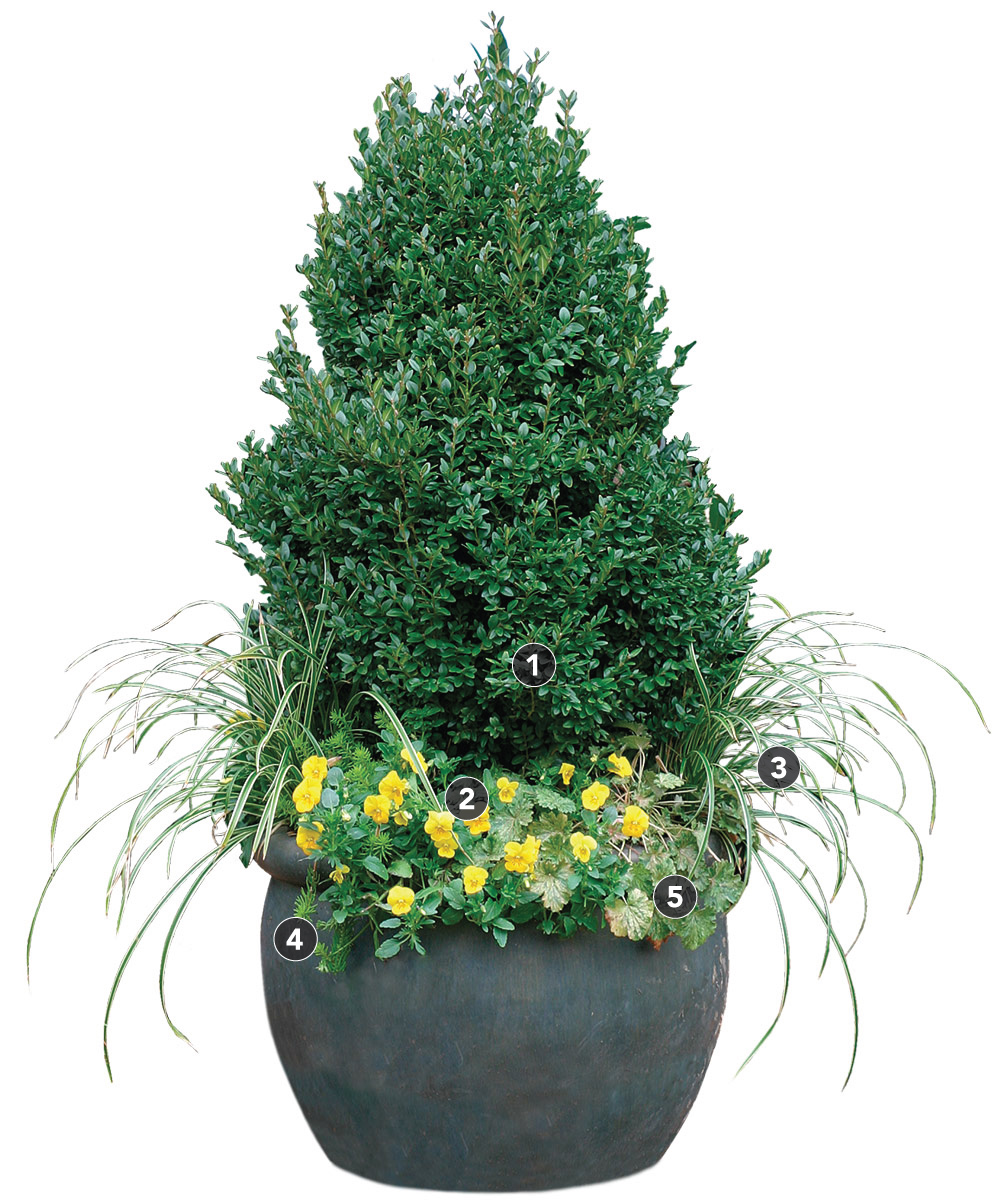
Many people feel that winter containers are a waste of time because they can’t be appreciated when covered in snow or ice. Using strong architectural forms in your containers will allow them to stand out even when encased in snow. Hardy ‘Green Mountain’ boxwood has this kind of profile. Its clean, simple lines stand out against almost any backdrop, especially when dusted with snow.
To highlight the dark foliage of the boxwood, I pair it with the slender leaves of silver-variegated Japanese sedge. The soft green-and-white mottled foliage of ‘Snow Angel’ heuchera gives mass to the arrangement, and ‘Angelina’ sedum is wedged in for its cascading tendency. The yellow pansies may not survive to the end of winter but are wonderful for a short time. The strong form of this design will make it a show-stopper throughout winter.
Hardy plants
1. ‘Green Mountain’ boxwood (Buxus ‘Green Mountain’, Zones 4–9)
2. Pansies (Viola × wittrockiana cv., Zones 8–11)
3. ‘Ice Dance’ Japanese sedge (Carex morrowii ‘Ice Dance’, Zones 5–9)
4. ‘Angelina’ sedum (Sedum rupestre ‘Angelina’, Zones 3–9)
5. ‘Snow Angel’ heuchera (Heuchera sanguinea ‘Snow Angel’, Zones 3–8)
Add flourishes to a focal point
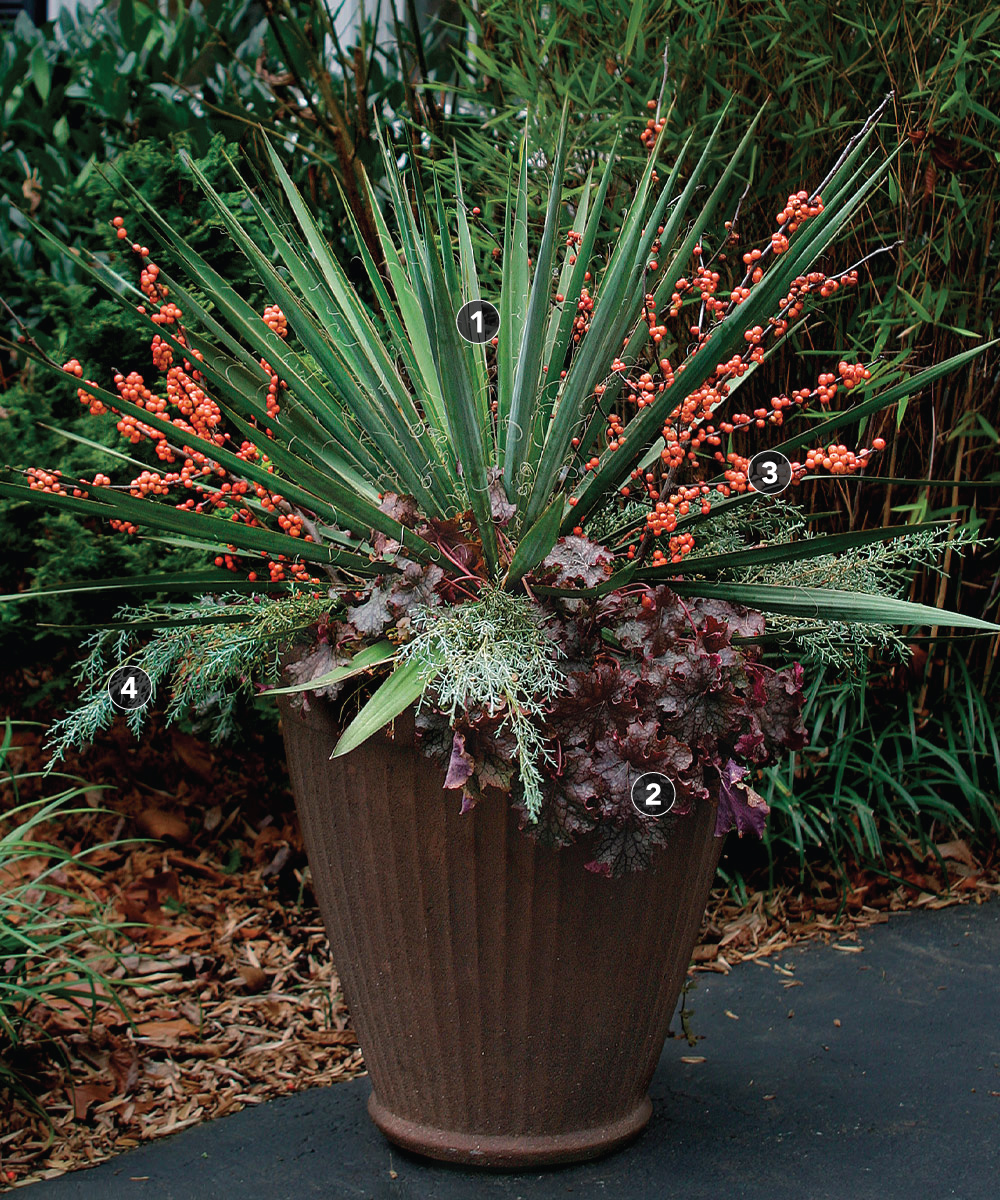
Although the hues featured in this planter are not necessarily traditional, they are still dramatic and seasonally appropriate. The strong vertical form of the evergreen beaked yucca makes it a perfect focal point for a design.
The dark foliage of a ‘Plum Pudding’ heuchera provides contrasting color at the base of the combination, and steely blue cut stems of smooth cypress pick up the silvery hues of the shimmering hairs along the edges of the yucca. With their opposing shape and color, orange winterberry branches also accentuate the sculptural yucca leaves. These fruits usually form earlier than red winterberry, so the berries do not last as long on the branch, but the color is worth the effort. The thick vertical leaves of the yucca and unexpected hues of this design stand out in winter, despite the absence of traditional red and green.
Hardy plants
1. Beaked yucca (Yucca rostrata, Zones 5–11)
2. ‘Plum Pudding’ heuchera (Heuchera ‘Plum Pudding’, Zones 4–9)
Fresh-cut boughs
3. Orange winterberry (Ilex verticillata ‘Aurantiaca’, Zones 5–8)
4. ‘Carolina Sapphire’ smooth cypress (Cupressus arizonica ‘Carolina Sapphire’, Zones 6–9)
Muffin Evander is the owner of Cultivated Designs, a container-garden design business based in Maryland.
Photos: Janet M. Jemmott



Comments
Can boxwoods be replanted after being in a container all winter? Stone container outdoors, next to buildings.
Hi Stephanie...I personally have found that I can transplant my boxwood out of the pot and into their next spot of service! Boxwood is such a great plant to have in your garden or in pots! I have also found that any branch that might have broken off can been stuck in the ground and it will root! Just make sure it's in the ground about 1/3 of the whole length of the stem.
I think it was thanks to you, Jeanne, that I have been sticking broken or cut off stems in the ground for the past couple of years. You mentioned it once in a GPOD comment and I thought, "Duh, well, of course, I should give this a try". I h now have a generous grouping of a red twig dogwood variety called 'Strawberry Daiquiri'...I started with 3 bushes and I now have 11.
Tis is great idea to change plants containers in the winter. Will try it.
Domestic cleaning Mitcham
The statement that terracotta is not as long lasting as other materials is 'false'. If you have seen the ruins in Rome you are looking at terracotta bricks that are over 1000 years old. The longest lasting pottery is from terracotta. You must know the product you are buying and the Italian clay known as Galestro will withstand freezing temperatures for centuries. Our Italian terracotta pottery comes with a 10 year warranty to minus 15 degrees. We send it to Michigan, Chicago, Minnesota, New York etc. BF http://www.eyeofthedaygdc.com
This is nice to visit such a lovely platform i read lots of wonderful things about plants and plantings i also love green https://arabnewsexpress.ae/
Log in or create an account to post a comment.
Sign up Log in