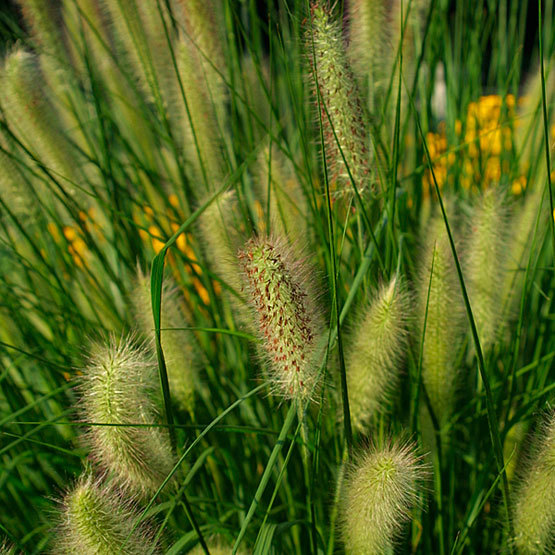
Genus Pennisetum (Fountain grass)

Pennisetum Pennisetum alopecuroides Photo/Illustration: Michelle Gervais
pen-nih-SEE-tum Common Name: Fountain grass
Pennisetum grows in savannas and woodlands throughout temperate to tropical climates. These plants exhibit feathery, spike-like panicles atop linear leaves in summer and autumn. Grow in containers, grass gardens, mixed herbaceous borders, and rock gardens; they are particularly effective en masse. The inflorescences are suitable for dried and fresh arrangements.  Note: Many species self-sow and may become invasive in warmer regions
Noteworthy characteristics: These grasses create delightful textures, with flower spikes that glow in the sun and wave in the breeze. There are many forms and sizes, some with deeply-colored foliage, that are adaptable to a wide variety of garden sites.
Care: Grow in light, average, well-drained soil in full sun. Cut back previous year's foliage by early spring.
Propagation: Divide in late spring or early autumn. Sow seed in early spring at 55° to 65°F.
Problems: Rust, eye spot, leaf spots.

Species, varieties and cultivars for genus Pennisetum

Pennisetum setaceum 'Fireworks' Pennisetum setaceum 'Fireworks'
(Variegated Purple Fountain Grass)
(1 user review)
Hardiness Zones: 1 2 3 4 5 6 7 8 9 10 11

A refreshing new look to an old time favorite ornamental grass! Pennisetum 'Fireworks' is the first variegated purple fountain grass. The midvein is the typical burgundy color and is flanked by hot pink margins. Produces beautiful red-burgundy foxtail flowers. Great accent plant and excellent in containers.

Pennisetum alopecuroides Pennisetum alopecuroides
(Fountain grass)
(1 user review)
Hardiness Zones: 1 2 3 4 5 6 7 8 9 10 11

This species produces 2- to 5-foot-tall mounds of narrow green foliage and bottle brush-like silvery-pink to purple flowers, both of which mature to shades of brown. It is the parent of numerous cultivars with notable flowers that range from purple to gray/black. It and some of its cultivars self-sow plentifully in warm climates. It is marginally hardy in Zone 5.

Pennisetum glaucum 'Purple Majesty' Pennisetum glaucum 'Purple Majesty'
(Pearl millet)
Be the first to rate this plant

This cultivar of pearl millet has wide, deep purple foliage and stems. It forms a 5-foot-high specimen with tight cylindrical flowers of purple-brown seeds—a favorite of many birds. This plant makes a stunning container specimen. In the mixed border, its foliage contrasts nicely with other plants.

Pennisetum messiacum Pennisetum messiacum
(Bunny tails)
Be the first to rate this plant
Hardiness Zones: 1 2 3 4 5 6 7 8 9 10 11

This annual grass produces deep pink flowers that resemble rabbits' tails. Flowers persist throughout the season. It forms a tidy, evergreen clump, 2 feet high and 3 feet wide.

no image available Pennisetum messiacum 'Red Buttons'
(Red bunny tails, Fountain grass)
Be the first to rate this plant
Hardiness Zones: 1 2 3 4 5 6 7 8 9 10 11

This annual produces deep reddish-black flowers that resemble rabbits' tails. Flowers persist throughout the season. This plant forms an evergreen clump of green foliage with burgundy highlights, 2 feet high and 3 feet wide.

Pennisetum orientale Pennisetum orientale
(Oriental fountain grass, Tall tails)
(2 user reviews)
Hardiness Zones: 1 2 3 4 5 6 7 8 9 10 11

Pink, bottle-brush flowers rise well above arching clumps of graceful foliage in summer. This grass is beautiful in a mixed border, rock garden, or massed at waterside. It blooms in June with pink plumes.

Pennisetum setaceum 'Rubrum' Pennisetum setaceum 'Rubrum'
(Purple fountain grass, Red fountain grass)
(1 user review)
Hardiness Zones: 1 2 3 4 5 6 7 8 9 10 11

This tropical annual produces mounds of narrow burgundy-red foliage and purple plumes to 1 foot long. It is invaluable for containers and stunning, annual foliage color in a border. It rarely sets seed.

no image available Pennisetum spathiolatum
(Slender veldt grass)
Be the first to rate this plant
Hardiness Zones: 1 2 3 4 5 6 7 8 9 10 11

Native to South Africa, this non-invasive evergreen species produces showy pink flowers in spring, which are held 2 to 3 feet above the foliage on stiff, wiry stalks.