

Make a Tiny Water Garden with a Container
Plunge into the world of aquatic plants by designing a mini-pond in a small pot
I’m into little water gardens in a big way. As the horticulturist responsible for all the displays and plantings in the extensive aquatic gardens flowing through the Denver Botanic Gardens’ 23 acres, I find my greatest challenges—and my greatest delights—in designing water gardens for small containers. Over the years, I’ve learned that a teacup or a half whiskey barrel can house a water garden as exciting as anything I can dream up for the vast, watery canvas at the botanic garden. In fact, small gardens can be even better; they permit you to get close enough to really appreciate the intriguing foliage of the aquatic plants, their spectacular flowers, and their sometimes vibrant scents.
They’re foolproof too. If you wind up with a design that you don’t like, it’s easy to rearrange the plants. Small-container water gardens are actually a collection of submerged potted plants, so redesigning a planting is as simple as moving the pots around. And the plants are tough—most are almost hard to kill and require virtually no maintenance. All you need is a sunny spot with at least six hours of direct sun a day, something that holds water, and a few plants. For me, small-container water gardens have been an endless source of inspiration. And once you’ve mastered a small container, think what you can do in a big water garden.
Anything that holds water can contain a water garden
The first step in designing a small water garden is deciding on the container. Anything that holds water qualifies. Even if it doesn’t, there’s still hope—holes can usually be plugged with inexpensive corks to make a container watertight.
I find widely sold half barrels to be perfect. At 24 inches wide by 16 inches deep, they are ideally sized to accommodate a dramatic display. The problem, though, is that toxins oozing from the wood can foul both water and plants. My solution is to purchase a durable, plastic liner made to fit perfectly. These are available at many garden centers. Or you could line the barrel with a flexible PVC liner; just be sure to use at least two layers if the material is 10 or fewer millimeters thick; otherwise, the liner will only last a year or two.
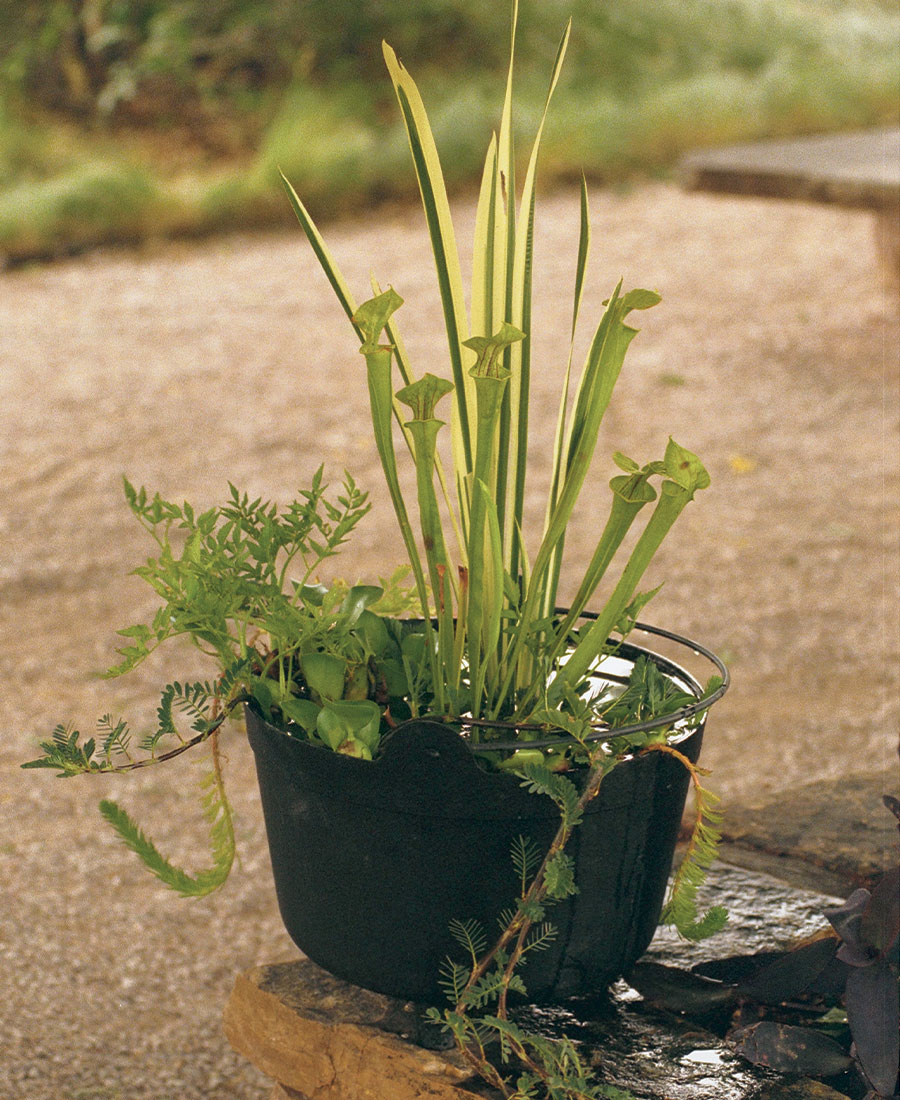
I’ve also used clay and plastic containers. To keep water from seeping into and through the porous clay of a ceramic container, I apply two coats of sealer. I also enjoy using black plastic containers that look like cast-iron pots. I’ve found them available in three sizes—15, 12, and 9 inches across—and sometimes like displaying them all as a group.
Use plants with contrasting shapes to create appealing compositions
Water, cupped in a container or basin, is a thing of beauty. Its flickering reflections are a welcome presence in any garden. But dressing it up with plants transports the display to a whole new dimension. I like to create compositions that are vibrant and dynamic, so I use plants with contrasting shapes, colors, and sizes. For me, the more contrast, the better. I like to combine the tall, slender, spiky shapes of an erect, fine-leaved marginal plant like yellow flag iris (Iris pseudacorus) or sweet flag (Acorus calamus) with the broad-leaved foliage of an easy-to-grow tropical marginal like taro (Alocasia or Colocasia spp.)—especially one of the varieties with variegated or dark-purple leaves. Marginal plants are those that are usually placed along the edges of a water garden; in the wild they grow in shallow water.
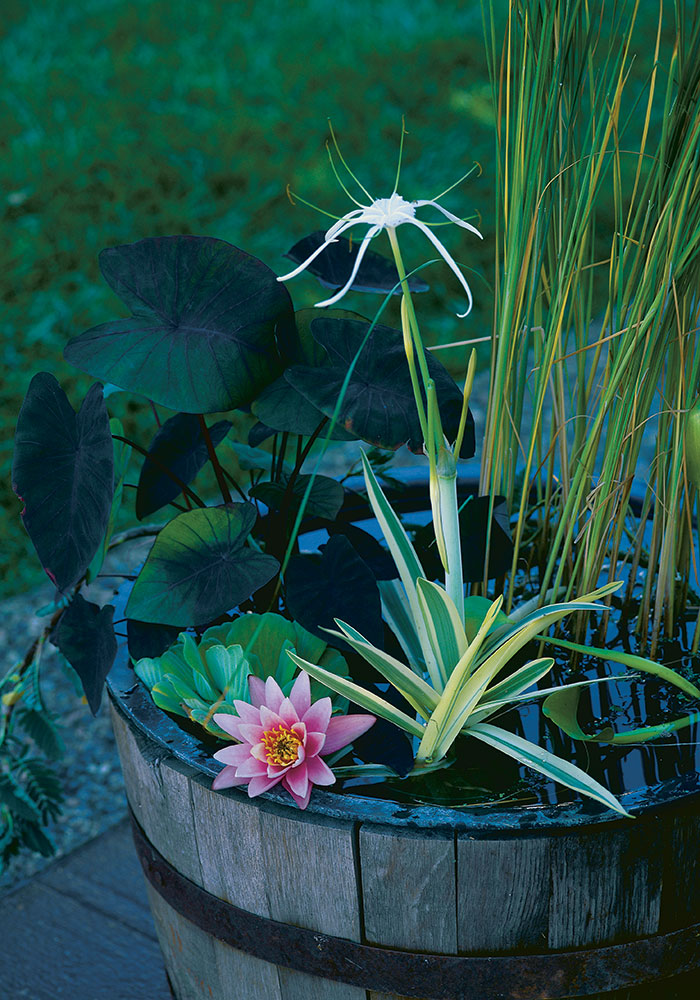
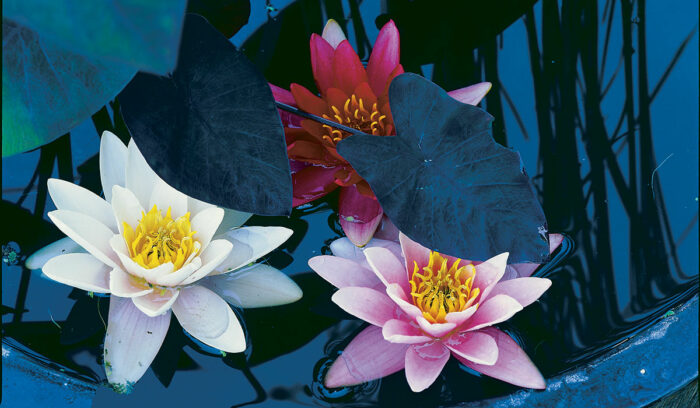
For a special touch, I might add a bright splash of color with a cut water lily flower or two. Water lily flowers, which I collect from a larger water garden, will last three days if cut the morning they first open. I don’t grow water lilies or lotus in my container compositions, though; they take up too much room. As an especially dramatic accent, I might add one of the real gems of the aquatic world—a variegated spider lily (Hymenocallis caribaea ‘Variegata’) or a clump of brightly colored chameleon plant (Houttuynia cordata ‘Chameleon’). I especially like using plants that have a story of their own; pitcher plants (Sarracenia spp.), for example, eat insects, digesting small bugs in the recesses of their large, trumpet-shaped leaves.
To finish off a planting, I sprinkle a few small floating plants—like water lettuce (Pistia stratiotes) or water hyacinth (Eichhornia crassipes)—over the surface of the water. I also might soften the hard edge of the container by letting a cascading plant like water mint (Mentha aquatica), with its fragrant foliage and powder-blue flowers, tumble over the side.
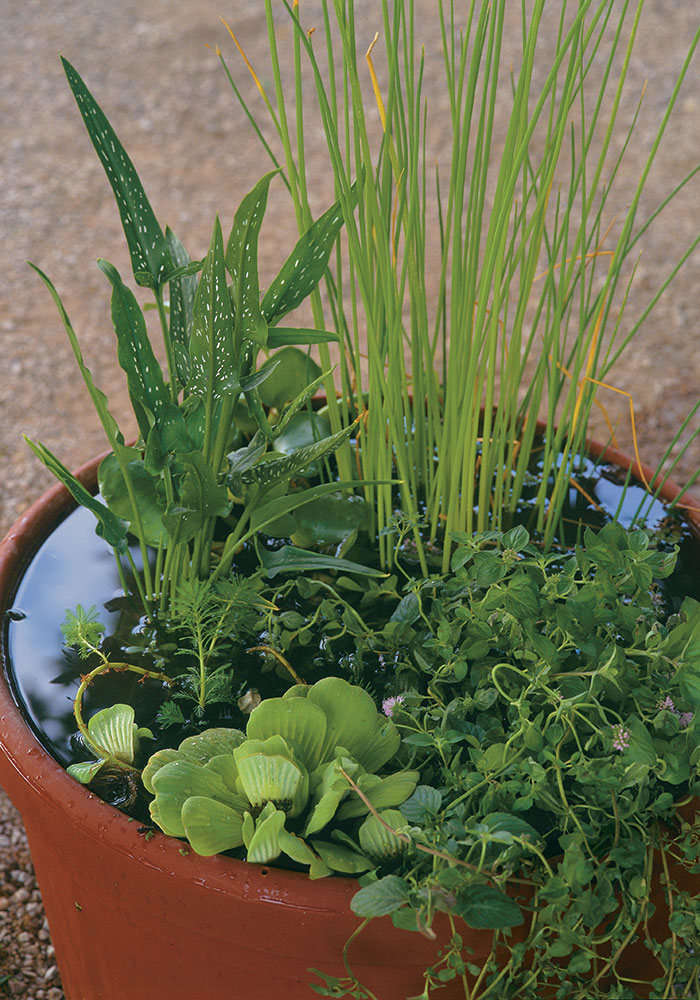
Whatever plants I use, I try to keep them in scale with the container. Huge plants spilling out of a tiny container most likely would not create a pleasing effect. There are no strict guidelines to follow, so I just aim for a plant and container combination that looks harmonious and proportionate.
For a crisp look, use only a few plants
The first mistake beginning water gardeners make is jamming too many plants into their container. Though a half-barrel-size container easily accommodates up to four plants potted in 2-gallon pots and a host of floating plants, there’s no need to use that many. An overcrowded container often results in designs that are chaotic. Keep it simple. Especially when you’re starting, it’s easiest to make pleasing designs with only two or three plants. As you gain experience, you can graduate to more complicated compositions using greater numbers and varieties of plants.
However many you use, how and where you place plants in the container is of paramount importance. The plants should fit as a unit to create the picture you want. First, determine how the planting will be viewed. Designing a container that will be seen from a few directions is a lot easier than making one that’s meant to be viewed from all sides.
Unless the container is to be displayed in the round, place a tall, spiky plant at the center rear to create a dramatic backdrop. Then use a broad-leaved marginal or two in front or to one side, where their generously sized leaves will contrast sharply with the whiplike fronds of taller plants. Remember to keep it simple; otherwise you risk diminishing the effect. For containers that will be seen from all sides, I put the tall, vertical-leaved plant in the middle and arrange broadleafs on each side.
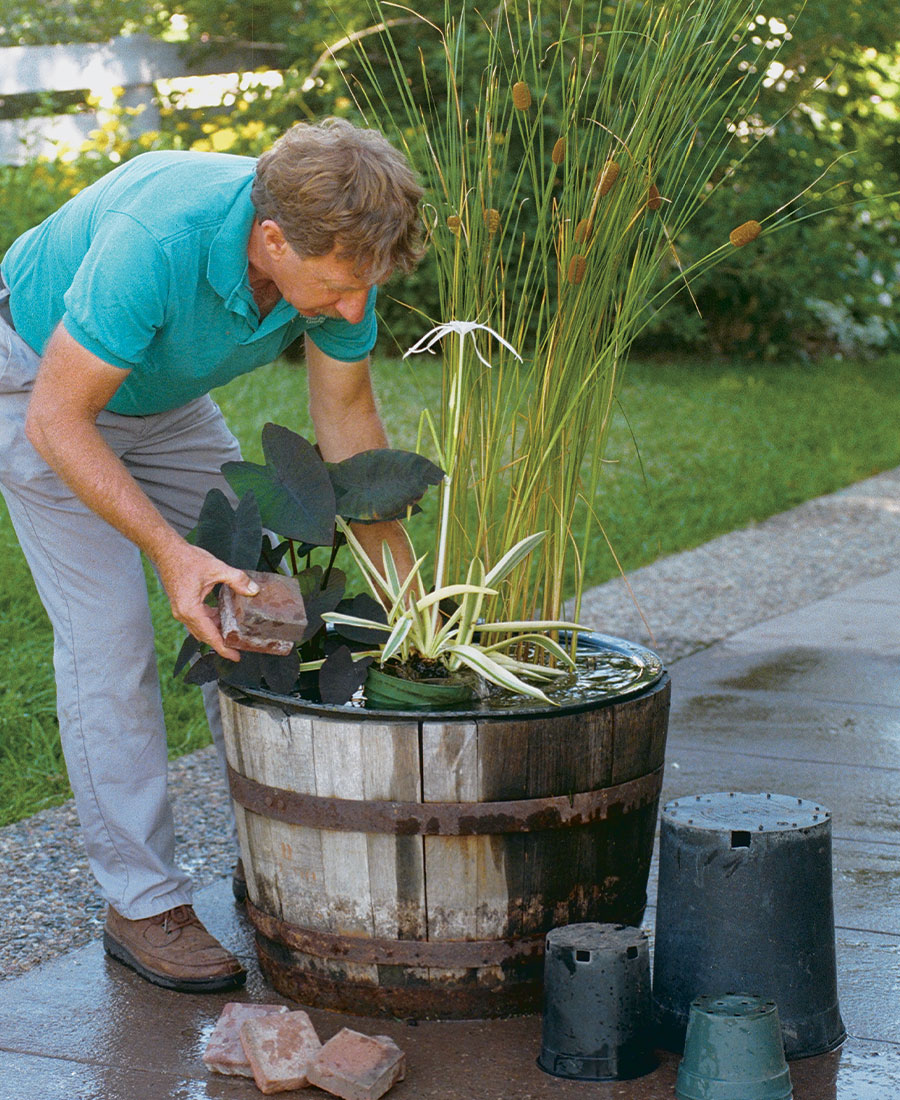
For either kind of design, I arrange and rearrange the plants until I get the effect I’m looking for. It’s easy to change the height and position of plants by perching them on bricks or empty, overturned containers. Most marginals, whether their leaves are thin and vertical or broad and horizontal, give excellent results when their crowns are placed 6 inches or less beneath the water’s surface. Only after the main parts have been positioned do I begin adding accents like floating or cascading plants, or for a special touch, an eye-catching specimen.
Container care is easy
Once your water garden has been planted, caring for it is a simple matter. If the plants don’t seem to be thriving, more than likely the problem is not enough light. If that’s the case, then move the container to a brighter spot. If it’s too heavy to lift, remove the plants, empty out the water, move the container, and then rearrange it.
Water plants grow quickly but, even so, I encourage them by using fertilizing tablets. For new plants, I delay fertilizing until they show signs of growth. When a plant gets big, I divide and repot it in heavy clay soil. Dense soils won’t cloud the water when containers are moved, and, just to be sure, I always firm the soil fairly tightly before lowering the container back into the water. If the plants seem too robust, I limit their growth by keeping them in small pots and trimming off the oldest and tallest leaves.
There’s no need to change the water in a container garden, although you should top it off every few days to replace liquid that may have evaporated. I’ve never had problems with mosquitoes breeding in containers, but if you want to eliminate any chance of establishing a breeding ground for insects, you might wash the larvae out by overfilling your container with water or add a few mosquitofish (Gambusia affinis), voracious eaters that feed on mosquito larvae. Aquatic nurseries have also developed specially formulated products for killing mosquito larvae.
When winter comes, it doesn’t have to mean the end of the garden. Most water plants can be brought indoors and used as houseplants, kept in an aquarium, or even placed in a tub of water in a cool basement. Hardy plants could be left in the container but may need protection against freezing. Where winters are severe, birdbath-type heaters can prevent your container water garden from turning into a giant ice cube.
When spring comes, plants are usually ready to divide. Use the extras to start a new water garden—by then you’ll probably be immersed in the world of aquatic plants.



Comments
A lined pond might be a cleaner pond: higher sides of liner ordinarily support shields them from gathering awful effects and absolutely different waste which can sink into the pond. With a couple of materials, Pondpro2000 pond liner could likewise make it more straightforward to scour the upside.
Log in or create an account to post a comment.
Sign up Log in