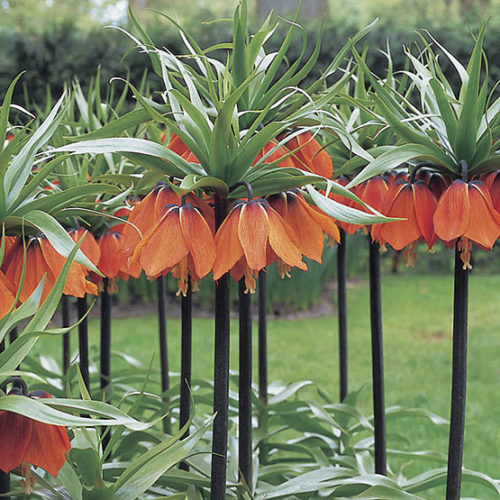
Fritillaria imperialis (Crown imperial)

Fritillaria imperialis Fritillaria imperialis 'Rubra Maxima' Photo/Illustration: Courtesy of White Flower Farm


Be the first to rate this plant

Hardiness Zones: 1 2 3 4 5 6 7 8 9 10 11
Botanical Name: Fritillaria imperialis Common Name: Crown imperial Genus: Fritillaria
This species draws much attention with its striking gaiety of color and form. Its large, bell-shaped flowers in shades of orange, yellow, and red dangle from tufts of shiny green leaf bracts. Sitting atop sturdy, 3-foot stalks, the flowers make a surprising and regal statement in the late spring garden.
Care: These bulbous perennials needs fertile, well-drained soil in full sun. Plant at four times their own depth. The hollow-centered bulbs do best planted on their sides and surrounded with sharp sand.
Propagation: Sow seed in a cold frame in fall, provide winter cold treatment, and then move to cool greenhouse. Divide offsets in late summer.
Problems: Rust, leaf spot.
Height 1 ft. to 3 ft.
Spread 6 in. to 12 in.
Growth Habit Clumps
Growth Pace Moderate Grower
Light Full Sun Only
Moisture Medium Moisture
Maintenance Moderate
Characteristics Showy Flowers
Bloom Time Spring
Flower Color Orange/ Salmon Flower; Red Flower; Yellow Flower
Uses Beds and Borders, Container, Cut Flower, Specimen Plant/ Focal Point
Style Cottage Garden
Seasonal Interest Spring Interest
Type Perennials

Plants you might also like

Hemerocallis 'Baby Fresh' Hemerocallis 'Baby Fresh'
(Daylily)
Be the first to rate this plant
Hardiness Zones: 1 2 3 4 5 6 7 8 9 10 11

Daylilies are classic, extremely popular garden plants. They feature long, arching, strappy leaves and long stems of generally 6-petaled flowers, though double flowers are popular as well. Each flower lasts only one day, hence the plant’s common name. Daylilies come in a wide range of colors, from cream and cheery yellow to peach, orange, fiery red, deep burgundy, pink, and purple. Some have contrasting throats and "eye-zones." Daylilies are ideal for a mixed herbaceous perennial border.

Hemerocallis 'Blackeyed Stella' Hemerocallis 'Blackeyed Stella'
(Daylily)
Be the first to rate this plant
Hardiness Zones: 1 2 3 4 5 6 7 8 9 10 11

Daylilies are classic, extremely popular garden plants. They feature long, arching, strappy leaves and long stems of generally 6-petaled flowers, though double flowers are popular as well. Each flower lasts only one day, hence the plant’s common name. Daylilies come in a wide range of colors, from cream and cheery yellow to peach, orange, fiery red, deep burgundy, pink, and purple. Some have contrasting throats and "eye-zones." Daylilies are ideal for a mixed herbaceous perennial border.

Dianthus deltoides Dianthus deltoides
(Maiden pink)
(1 user review)
Hardiness Zones: 1 2 3 4 5 6 7 8 9 10 11

This mat-forming species with dark green leaves is one of the easiest to grow.  Blossoms range from white to red and are usually single and without fragrance. Use as bedding or in rock gardens.

Hemerocallis 'Forsyth Lemon Drop' Hemerocallis 'Forsyth Lemon Drop'
(Daylily)
Be the first to rate this plant
Hardiness Zones: 1 2 3 4 5 6 7 8 9 10 11

'Forsyth Lemon Drop' is lovely and cheerful daylily cultivar.

no image available Coreopsis grandiflora
(Large-flowered tickseed)
Be the first to rate this plant
Hardiness Zones: 1 2 3 4 5 6 7 8 9 10 11

As the name implies, this species bears large, daisy-like blossoms (2.5 inches across) of golden yellow rays and darker yellow centers. It blooms from late spring to late summer and is native to the central and southeastern U.S.