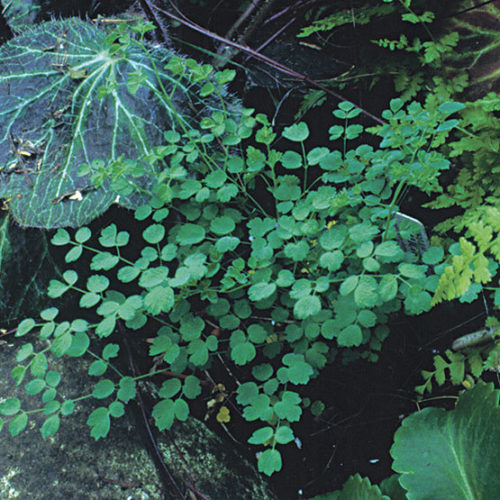
Thalictrum minus (Meadow rue)

Thalictrum minus Photo/Illustration: Linda Wesley


Be the first to rate this plant

Hardiness Zones: 1 2 3 4 5 6 7 8 9 10 11
Botanical Name: Thalictrum minus Common Name: Meadow rue Genus: Thalictrum
This perennial species is one of the most delicate of Thalictrums, with tiny foliage reminiscent of maidenhair ferns. It bears small, nodding, long-lasting flowers of a unique yellowish plum-brown. It grows to about 3 feet tall and wide.
Noteworthy characteristics: Thalictrum minus earns it place in the garden with its foliage alone and does well as a see-through plant in a mixed border. It is also suitable for a wild garden or woodland garden.
Care: Provide moist, humus-rich soil in full sun to partial shade. Most Thalictrums are late to emerge in mid- to late spring.
Propagation: Sow seed in a cold frame when fresh. Divide as new growth appears in spring.
Problems: Powdery mildew, rust, white smut, leaf spots, slugs.
Height 6 in. to 12 in.
Spread 6 in. to 12 in.
Growth Habit Clumps
Growth Pace Moderate Grower
Light Part Shade to Full Shade
Moisture Medium to Wet
Maintenance Low
Characteristics Showy Foliage
Bloom Time Early Summer; Summer
Flower Color Brown Flower; Purple/ Lavender Flower; Yellow Flower
Uses Beds and Borders, Ground Covers, Cut Flower, Dried Flower, Naturalizing, Waterside
Style Shade, Cottage Garden, Meadow Garden, Woodland Garden
Seasonal Interest Spring Interest, Summer Interest
Type Perennials

Plants you might also like

Thalictrum aquilegiifolium Thalictrum aquilegiifolium
(Columbine meadow rue)
Be the first to rate this plant
Hardiness Zones: 1 2 3 4 5 6 7 8 9 10 11

The lacy leaves of this meadow rue look like a columbine's, hence the common and scientific names. But the leaves are actually gray-green and more delicate than its namesake. It bears clusters of long-lasting cottony flowers in shades of lilac, purple, or white in early summer. It is suitable for naturalizing in a meadow or woodland. These perennials grow to about 3 feet tall and half as wide.

Thalictrum rochebruneanum Thalictrum rochebruneanum
(Meadow rue)
Be the first to rate this plant
Hardiness Zones: 1 2 3 4 5 6 7 8 9 10 11

This beautiful specimen has tall, delicate stems punctuated by clusters of columbine-like, bluish gray leaves. In summer, it bears sprays of nodding lavender-pink or white flowers with pale yellow stamens that reach as high as 3 feet. Plants grow to 12 inches wide. Plant at the back of a border; it may require staking.

Salvia pratensis Salvia pratensis
(Meadow clary)
Be the first to rate this plant
Hardiness Zones: 1 2 3 4 5 6 7 8 9 10 11

This woody-stemmed perennial produces sticky spikes of deep violet or, rarely, white to pink flowers. It blooms from early summer to autumn; reblooming is most reliable if spent flowers are deadheaded promptly. It has wrinkled leaves and forms an upright clump 3 feet tall by 1 foot wide. This salvia is most noted for its many hybirds with S. nemerosa.  

Tiarella 'Black Snowflake' Tiarella 'Black Snowflake'
(Foam flower)
Be the first to rate this plant
Hardiness Zones: 1 2 3 4 5 6 7 8 9 10 11

This clump-forming variety has very dramatic, deeply cut foliage with wide black veins that looks like a black snowflake when new. The dark color is more pronounced in cool weather. Plants produce a profusion of starry white flowers on numerous spires up to 12 inches high and grow to about a foot wide. Tiarellas are at home in moist woodland environments. In the garden they make wonderful carpets of intricate leaves. For a long period from spring into summer, the profusion of foamy flowers can be appreciated up close or from a distance. Grow 'Black Snowflake' as a groundcover or edger in a shady border or woodland garden. It is a great foil to early spring bulbs.

no image available Salvia nemorosa
(Sage)
Be the first to rate this plant
Hardiness Zones: 1 2 3 4 5 6 7 8 9 10 11

This drought-tolerant perennial produces flower spikes in shades of violet, purple, or white to pink, with purple bracts. It blooms from early summer to autumn; reblooming is most reliable if spent flowers are promptly deadheaded. It has wrinkled leaves and forms an erect clump 3 feet tall by 2 feet wide. This species is most noted for its many S. sylvestris hybrids.