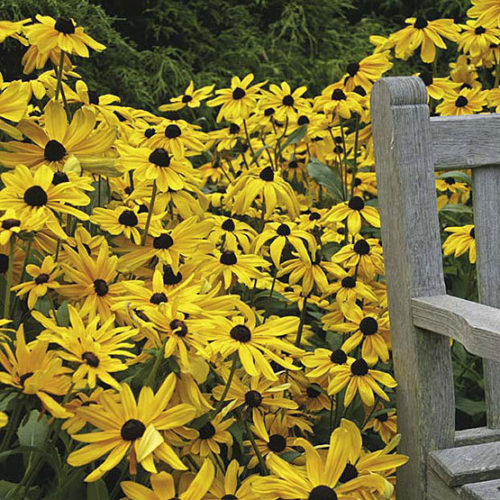
Rudbeckia hirta ‘Indian Summer’ (Black-eyed Susan, Gloriosa daisy)

Rudbeckia hirta ‘Indian Summer’ Photo/Illustration: Courtesy of Bluestone Perennials

(Based on 1 user review)

Rate this plant

Hardiness Zones: 1 2 3 4 5 6 7 8 9 10 11
Botanical Name: Rudbeckia hirta ‘Indian Summer’ rud-BEK-ee-ah HER-tah Common Name: Black-eyed Susan, Gloriosa daisy Synonyms: R. gloriosa Genus: Rudbeckia
'Indian Summer' is a standout among a sea of Black-eyed Susans because of its extra-large, golden yellow flowerheads. It will bloom from early summer until first frost. Use it in borders, cottage gardens, meadows, or for naturalizing. Butterflies are drawn to it. The species is native to the central U.S.
Noteworthy characteristics: Long bloom time. Large flowerheads to 9 inches wide. May be short-lived; often grown as an annual.   
Care: Grow in full sun and well-drained soil that is consistently moist. Deadhead regularly.
Propagation: Start seeds indoors in spring or direct sow in the garden after the frost-free date. May be short-lived, but plants will self-sow.
Problems: Fairly trouble-free, but watch for aphids, powdery mildew, smut, and leaf spots. Also, slugs and snails may eat young plants. May be invasive.
Height 1 ft. to 3 ft.
Spread 6 in. to 12 in.
Growth Pace Moderate Grower
Light Full Sun Only
Moisture Medium Moisture
Maintenance Moderate
Characteristics Attracts Birds; Attracts Butterflies; Native; Showy Flowers
Bloom Time Early Fall; Early Summer; Late Summer; Summer
Flower Color Yellow Flower
Uses Beds and Borders, Cut Flower, Naturalizing, Suitable as Annual
Style Cottage Garden
Seasonal Interest Summer Interest, Fall Interest
Type Perennials

Plants you might also like

Rudbeckia hirta Rudbeckia hirta
(Black-eyed Susan, Gloriosa daisy, Coneflower)
Be the first to rate this plant
Hardiness Zones: 1 2 3 4 5 6 7 8 9 10 11

This biennial or short-lived perennial has given rise to numerous cultivars which are often grown as annuals. From summer into early autumn, it bears daisy-like blossoms (to 3 inches across) with light or deep yellow rays and brownish-purple centers. The flowers are a staple in late summer bouquets.

Ratibida columnifera Ratibida columnifera
(Mexican hat, Prairie coneflower, Long-head coneflower)
(1 user review)
Hardiness Zones: 1 2 3 4 5 6 7 8 9 10 11

This perennial coneflower, sometimes grown as an annual, has a long season of flowers on thin, branching stems. The flowers resemble small hats, with yellow reflexed ray florets and large greenish-brown columnar centers.

Echinacea purpurea ‘Bright Star’ Echinacea purpurea ‘Bright Star’
(Purple coneflower)
Be the first to rate this plant
Hardiness Zones: 1 2 3 4 5 6 7 8 9 10 11

This native meadow derivative with daisy-like flowers blooms from early summer into early autumn. 'Bright Star' has prominent, copper-orange central cones surrounded by red-purple ray petals (to 5 inches across), and grows to less than 3 feet tall.

Echinacea purpurea ‘White Swan' Echinacea purpurea ‘White Swan'
(White coneflower)
(2 user reviews)
Hardiness Zones: 1 2 3 4 5 6 7 8 9 10 11

This cultivar of a native meadow coneflower has white, daisy-like flowers from early summer into early autumn. Its prominent, coppery-green, central cones are surrounded by large white ray petals that reach 4.5 inches long.

Echinacea purpurea 'Kim's Knee High' Echinacea purpurea 'Kim's Knee High'
(Purple coneflower)
(3 user reviews)
Hardiness Zones: 1 2 3 4 5 6 7 8 9 10 11

This native meadow derivative is a compact version of the species. It blooms from midsummer into early autumn, with prominent, copper-orange central cones surrounded by drooping, rose- or purple-pink ray petals. It will reach 24 inches if not cut back.