OR Browse All Plants
Be the first to rate this plant
Click on a thumbnail to see a full sized image
Triandrus-type daffodils usually have one or two nodding flowers per stem and are noted for their wonderful, often fruity, fragrance. N. ‘Hawera’ (pre-1950, Zones 3–8) is a miniature triandrus-type daffodil with many elfin, pale-yellow nodding bells per stem, each with a demitasse-shaped cup surrounded by swept-back petals. This adaptable daffodil can grow in dry areas, in pots, in full sun, and in partial shade. It contrasts nicely with Muscari armeniacum and is exquisite with hellebores.
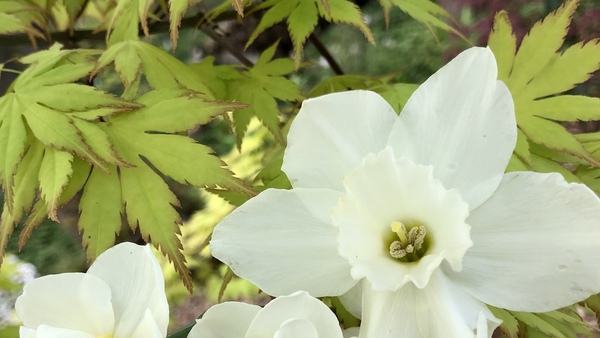
Generally speaking, daffodils perform best in full sun and well-drained soil, in areas where there is a fair amount of rainfall in the fall and spring and where the summer is relatively dry. However, cyclamineus-type daffodils seem to tolerate at least partial shade and more moisture than others do. Narcissus ‘Jack Snipe’ (pre-1951, Zones 3–8) is a charming example of this type of daffodil. Its white petals are swept back, as if it were standing in front of a fan, and its medium-length, buttercup-yellow trumpet (or nose) sticks straight out at a 90 degree angle from the stem. ‘Jack Snipe’ is an intermediate-size daffodil, standing only 8 to 10 inches tall, and is perfect for a rock garden or the front of a flower border. This whole division of daffodils is becoming more popular not only because it tolerates some shade but also because the shape of the flower is so handsome.
Although some people don’t consider double or peonylike daffodils classics, many double hybrids have been in existence for a long time. N. ‘Tahiti’ (1956, Zones 3–8) has a soft-yellow flower with bright reddish-orange interior ruffles is reminiscent of a blossom from the tropics. ‘Tahiti’ stands up straight under its own weight, even on windy days. Its coloration is eye-catching, so it makes a big impact in the garden.
The species daffodil N. bulbocodium var. conspicuus (Zones 3–9) has been around so long that no one can actually put a date on it. Its look is unusual: It does have six golden petals, but they are tiny, twisted, and often difficult to see. Its prominent rounded cup gives rise to its nickname, hoop petticoats. It prefers acidic soil and when happy, will reseed, blooming like buttercups in groups. Only 4 to 6 inches tall, it naturalizes itself in many areas.
The newly opened blossoms of N. ‘Intrigue’ (1970, Zones 3–9) are a soft chartreuse-yellow. As they mature, however, the flowers become a luminous white and attract a lot of attention, especially when planted with a blood-red tulip like ‘Hollandia’. When combined with another soft-colored flower, like Hyacinthus orientalis ‘Lady Derby’, it creates a peaceful scene. An American-bred jonquilla-type daffodil with several flowers per stem, ‘Intrigue’ also has a wonderful fragrance.
Planting Spring Bulbs in Containers by Richard Hartlage
Alliums All Season Long Deer resistant and dynamic, these bulbs provide color from the first showers of spring to the last leaves of fall by Stephanie Cohen
Rex Begonias A guide to growing, care, and propagation of rex begonias, plus some great cultivars by Rita Randolph
How to Grow Trilliums Plant the best species for your region in fall for a spectacular display in spring by Gene E. Bush
10 Plants for Year-round Containers These survivors can stay in pots for years, lending consistency to your designs by Muffin Evander
Great Plants, Vol.2Learn how to choose and use the best plant varieties for your gardenMore Info
Great Gardens, Vol. 2An insider's look at America's most beautiful gardensMore Info
Container Gardening, Vol. 5An inspirational collection of the best container gardening articles from Fine GardeningMore Info