previous
  • Save Money by Growing Your Own
    Save Money by Growing Your Own
  • Mulch for a Healthy Garden
    Mulch for a Healthy Garden
  • Designing with Curved Terraces
    Designing with Curved Terraces
  • Lawn Alternatives
    Lawn Alternatives
  • Colorful Selections for Shade
    Colorful Selections for Shade
  • Fragrant Plants for Pathways
    Fragrant Plants for Pathways
  • In Pursuit of the Perfect Potting Shed
    In Pursuit of the Perfect Potting Shed
  • Garden Confidential: A Plant Walks into a Bar
    Garden Confidential: A Plant Walks into a Bar
  • Indeterminate or Determinate Tomatoes?
    Indeterminate or Determinate Tomatoes?
  • Comfortable Alfresco Dining
    Comfortable Alfresco Dining
  • Dwarf Citrus Trees
    Dwarf Citrus Trees
  • Containers as Focal Points
    Containers as Focal Points
  • Building a Compost Bin
    Building a Compost Bin
  • Elephant's Ears
    Elephant's Ears
  • Make a Succulent Topiary
    Make a Succulent Topiary
  • 6 Tips for Weed Control
    6 Tips for Weed Control
  • Stylish Shady Containers
    Stylish Shady Containers
  • Plants that Spark!
    Plants that Spark!
  • Slideshow: Beautiful Clematis
    Slideshow: Beautiful Clematis
  • Homegrown / Homemade
    Homegrown / Homemade
  • Pretty in Pink
    Pretty in Pink
  • Thoughts From a Foreign Field
    Thoughts From a Foreign Field
  • Fast-Growing Trees for Impatient Gardeners
    Fast-Growing Trees for Impatient Gardeners
  • NEW Video Series: There's a Better Way
    NEW Video Series: There's a Better Way
  • Plant an Easy-to-Water Strawberry Jar
    Plant an Easy-to-Water Strawberry Jar
next

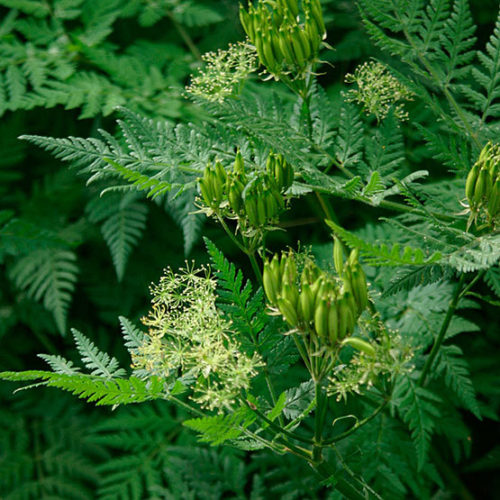
Myrrhis odorata (Sweet cicely)

Myrrhis odorata Photo/Illustration: Michelle Gervais

(Based on 1 user review)

Rate this plant

Plant Showcase - from our advertisers


Hardiness Zones: 1 2 3 4 5 6 7 8 9 10 11
Botanical Name: Myrrhis odorata MEER-iss oh-dor-AY-tah Common Name: Sweet cicely Genus: Myrrhis
This elegant fern-like herb has a mounding form and anise-flavored bright-green leaves. In late spring, it bears compound umbels of star-shaped white flowers, followed by shiny, ridged brown seeds.
Care: Shade tolerant. Grow in moderately fertile, moist but well-drained soil. Self-seeds freely. Remove emerging flowering stalks to improve the flavor and quality of the leaves.
Propagation: Sow seed in situ or in containers. Divide in spring or autumn.
Problems: Infrequent.
Height 3 ft. to 6 ft.
Spread 3 ft. to 6 ft.
Light Part Shade Only
Moisture Medium Moisture
Characteristics Fragrant Foliage; Self Seeds; Showy Foliage
Bloom Time Spring
Flower Color White Flower
Uses Beds and Borders, Ground Covers
Style Herb Garden, Woodland Garden
Seasonal Interest Spring Interest, Summer Interest
Type Perennials

Plants you might also like

Polygonatum odoratum Polygonatum odoratum
(Fragrant Solomon’s seal, Solomon’s seal)
(1 user review)
Hardiness Zones: 1 2 3 4 5 6 7 8 9 10 11

From late spring to early summer, this species bears pendent, green-tipped white flowers along arching stems. These mature into spherical black fruit in autumn, when the foliage turns yellow.

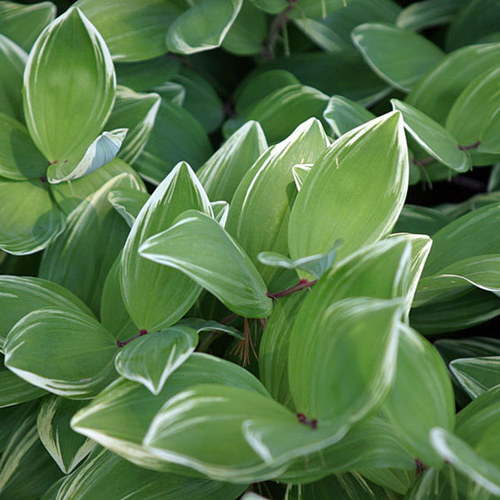
Polygonatum odoratum 'Variegatum' Polygonatum odoratum 'Variegatum'
(Variegated fragrant Solomon's seal)
Be the first to rate this plant
Hardiness Zones: 1 2 3 4 5 6 7 8 9 10 11

Gracefully arching 2 to 3-foot tall burgundy stems support narrow leaves streaked in pure white. From late spring to early summer, this species bears white flowers that mature into spherical black fruit in autumn, when the foliage turns a golden yellow. Variegated Solomon's seal is a fine choice for a shady bed. -Matt Griswold, Regional Picks: Northeast, Fine Gardening issue #27

Dicentra eximia ‘Alba’ Dicentra eximia ‘Alba’
(Fringed bleeding heart, Turkey corn)
(1 user review)
Hardiness Zones: 1 2 3 4 5 6 7 8 9 10 11

Rows of white flowers dangle above the fern-like foliage, opening in April and continuing intermittently until October.

Polygonatum biflorum Polygonatum biflorum
(Small Solomon's seal, Solomon's seal)
Be the first to rate this plant
Hardiness Zones: 1 2 3 4 5 6 7 8 9 10 11

From late spring into summer, this species bears tubular greenish-white flowers that dangle underneath the arching stems. The foliage is smooth; in autumn it turns to clear yellow, contrasting with the blue-black berries this plant produces. Its height varies wildly from 1.5 to 6 feet tall.

Brunnera macrophylla 'Jack Frost' Brunnera macrophylla 'Jack Frost'
(4 user reviews)
Hardiness Zones: 1 2 3 4 5 6 7 8 9 10 11

This woodland plant is valued for its flowers and its heart-shaped, ground-covering leaves. Its small blue flowers go nicely with ephemeral bulbs in mid- to late spring,  as the enlarging leaves block out the ripening bulb foliage. 'Jack Frost' can take dry summers and wet winters. This cultivar is prized for its improved tolerance of heat and sun. -Marty Hair, Regional Picks: Upper Midwest, Fine Gardening issue# 127