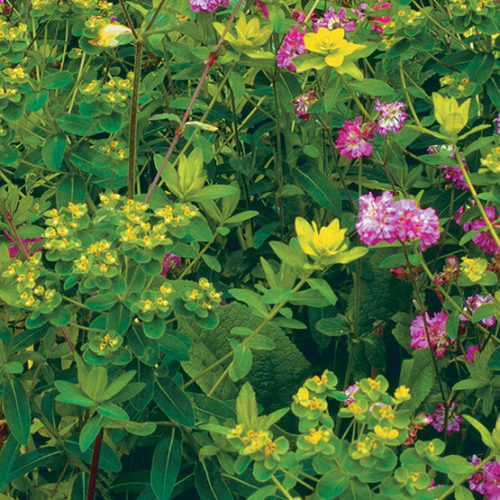
Euphorbia palustris

Euphorbia palustris Photo/Illustration: Allan Mandell


Be the first to rate this plant

Hardiness Zones: 1 2 3 4 5 6 7 8 9 10 11
Botanical Name: Euphorbia palustris yew-FOR-bee-ah pah-LUSS-tris Genus: Euphorbia
This robust perennial forms a large shrub that adds a nice textural element to the back of the border. In early spring it produces 6-inch-wide, vivid yellow bracts.
Noteworthy characteristics: Milky sap may cause irritation to skin and severe discomfort if ingested.
Care: This plant prefers permanently moist soil in full sun. 
Propagation: Start seed of hardy perennials when ripe or in spring. Divide in early spring.
Problems: Nematodes, spider mites, aphids, mealybugs, fungal and bacterial diseases.
Height 3 ft. to 6 ft.
Spread 3 ft. to 6 ft.
Growth Habit Clumps
Growth Pace Fast Grower
Light Full Sun to Part Shade
Moisture Medium Moisture
Maintenance Low
Tolerance Deer Tolerant
Characteristics Showy Flowers
Bloom Time Early Spring; Spring
Flower Color Yellow Flower
Uses Beds and Borders
Seasonal Interest Spring Interest, Summer Interest
Type Perennials

Plants you might also like

no image available Euphorbia 'Helena’s Blush™'
Be the first to rate this plant
Hardiness Zones: 1 2 3 4 5 6 7 8 9 10 11

This hybrid has petite green-and-cream variegated foliage with a hint of pink on the undersides. It produces chartreuse and apple green bicolored bracts on airy stems.

Euphorbia polychroma Euphorbia polychroma
(Cushion spurge)
(1 user review)
Hardiness Zones: 1 2 3 4 5 6 7 8 9 10 11

Electric yellow bracts bloom on a low cushion in April and persist, but gently fade as the stems elongate to form a 16-inch mound by midsummer. The leaves produce shades of red, orange, and purple in autumn.

no image available Digitalis purpurea 'Pam's Choice'
(Common Foxglove)
Be the first to rate this plant
Hardiness Zones: 1 2 3 4 5 6 7 8 9 10 11

This is a biennial or short-lived perennial, which may last longer and rebloom if deadheaded. It sports dramatic blossoms in contrasting colors in spires reaching six feet high in rich soil, but more likely to 3 or 4 feet. 

Darmera peltata Darmera peltata
(Indian rhubarb, Umbrella plant)
Be the first to rate this plant
Hardiness Zones: 1 2 3 4 5 6 7 8 9 10 11

Darmera's flower stalks emerge from the ground on naked stems in spring, and are followed by cupped, rounded but indented leaves up to 24 inches across. The foliage forms a lovely, vase-like clump, 4 feet tall and 3 feet wide. The flower clusters are composed of many 5-petaled, starry, pink or white florets with conspicuous stamens. This native of the western U.S. is found growing along woodland stream banks, and helps to add a tropical look to temperate gardens. Darmera makes a distinct and long-lasting foliage statement in moist conditions, and exhibits autumn color also. 

Geranium pratense 'Dark Reiter' Geranium pratense 'Dark Reiter'
('Dark Reiter' geranium)
Be the first to rate this plant
Hardiness Zones: 1 2 3 4 5 6 7 8 9 10 11

This fairly new cultivar has a short mounded habit and dissected dark leaves highlighted by bright lilac-blue blossoms in spring. Trimming it back after flowering encourages more blooms in fall and helps maintain its neat habit. 'Dark Reiter' is slow growing, making it perfect for a rock garden, and like many other geraniums, deer tend to avoid browsing. Silver-toned foliage tends to pop when paired with this beauty.