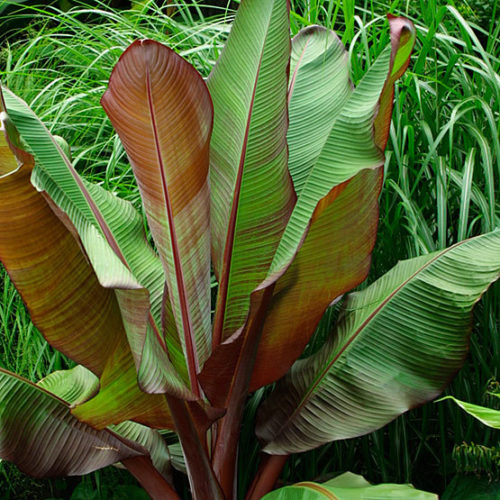
Ensete ventricosum 'Maurelii' (Red banana, Abyssinian banana, Ethiopian banana)

Ensete ventricosum 'Maurelii' Photo/Illustration: Michelle Gervais

(Based on 1 user review)

Rate this plant

Hardiness Zones: 1 2 3 4 5 6 7 8 9 10 11
Botanical Name: Ensete ventricosum 'Maurelii' en-SET-ay ven-trih-KOE-sum Common Name: Red banana, Abyssinian banana, Ethiopian banana Synonyms: Musa arnoldiana, Musa ensete Genus: Ensete
This banana-like perennial has large paddle-shaped leaves, which range in color from deep claret brown to red-purple to pale green, produced from the center of the plant, with thick midribs bright red beneath. White flowers are borne in inflorescences 3 to 4 feet long. Fruits are banana-like but dry and unpalatable.
Noteworthy characteristics: Large reddish leaves. Reaches 20 feet or more.
Care: Native to the tropical and subtropical forests of Africa, bananas are large herbaceous plants that die back in winter in frosty areas. Grow outdoors in rich soil in a sheltered area. Lift plants before first frost, cut back long roots, and reduce top-growth to the newest 2 or 3 leaves.
Propagation: Sow seed in spring after soaking in tepid water for 24 hours. Germination is erratic.
Problems: Spider mites and aphids may be problems, especially under glass.
Height Over 30 ft.
Spread 10 ft. to 15 ft.
Growth Habit Clumps
Light Full Sun to Part Shade
Moisture Medium Moisture
Maintenance Moderate
Characteristics Showy Foliage
Bloom Time Early Summer; Late Summer; Summer
Foliage Color Colorful/Burgundy Foliage
Flower Color White Flower
Uses Specimen Plant/ Focal Point
Seasonal Interest Summer Interest
Type Perennials

Plants you might also like

Eucomis comosa 'Oakhurst' Eucomis comosa 'Oakhurst'
(Pineapple lily, Pineapple flower)
(1 user review)
Hardiness Zones: 1 2 3 4 5 6 7 8 9 10 11

This bulbous perennial has striking reddish purple, strap-like leaves and foot-long purple flowers that resemble pineapples in late summer. Grow in a sunny border, container, or greenhouse. Plants used outdoors may be overwintered in a frost-free location. The species is native to South Africa.

Dahlia 'Bishop of Llandaff' Dahlia 'Bishop of Llandaff'
(Dahlia)
Be the first to rate this plant
Hardiness Zones: 1 2 3 4 5 6 7 8 9 10 11

This tuberous plant dazzles the eye with its deep purple-black leaves and brilliant summer blooms. The 4- to 6-inch-round flowers display red petals and deep purple and yellow centers, which are accentuated by the dark foliage. Its stems are the perfect addition to cut-flower arrangements.

Dahlia 'Bashful' Dahlia 'Bashful'
Be the first to rate this plant
Hardiness Zones: 1 2 3 4 5 6 7 8 9 10 11

A reliable and prolific bloomer, 'Bashful' sports petals with colors that combine handsomely with their golden stamens. The blooms have a velvety texture and are highly attractive to bees and butterflies. Of relatively short stature, 'Bashful' should be planted near the front of a bed, where it will send up an endless succession of richly hued blooms.

Dahlia 'Myrtle's Folly' Dahlia 'Myrtle's Folly'
Be the first to rate this plant
Hardiness Zones: 1 2 3 4 5 6 7 8 9 10 11

'Myrtle's Folly' has one of the more complex blooms you will ever see on a dahlia. The flowers—a dense ball of narrow, irregular, twisted petals of deep pink and light orange—gradually mature to reveal a yellow center. Though slightly ungainly as a border plant, 'Myrtle's Folly' provides a steady supply of wonderful cut flowers that look lovely in a vase, where the frilly, candy-colored concoction of peach and pink can be enjoyed at close quarters.

Dahlia 'Pooh' Dahlia 'Pooh'
Be the first to rate this plant
Hardiness Zones: 1 2 3 4 5 6 7 8 9 10 11

'Pooh' possesses all the naive charm its name suggests. The petals of orange-red, thinly outlined in yellow with an inner ring of gold and lemon-colored petal-like sepals, provide a stunning combination of color and form easy to appreciate from a distance. With numerous small flowers borne on tall plants, this dahlia should be placed farther back in a border, where it is sure to stand out.