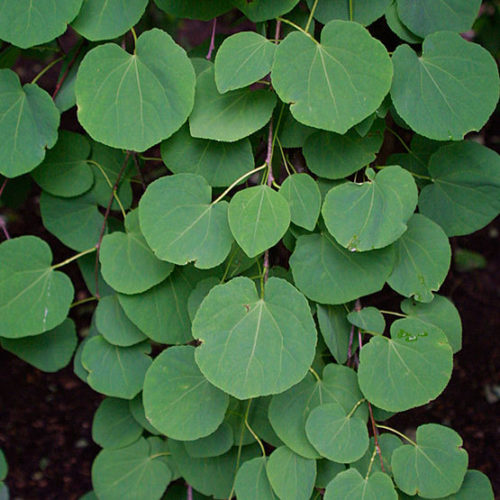
Cercidiphyllum japonicum f. pendulum (Weeping katsura)

Cercidiphyllum japonicum f. pendulum Photo/Illustration: Michelle Gervais


Be the first to rate this plant

Hardiness Zones: 1 2 3 4 5 6 7 8 9 10 11
Botanical Name: Cercidiphyllum japonicum f. pendulum sir-sid-ih-FIL-um jah-PON-ih-kum forma PEND-yew-lum Common Name: Weeping katsura Synonyms: Cercidiphyllum japonicum 'Pendulum' Genus: Cercidiphylllum
This deciduous small tree initially has a pyramidal form, and later rounded. Cercis-like, opposite, heart-shaped blue-green leaves are borne on stiff, slender, pendulous branches that fan out from the crown and sweep the ground. Caramel-scented foliage emerges bronze or purple-red, turns blue-green, then fades to gold or apricot in autumn. Tiny red flowers emerge in late March or early April before the leaves.
Noteworthy characteristics: Stands out all year long. Leaves fall to the ground all at once in autumn. Suited to a residential garden due to its compact shape. Provides light shade. Great as a specimen or in a group.
Care: Plant in early spring in full sun, in rich, well-drained, slightly acidic soil. Water generously until established and during hot, dry summers.
Propagation: From basal cuttings in late spring and semi-ripe cuttings in mid-summer.
Problems: Infrequent.
Height 15 ft. to 30 ft.
Spread 15 ft. to 30 ft.
Light Full Sun to Part Shade
Moisture Medium Moisture
Characteristics Fragrant Foliage; Showy Foliage
Bloom Time Early Spring; Spring
Foliage Color Colorful/Burgundy Foliage
Flower Color Red Flower
Uses Specimen Plant/ Focal Point
Style Shade
Seasonal Interest Summer Interest, Fall Interest
Type Trees

Plants you might also like

Cercis canadensis and cvs. Cercis canadensis and cvs.
(Eastern redbud)
Be the first to rate this plant
Hardiness Zones: 1 2 3 4 5 6 7 8 9 10 11

Bright purplish-pink blooms are borne in clusters, before the leaves, along smooth gray branches. Heart-shaped leaves emerge bronze, turning green, then yellow in autumn. Cultivars are available with white ('Royal White') or pink flowers ('Tennessee Pink'), purple foliage ('Forest Pansy'), and weeping form ('Covey'). Grows 15 to 25 feet tall with a slightly wider spread.

Prunus virginiana 'Schubert' Prunus virginiana 'Schubert'
('Schubert' choke cherry)
Be the first to rate this plant
Hardiness Zones: 1 2 3 4 5 6 7 8 9 10 11

'Schubert' choke cherry has a pyramidal form and vivid foliage that makes it a great focal point. Abundant, dark red-purple fruit follow the ephemeral, light pink flowers. The fruit is attractive to birds, so 'Schubert' choke cherry should not be planted near patios or walks due to the calling cards well-fed birds leave behind. Ask if the tree you buy is grafted onto nonsuckering rootstock; otherwise, suckers could pose problems down the road.

Acer griseum Acer griseum
(Paperbark maple)
(1 user review)
Hardiness Zones: 1 2 3 4 5 6 7 8 9 10 11

This slow-growing understory tree has highly ornamental, peeling orange-cinnamon bark. Its dark green, three-lobed leaves turn a brilliant orange-red in autumn.

Chamaecyparis obtusa 'Aurea' Chamaecyparis obtusa 'Aurea'
(Hinoki cypress)
Be the first to rate this plant
Hardiness Zones: 1 2 3 4 5 6 7 8 9 10 11

Hinoki cypress is a conical, evergreen, coniferous tree with leaves that are actually minute scales on tiny branches in the form of fans. The outer foliage of 'Aurea' is golden and the inner is green. Growth can be slow. Use as a specimen or use several as screening.

no image available Picea pungens ‘Procumbens’
(Colorado blue spruce)
Be the first to rate this plant
Hardiness Zones: 1 2 3 4 5 6 7 8 9 10 11

'Procumbens' is similar to 'Pendula' in color but prostrate in habit, with cascading branches sometimes staying stiffly horizontal. Makes a spreading, undulating, mounding ground cover of silvery white needles.