previous
  • Colorful Selections for Shade
    Colorful Selections for Shade
  • 6 Tips for Weed Control
    6 Tips for Weed Control
  • Stylish Shady Containers
    Stylish Shady Containers
  • Fragrant Plants for Pathways
    Fragrant Plants for Pathways
  • Plant an Easy-to-Water Strawberry Jar
    Plant an Easy-to-Water Strawberry Jar
  • Thoughts From a Foreign Field
    Thoughts From a Foreign Field
  • Slideshow: Beautiful Clematis
    Slideshow: Beautiful Clematis
  • Fast-Growing Trees for Impatient Gardeners
    Fast-Growing Trees for Impatient Gardeners
  • Homegrown / Homemade
    Homegrown / Homemade
  • Elephant's Ears
    Elephant's Ears
  • In Pursuit of the Perfect Potting Shed
    In Pursuit of the Perfect Potting Shed
  • Mulch for a Healthy Garden
    Mulch for a Healthy Garden
  • Building a Compost Bin
    Building a Compost Bin
  • Save Money by Growing Your Own
    Save Money by Growing Your Own
  • Make a Succulent Topiary
    Make a Succulent Topiary
  • Designing with Curved Terraces
    Designing with Curved Terraces
  • Pretty in Pink
    Pretty in Pink
  • Plants that Spark!
    Plants that Spark!
  • Comfortable Alfresco Dining
    Comfortable Alfresco Dining
  • Containers as Focal Points
    Containers as Focal Points
  • Lawn Alternatives
    Lawn Alternatives
  • NEW Video Series: There's a Better Way
    NEW Video Series: There's a Better Way
  • Indeterminate or Determinate Tomatoes?
    Indeterminate or Determinate Tomatoes?
  • Garden Confidential: A Plant Walks into a Bar
    Garden Confidential: A Plant Walks into a Bar
  • Dwarf Citrus Trees
    Dwarf Citrus Trees
next

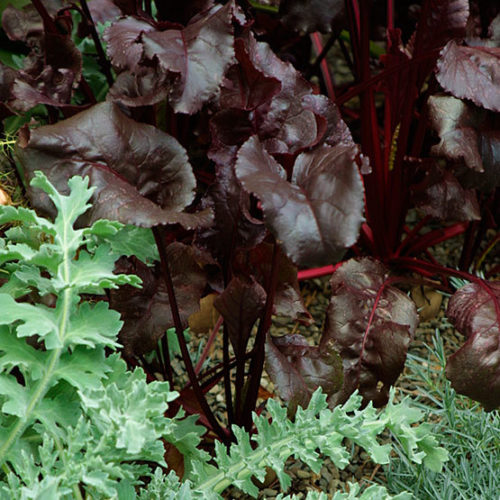
Beta vulgaris 'Bull's Blood' (Beet)

Beta vulgaris 'Bull's Blood' Photo/Illustration: Michelle Gervais

(Based on 1 user review)

Rate this plant

Plant Showcase - from our advertisers


Botanical Name: Beta vulgaris 'Bull's Blood' BAY-tah vul-GAR-iss Common Name: Beet Synonyms: B. vulgaris subsp. cicla 'Bull's Blood' Genus: Beta
This heirloom beet from 1840 is primarily grown for its tender, sweet, deep red-burgundy foliage, but the beets are tasty when harvested at the 2- to 3-inch size. The glossy leaves reach 18 inches high. Though it is edible, it is often grown as an ornamental, and its dark leaves contrast nicely with many garden plants.
Care: 'Bull's Blood' beet likes rich, light, moist soil, in full sun or partial shade. It needs extra water during dry periods to reduce the likelihood of bolting.
Propagation: Sow seed where it is to grow in early spring or late summer.
Problems: Beets are prone to fungal leaf spots, downy mildew, powdery mildew, damping off, root rots, while leaf miners, aphids, and caterpillars can also be problems.
Height 1 ft. to 3 ft.
Growth Habit Clumps
Growth Pace Moderate Grower
Light Full Sun to Part Shade
Moisture Medium Moisture
Maintenance Moderate
Characteristics Showy Foliage
Foliage Color Colorful/Burgundy Foliage
Uses Beds and Borders, Container, Cottage Garden
Seasonal Interest Spring Interest, Summer Interest, Fall Interest
Type Annuals,Vegetables

Plants you might also like

Beta vulgaris 'Ruby Red' Beta vulgaris 'Ruby Red'
(Swiss chard)
Be the first to rate this plant

This is a sweet Swiss chard with beautiful candy-apple-red stalks and dark green, crinkly leaves with touches of red. Both the leaves and the stalks are very ornamental and 'Ruby Red' is great in a vegetable or cottage garden, or in an ornamental bed or border. It is especially attractive when grown with plants whose colors call attention to the red coloring. Although related to beets, the root is inedible, but the leafy greens are valued for their mild flavor and high nutritional value.

Alternanthera dentata 'Purple Knight' Alternanthera dentata 'Purple Knight'
(Calico plant, Joy weed)
(1 user review)

This dark-leaved, tropical foliage plant loves heat, and is useful spreading through a bed, border, or in a container where its deep purple leaves can contrast with brightly colored flowers or foliage. Alternanthera are native to tropical and sub-tropical areas of Central and South America. Their flowers are generally an afterthought. This plant works well for edging, as an annual groundcover, or in a formal knot garden.

Cerinthe major ‘Purpurascens’ Cerinthe major ‘Purpurascens’
(Blue shrimp plant)
(1 user review)

Though subtly colored, Cerinthe major ‘Purpurascens’ draws comment wherever it inserts itself. The steely purple bracts and leathery gray foliage of this annual seem extraterrestrial poking up among more conventional herbaceous plants. It is an annual from the Mediterranean region with leaves like a eucalyptus and flowers like a purple euphorbia. This plant produces large black seeds that drop to the ground in late summer and germinate in fall to start the cycle all over again if growing conditions are right.

Centaurea cineraria 'Colchester White' Centaurea cineraria 'Colchester White'
(1 user review)
Hardiness Zones: 1 2 3 4 5 6 7 8 9 10 11

Best used as a foliage plant, this plant's intricately cut, frosty-silver leaves produce a large, elegant arching mound. It also bears pale lavender-blue pin-cushion flowers on lanky 30-inch stems in late spring.

Brassica oleracea Brassica oleracea
(Ornamental cabbage, Ornamental kale)
(2 user reviews)
Hardiness Zones: 1 2 3 4 5 6 7 8 9 10 11

Rosettes of cabbage foliage are grown as annuals for fall and winter interest. Color intensifies in cooler temperatures (below 50°F). Good for bedding and containers.