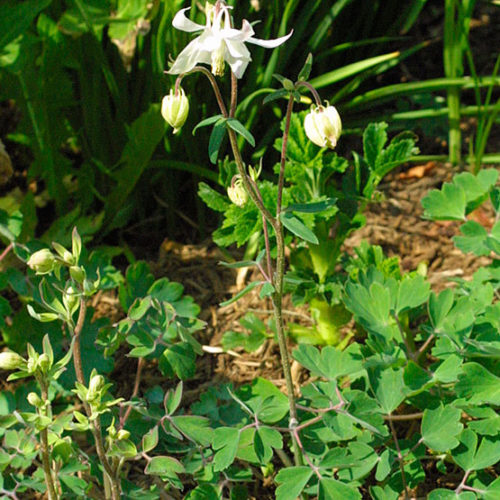
Aquilegia vulgaris (Granny’s bonnet)

Aquilegia vulgaris Photo/Illustration: Melissa Lucas


Be the first to rate this plant

Plant Showcase - from our advertisers


Hardiness Zones: 1 2 3 4 5 6 7 8 9 10 11
Botanical Name: Aquilegia vulgaris ak-will-EE-zsah vul-GAR-iss Common Name: Granny’s bonnet Genus: Aquilegia
Usually this plant produces nodding blue and white flowers, but color variation is common in this species.
Noteworthy characteristics: Several cultivars offer unique characteristics.
Care: Provide part shade to full sun and humusy, moist but well-drained soil.
Propagation: Sow seed in a cold frame in spring. Can divide cultivars in spring but plants respond slowly to root disturbance.
Problems: Powdery mildew, rust, fungal leaf spots. Aphids, leaf miners, and caterpillars.
Height 1 ft. to 3 ft.
Spread 6 in. to 12 in.
Light Full Sun to Part Shade
Moisture Dry to Medium
Maintenance Low
Tolerance Drought Tolerant
Characteristics Showy Flowers
Bloom Time Early Spring; Spring
Flower Color Blue Flower; Pink Flower; White Flower
Uses , Beds and Borders
Style , Cottage Garden, Rock Garden, Woodland Garden
Seasonal Interest , Spring Interest, Summer Interest
Type ,Perennials

Plants you might also like

Clematis integrifolia Mongolian Bells™ Clematis integrifolia Mongolian Bells™
Be the first to rate this plant
Hardiness Zones: 1 2 3 4 5 6 7 8 9 10 11

Clematis integrifolia is no longer only blue. This selection produces progeny with pink, white, and lavender blooms from midspring until late summer. The flowers are followed by attractive seed heads in fall. It has a compact, herbaceous form and grows to just 10 to 14 inches tall.

Corydalis lutea Corydalis lutea
(Yellow corydalis)
(3 user reviews)
Hardiness Zones: 1 2 3 4 5 6 7 8 9 10 11

This species has bluntly spurred golden yellow flowers from late spring to early fall. Its pale green, glaucous leaves form compact, ferny mounds.

Dianthus deltoides Dianthus deltoides
(Maiden pink)
(1 user review)
Hardiness Zones: 1 2 3 4 5 6 7 8 9 10 11

This mat-forming species with dark green leaves is one of the easiest to grow.  Blossoms range from white to red and are usually single and without fragrance. Use as bedding or in rock gardens.

Penstemon digitalis 'Husker Red' Penstemon digitalis 'Husker Red'
Be the first to rate this plant
Hardiness Zones: 1 2 3 4 5 6 7 8 9 10 11

'Husker Red' is one of the few penstemons that does well in wet winters and hot, humid summers. Ruby-toned leaves appear in spring, followed in late spring and early summer by 3-foot-high stems adorned by panicles of white blooms.  The flowers attract bees, hummingbirds, and butterflies, but the plants are not magnets for deer or rabbits. In autumn and winter, songbirds feast on the seed. For a stunning display, plant 'Husker Red' in groups.

Corydalis solida Corydalis solida
(Fumewort)
(1 user review)
Hardiness Zones: 1 2 3 4 5 6 7 8 9 10 11

This species produces mauve-pink, purple, or white flower spikes in spring over deeply divided gray-green leaves that are barely 10 inches tall.