

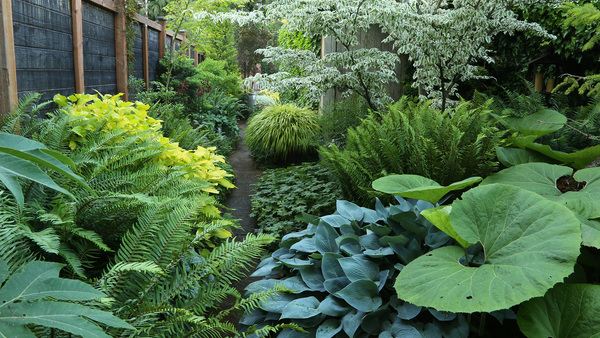
It’s a woodland story—you know that right away—but the rest is a mystery. Do you hear water? Music? Mozart perhaps? Some laughing far away? You are beginning chapter one of the story of a garden, on a lake, in Alabama. I consider my garden just that—a story—as opposed to gardens that are paintings. The painting garden is a single set piece; you see it all at once. It may be examined for its design elements and composition, but it there is no page two. By contrast, the first moments in a story garden should immediately cause the visitor to begin wondering what happens next, or, in garden terms, What’s down this path? The garden then, like any good story, draws the visitor through to its final resolution.
Whether a garden should be a painting or a story depends on the garden’s purpose. Most front yards, designed to be seen from the street, are, by their nature, pictures. Many backyards, built to be seen from inside the house or to complement a patio, are to be looked at as well, not explored. If a garden goes beyond this and beckons you to actively explore its secrets, it’s a story. Whether the story is an anecdote or a novel, the gardener, like the author, must use certain devices to ensure interest and excitement as the garden story unfolds.


Each episode of a garden story should have three parts: Anticipation—a gate or entrance that provides a sense of invitation, a suggestion of something ahead; Tension—a journey to the unknown, a walk down a twisting path, or a set of steps to a place unseen; and Release—a destination, a breakout to a lawn, veranda, pool, or sitting area, where the visitor will stop, rest, and leisurely explore the destination, the vista, the planting, and the completion of that episode.
The entrance creates anticipation

A story that begins something like this immediately has your attention: The duchess saw Petr, the man she thought was a priest, looking at the dead girl’s teeth…. You want to know more. Not only has anticipation been created, but a tone has also been set. The same should be done with a story garden.
Your gate or entrance should draw people in by being dramatic in a way that will let them know something interesting is just beyond. An arch or pergola seen at an angle with the beginning of a path bending out of sight excites any visitor worth inviting. An obstructed view of a distant summer house or waterfall with no clear way to get there always creates anticipation. But just as you should not be able to guess the ending of the book after the first chapter, ideally, your visitor should not be able to see his final destination fully from the entrance. A foreshadowing, yes, but don’t give away the plot.


The tone created by your entrance should set the pace for your journey through the garden. An inspirational garden should be paced slow and easy. Try long paths, gentle curves, and places to pause, sit, and, quite literally, smell the roses (seats can mark the paragraphs in your garden story). An amusing garden can have a faster pace: quick turns followed by surprises. A mystery garden should be paced unevenly: worn steps that hint of decayed antiquity; plantings that sprawl onto the paths. People like a little melancholia, which is why ruins, real or created, are pleasing. A visitor to a truly great mystery garden should feel that he has discovered this garden, that it was something lost, like a castle no tourists have visited.
Tension builds as you move along

Ever read a book you couldn’t put down? Then that book had tension, suspense, and mystery; you were pulled along and couldn’t stop. Finally at 2 a.m., something was resolved, you sighed, marked your page, and went to sleep. Even a joke creates suspense until the punch line is delivered.
In my garden, a twisting path sunk in a narrow, fern-lined ravine overplanted with dense foliage is pretty, but it also creates a sense of foreboding. A momentary hint—and only a hint—of an unexpected faraway green sward or the smell of unseen roses offers mystery. A steep flight of steps, a pool with small irregular stepping stones equals danger.
I use these paths as an author would his narrative. They create tension and a desire for the resolution or release of a soothing destination. Each of the tensions should accentuate that release. The narrower a path is, the more open the subsequent area seems; the longer the flight of steps, the more blessed the patio at the bottom. Intersecting paths are great tension tools. When a path splits in two, both alternatives can twist out of sight. A choice must be made. A flight of stairs or another turn in the path is another way to add tension. Perhaps my love of intersections comes from a childhood of Oz stories. Dorothy is always faced with a choice of one path or another, and her choice always leads to a remarkable place or a surprising adventure.
A destination provides a sense of release

Just as the end of a chapter must bring some type of resolution in the story, so too, a path must have some destination. Every tension needs a release, and there must be a balance between the two. When you build up, you have to deliver. A wonderful path with a disappointing destination is like a long joke with a bad punch line. If the destination is modest, the path should not create anticipation.


A dominant idea in my destinations is the concept of activities, real or suggested. If there is nothing to do there, the space has no purpose. At each destination there is an invitation for an activity to take place: sitting, eating, drinking, dancing, courting, swimming, croquet, chess, ad infinitum. You do not have to physically engage in the activity to mentally enjoy such play. A visit to a castle is fun because you can imagine what went on there without having to dodge arrows. Magazines show dining room tables fully set; you imagine the party. I always put out the 2-foot-high chess men on the giant walk-on chess board, even when I’m sure no one will play. The Victorian sandbox has half-buried digging tools and partially filled buckets. The places are ready—are you?
Reading a garden story is an activity—it is dynamic, not static. The destination should also invoke an action, but an action taking place at a specific spot, something to do at end of the path’s journey; otherwise, you have taken a story route just to see a picture.









Comments
A very interesting story garden.
This is a great article. It's exactly what I do in my garden designs. I refer to "tension" as "compression/expansion" that produces a feeling of euphoria. And yes, a garden without a story is simply a pretty picture that someone might hang on a wall. There's no emotional connection. If a garden doesn't make an emotional connection, it has failed, I believe. Thanks for this.
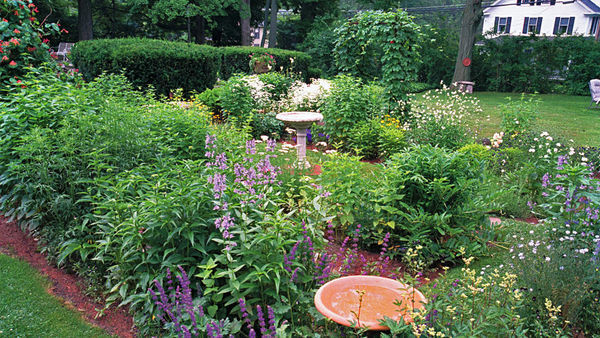
It's not our typical GPOD. It feels more like an article in Fine Gardening. I would have liked to have more plant names, especially for the lead picture. All of that being said, I do love this piece. I don't know if everyone aspires to have this type of garden, but it certainly gives us a place to start, even on a small scale.
Great article that I didn’t want to end. It made me realize that we have a perfect property for creating more of a story. The door to your children’s garden is perfect and you’ve inspired us to make ours more creative. Thank you.
Wow! This is a great read and has given me some more ideas for my gardens! Now i need to fing some good help to help me with it! What a journey! Thanks!
Lovely garden prose - not just instructional, but good reading as well.
Wow!! Fine Gardening X2 today!! (Tripley blessed!!)
This article could not have come forward at a better time and addresses several concerns I've been having lately with my created views. And, Mr. Sifford's addendum is also timely, appreciated, and confirming. (Sadly, Jay, I've failed for now...better not quit my day job, just yet!!) But, since my gardens are pretty new and still under development, perhaps I can fix them!
Mr. Scott's analogy to stories made sense to me and answered the questions I didn't even know I was posing!
jesse
Thanks for explaining/naming and demonstrating your 'story garden' so well. You've provided a beautiful example , as well as much food for thought in your article. I've been working on the idea in my garden in a more intuitive manner. You laid it all out so clearly! Now if the snow just keeps melting.....
Log in or create an account to post a comment.
Sign up Log in