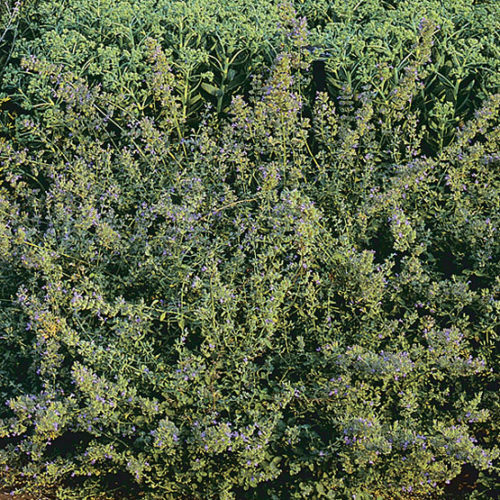
Nepeta × faassenii ‘Dropmore’ (Catmint)

Nepeta × faassenii ‘Dropmore’ Photo/Illustration: Scott Kunst


Be the first to rate this plant

Plant Showcase - from our advertisers


Hardiness Zones: 1 2 3 4 5 6 7 8 9 10 11
Botanical Name: Nepeta × faassenii ‘Dropmore’ NEP-eh-tah ex fah-SEEN-ee-eye Common Name: Catmint Synonyms: N. nepetella × N. racemosa, N. mussinii of gardens Genus: Nepeta
This cultivar is a clump-forming perennial with toothed gray-green leaves and larger flowers than the hybrid. It flowers profusely and long, especially if sheared. The blue-purple flowers are small but abundant, and the foliage is aromatic.
Noteworthy characteristics: Profuse, large blue flowers that attract bees and butterflies; aromatic foliage; long-blooming if sheared. May be attractive to cats.
Care: Well-drained soil in full sun to part shade (especially in hot climates). Thrives in dry soils in full sun, and is very drought tolerant. Shear flower spikes after initial flowering to promote continued bloom.
Propagation: Divide in spring or autumn. Softwood cuttings in early autumn.
Problems: Nothing serious, sometimes leaf spots.
Height 1 ft. to 3 ft.
Spread 1 ft. to 3 ft.
Growth Habit Clumps
Growth Pace Moderate Grower
Light Full Sun Only
Moisture Dry to Medium
Maintenance Low
Tolerance Deer Tolerant;Drought Tolerant
Characteristics Attracts Butterflies; Fragrant Foliage; Showy Flowers
Bloom Time Fall; Summer
Flower Color Blue Flower
Uses , Beds and Borders, Ground Covers
Style , Herb Garden, Cottage Garden, Rock Garden
Seasonal Interest , Summer Interest, Fall Interest
Type ,Perennials

Plants you might also like

Nepeta × faassenii 'Walker's Low' Nepeta × faassenii 'Walker's Low'
(Catmint)
(11 user reviews)
Hardiness Zones: 1 2 3 4 5 6 7 8 9 10 11

This mound of lavender-blue flowers and aromatic, grayish green leaves up to 2 feet tall and 3 feet wide is great as edging or in a border, herb, or rock garden. It is an easy to grow, prolific bloomer that seems to be deer resistant. It blooms the whole summer and tolerates some shade. It also looks great with roses or on walls.

Hemerocallis 'Happy Returns' Hemerocallis 'Happy Returns'
(Daylily)
(15 user reviews)
Hardiness Zones: 1 2 3 4 5 6 7 8 9 10 11

This pale-yellow-flowered daylily distinguishes itself with its profuse bloom and compact size (only 16 inches tall), making it good for containers and the borders. It is an early season bloomer with circular flowers that open in late afternoon and last through the night.

Salvia pratensis Salvia pratensis
(Meadow clary)
Be the first to rate this plant
Hardiness Zones: 1 2 3 4 5 6 7 8 9 10 11

This woody-stemmed perennial produces sticky spikes of deep violet or, rarely, white to pink flowers. It blooms from early summer to autumn; reblooming is most reliable if spent flowers are deadheaded promptly. It has wrinkled leaves and forms an upright clump 3 feet tall by 1 foot wide. This salvia is most noted for its many hybirds with S. nemerosa.  

Solidago nemoralis Solidago nemoralis
(Goldenrod, Gray goldenrod)
Be the first to rate this plant
Hardiness Zones: 1 2 3 4 5 6 7 8 9 10 11

This is one of the smallest species of goldenrod, topping out at only 4 to 6 inches high in poor soils, and 2 feet high in fertile soils. It is considered a garden-worthy species, with gray-green leaves that form clumps and languid, one-sided yellow plumes. It is tolerant of both sandy and clay soils.

Solidago flexicaulis Solidago flexicaulis
(Goldenrod, Zigzag goldenrod)
Be the first to rate this plant
Hardiness Zones: 1 2 3 4 5 6 7 8 9 10 11

This species is aptly named for its distinctive crooked stems that bend back and forth at 45° angles between nodes. It bears starry, medium-yellow flowers atop 1- to 3-foot tall stems.