previous
  • 6 Tips for Weed Control
    6 Tips for Weed Control
  • Mulch for a Healthy Garden
    Mulch for a Healthy Garden
  • Lawn Alternatives
    Lawn Alternatives
  • Thoughts From a Foreign Field
    Thoughts From a Foreign Field
  • Garden Confidential: A Plant Walks into a Bar
    Garden Confidential: A Plant Walks into a Bar
  • NEW Video Series: There's a Better Way
    NEW Video Series: There's a Better Way
  • Comfortable Alfresco Dining
    Comfortable Alfresco Dining
  • Colorful Selections for Shade
    Colorful Selections for Shade
  • Containers as Focal Points
    Containers as Focal Points
  • Save Money by Growing Your Own
    Save Money by Growing Your Own
  • Homegrown / Homemade
    Homegrown / Homemade
  • Indeterminate or Determinate Tomatoes?
    Indeterminate or Determinate Tomatoes?
  • Fragrant Plants for Pathways
    Fragrant Plants for Pathways
  • Pretty in Pink
    Pretty in Pink
  • In Pursuit of the Perfect Potting Shed
    In Pursuit of the Perfect Potting Shed
  • Slideshow: Beautiful Clematis
    Slideshow: Beautiful Clematis
  • Make a Succulent Topiary
    Make a Succulent Topiary
  • Fast-Growing Trees for Impatient Gardeners
    Fast-Growing Trees for Impatient Gardeners
  • Dwarf Citrus Trees
    Dwarf Citrus Trees
  • Plant an Easy-to-Water Strawberry Jar
    Plant an Easy-to-Water Strawberry Jar
  • Elephant's Ears
    Elephant's Ears
  • Plants that Spark!
    Plants that Spark!
  • Designing with Curved Terraces
    Designing with Curved Terraces
  • Stylish Shady Containers
    Stylish Shady Containers
  • Building a Compost Bin
    Building a Compost Bin
next

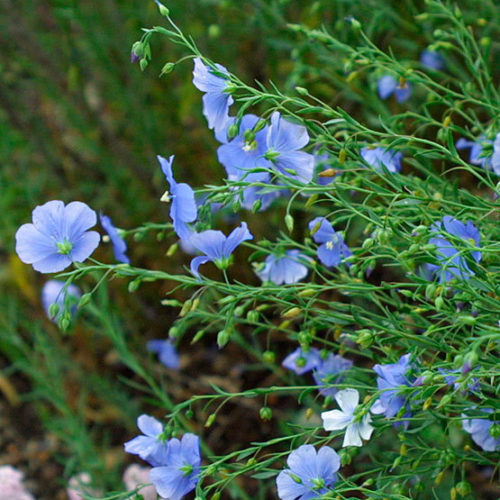
Linum lewisii (Blue flax)

Linum lewisii Photo/Illustration: Jennifer Benner

(Based on 1 user review)

Rate this plant

Plant Showcase - from our advertisers


Hardiness Zones: 1 2 3 4 5 6 7 8 9 10 11
Botanical Name: Linum lewisii LY-num loo-ISS-ee-eye Common Name: Blue flax Synonyms: Linum perenne ssp. lewisii Genus: Linum
Blue flax is a short-lived perennial with blue-green needlelike leaves on graceful 2-foot-tall stems. Satiny sky blue flowers, borne on wiry stems, appear in late spring, last through mid-summer, and open fully only on sunny days. Small rounded seedheads form in summer. 
Noteworthy characteristics: Discovered and documented by Meriwether Lewis, in whose honor it was named.
Care: Grow in lean, well-drained soil and full sun. Cut back to sedum-like basal growth in formal plantings or leave spent flower stems behind to blend in with a naturalistic setting.
Propagation: Sow seed in spring or autumn.
Problems: Stem rot, rust, wilt, anthracnose, damping off, slugs, snails, and aphids.
Height 1 ft. to 3 ft.
Light Full Sun Only
Moisture Medium Moisture
Tolerance Deer Tolerant
Characteristics Self Seeds; Showy Seed Heads
Bloom Time Summer
Flower Color Blue Flower
Uses Beds and Borders
Seasonal Interest Spring Interest, Summer Interest
Type Perennials

Plants you might also like

Nepeta × faassenii 'Walker's Low' Nepeta × faassenii 'Walker's Low'
(Catmint)
(11 user reviews)
Hardiness Zones: 1 2 3 4 5 6 7 8 9 10 11

This mound of lavender-blue flowers and aromatic, grayish green leaves up to 2 feet tall and 3 feet wide is great as edging or in a border, herb, or rock garden. It is an easy to grow, prolific bloomer that seems to be deer resistant. It blooms the whole summer and tolerates some shade. It also looks great with roses or on walls.

Hemerocallis 'Blackeyed Stella' Hemerocallis 'Blackeyed Stella'
(Daylily)
Be the first to rate this plant
Hardiness Zones: 1 2 3 4 5 6 7 8 9 10 11

Daylilies are classic, extremely popular garden plants. They feature long, arching, strappy leaves and long stems of generally 6-petaled flowers, though double flowers are popular as well. Each flower lasts only one day, hence the plant’s common name. Daylilies come in a wide range of colors, from cream and cheery yellow to peach, orange, fiery red, deep burgundy, pink, and purple. Some have contrasting throats and "eye-zones." Daylilies are ideal for a mixed herbaceous perennial border.

Hemerocallis 'Armani' Hemerocallis 'Armani'
(Daylily)
Be the first to rate this plant
Hardiness Zones: 1 2 3 4 5 6 7 8 9 10 11

Daylilies are classic, extremely popular garden plants. They feature long, arching, strappy leaves and long stems of generally 6-petaled flowers, though double flowers are popular as well. Each flower lasts only one day, hence the plant’s common name. Daylilies come in a wide range of colors, from cream and cheery yellow to peach, orange, fiery red, deep burgundy, pink, and purple. Some have contrasting throats and "eye-zones." Daylilies are ideal for a mixed herbaceous perennial border.

Hemerocallis 'Frances Fay' Hemerocallis 'Frances Fay'
(Daylily)
Be the first to rate this plant
Hardiness Zones: 1 2 3 4 5 6 7 8 9 10 11

This floriforous daylily is a melony yellow.

Hemerocallis 'Froufrou' Hemerocallis 'Froufrou'
(Daylily)
Be the first to rate this plant
Hardiness Zones: 1 2 3 4 5 6 7 8 9 10 11

'Froufrou' gets its name from its small, ruffled yellow petals.