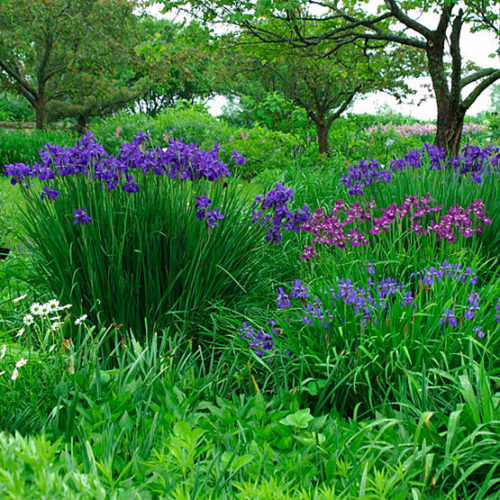
Iris sibirica (Siberian iris)

Iris sibirica Photo/Illustration: Jennifer Benner

(Based on 1 user review)

Rate this plant

Plant Showcase - from our advertisers


Hardiness Zones: 1 2 3 4 5 6 7 8 9 10 11
Botanical Name: Iris sibirica EYE-riss sih-BEER-ih-kah Common Name: Siberian iris Genus: Iris
Attractive, grass-like leaves to 18 inches long are topped by showy flowers in a wide range of colors. Flowers unfurl in May and bloom well into June. Cultivars include ‘Caesar’s Brother’, with rich purple flowers; ‘Eric the Red’, a bright violet-pink Siberian; and ‘Chilled Wine’, a garnet iris suffused with blue.
Care: Thrives in acidic, heavy, clay soils, and loves wet feet. Low maintenance, requiring only feeding and division every few years. Ideal for ponds, streams, or boggy areas. In beds, they require a few extra waterings in a season.
Propagation: Lift and divide clumps, or separate bulb offsets, and plant immediately, in early autumn.
Problems: Iris borer, verbena bud moth, whiteflies, iris weevil, thrips, slugs and snails, aphids, and nematodes. Bacterial leaf blight and soft rot, crown rot, rhizome rot, leaf spot, rust, viruses, and scorch.
Height 1 ft. to 3 ft.
Growth Habit Clumps
Growth Pace Slow Grower
Light Full Sun to Part Shade
Moisture Medium to Wet
Maintenance Moderate
Characteristics Showy Flowers
Bloom Time Early Summer; Late Spring; Spring; Summer
Flower Color Blue Flower; Pink Flower; Purple/ Lavender Flower
Uses , Beds and Borders, Cut Flower, Waterside
Style , Water Garden
Seasonal Interest , Summer Interest
Type ,Perennials

Plants you might also like

Dianthus barbatus Dianthus barbatus
(Sweet William)
Be the first to rate this plant
Hardiness Zones: 1 2 3 4 5 6 7 8 9 10 11

These short-lived perennials or biennials are charming plants, and are worth their weight in gold in the cottage border. After flowering, the attractive foliage holds the space well.

Hemerocallis 'Blackeyed Stella' Hemerocallis 'Blackeyed Stella'
(Daylily)
Be the first to rate this plant
Hardiness Zones: 1 2 3 4 5 6 7 8 9 10 11

Daylilies are classic, extremely popular garden plants. They feature long, arching, strappy leaves and long stems of generally 6-petaled flowers, though double flowers are popular as well. Each flower lasts only one day, hence the plant’s common name. Daylilies come in a wide range of colors, from cream and cheery yellow to peach, orange, fiery red, deep burgundy, pink, and purple. Some have contrasting throats and "eye-zones." Daylilies are ideal for a mixed herbaceous perennial border.

Hemerocallis 'Mini Pearl'

Hemerocallis 'Mini Pearl'


(Daylily)
Be the first to rate this plant
Hardiness Zones: 1 2 3 4 5 6 7 8 9 10 11

This is a lovely yellow-pink (some say apricot) daylily.

Clematis integrifolia Mongolian Bells™ Clematis integrifolia Mongolian Bells™
Be the first to rate this plant
Hardiness Zones: 1 2 3 4 5 6 7 8 9 10 11

Clematis integrifolia is no longer only blue. This selection produces progeny with pink, white, and lavender blooms from midspring until late summer. The flowers are followed by attractive seed heads in fall. It has a compact, herbaceous form and grows to just 10 to 14 inches tall.

Salvia pratensis Salvia pratensis
(Meadow clary)
Be the first to rate this plant
Hardiness Zones: 1 2 3 4 5 6 7 8 9 10 11

This woody-stemmed perennial produces sticky spikes of deep violet or, rarely, white to pink flowers. It blooms from early summer to autumn; reblooming is most reliable if spent flowers are deadheaded promptly. It has wrinkled leaves and forms an upright clump 3 feet tall by 1 foot wide. This salvia is most noted for its many hybirds with S. nemerosa.