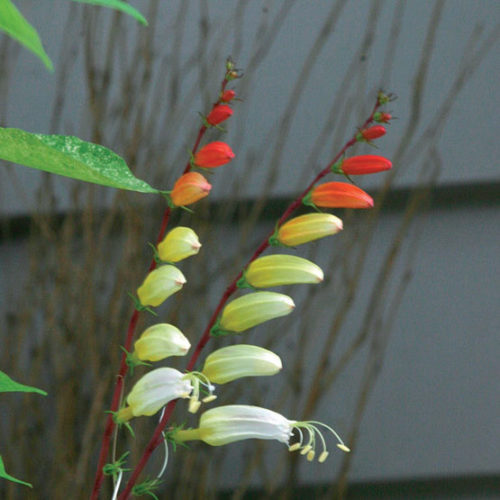
Ipomoea lobata (Firecracker vine, Spanish flag)

Ipomoea lobata Photo/Illustration: Danielle Sherry

(Based on 2 user reviews)

Rate this plant

Botanical Name: Ipomoea lobata eye-poe-MEE-ah lo-BAY-tah Common Name: Firecracker vine, Spanish flag Synonyms: I. versicolor, Quamoclit lobata Genus: Ipomoea
This unusual annual vine is the perfect choice for adding some vertical interest to the garden. Its racemes of vivid blossoms are a hummingbird favorite, with their red tooth-like flowers that fade to orange and then yellow and white. Firecracker vine can bloom year round in warm climates, but generally blooms from summer to fall. It is a native of Mexico and Central and South America.
Noteworthy characteristics: Long stems of multi-colored flowers that attract hummingbirds.
Care: Provide full sun and well-drained soil in a sheltered location.
Propagation: Sow seed at 64°F in spring.
Problems: Wilt, charcoal rot, thread blight, white blister, rust, fungal leaf spots, and stem rot may affect plants.
Height 6 ft. to 10 ft.
Growth Habit Runs
Light Full Sun Only
Moisture Medium Moisture
Maintenance Low
Characteristics Attracts Hummingbirds; Showy Flowers
Bloom Time Early Fall; Early Summer; Late Summer; Summer
Flower Color Orange/ Salmon Flower; Red Flower; Yellow Flower
Uses Beds and Borders, Trellis
Seasonal Interest Summer Interest
Type Annuals,Vines

Plants you might also like

Mina lobata Mina lobata
(Spanish flag)
(2 user reviews)

Sprays of long, tubular buds spark into a fiery scarlet and fade to a pale cream on this annual climbing vine. A single flower holds tints of yellow, warm pink, orange, and red as if a watercolorist had laid down colors one layer at a time. As the bud matures, the colors wash away, leaving a pale blossom pushed open at the tip by protruding anthers. From a distance, the plant seems to be covered in hundreds of brightly lit candles. This vine also produces rich, bronzy-purple new growth which ages to a lovely deep green. The heavily indented, trilobed leaves resemble a hawk's strong wings, giving the plant the look of birds in flight. The foliage stays intact and healthy until frost. The bottom of the vine sheds its leaves as the season progresses, so disguising its bare base behind lower-growing plants is a must.

PetuniaSweetunia® Soft Pink Morning Petunia Sweetunia® Soft Pink Morning
(Sweetunia® Soft Pink Morning petunia)
Be the first to rate this plant
Hardiness Zones: 1 2 3 4 5 6 7 8 9 10 11

This spectacular selection shines brightly in the most brutal of circumstances. Month after month, this petunia spills oodles of white- and yellow-throated, pink-rimmed blooms elegantly over bed edges.

Tropaeolum majus 'Jewel of Africa' Tropaeolum majus 'Jewel of Africa'
(Indian cress, Nasturtium)
(2 user reviews)

This climbing, old-fashioned cultivar grows to 8 feet tall. In summer and fall, it bears flowers of maroon, yellow, cream, and orange, and in-between shades of peach, apricot, salmon, and scarlet. The leaves are marbled with white variegation. The leaves and flowers are edible.

Tropaeolum majus 'Whirlybird Mix' Tropaeolum majus 'Whirlybird Mix'
(Indian cress, Nasturtium)
Be the first to rate this plant

This old-fashioned cultivar of the species has a mounding habit and grows up to 18 inches tall and a foot wide. From summer to frost, it bears blossoms in shades of yellow, red, and orange which are held clear above the foliage.

Thunbergia alata Thunbergia alata
(Black-eyed Susan vine)
(2 user reviews)
Hardiness Zones: 1 2 3 4 5 6 7 8 9 10 11

This tender perennial climber is evergreen in Zones 10 and warmer. Cheerful, 1.5-inch flowers in shades of orange and yellow cover this fast-growing vine. The blossoms have a simple form: 5 petals surrounding a brownish purple center. Where grown as an annual, plants can reach 8 feet; when grown as a perennial, 20 feet.