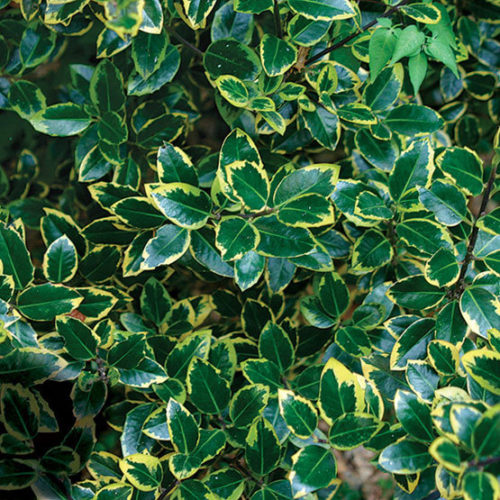
Ilex aquifolium (English holly)

Ilex aquifolium Photo/Illustration: Colleen Fitzpatrick


Be the first to rate this plant

Plant Showcase - from our advertisers


Hardiness Zones: 1 2 3 4 5 6 7 8 9 10 11
Botanical Name: Ilex aquifolium EYE-leks ah-kwih-FOE-lee-um Common Name: English holly Genus: Ilex
This tall, pyramidal, evergreen tree may be grown as a large shrub. Its evergreen, spiny foliage is leathery and glossy. Insignificant, though fragrant, flowers bloom in spring followed by red, orange, or yellow drupes that attract birds. Many cultivars are available.
Noteworthy characteristics: English holly is less hardy than our American holly (I. opaca) and is more difficult to grow in some areas of the country. However, it is an agressive/invasive plant in certain areas, including the Pacific Northwest.
Care: Provide full sun to part shade and moist but well-drained soil in a sheltered site. In hot climates, English holly grows best with some afternoon shade. Prune in winter, if desired. Plant at least one male pollinator to ensure fruit set.
Propagation: Take semi-ripe cuttings in summer or early fall.
Problems: Holly leaf miner, spider mites, whitefly, scale, leaf spot, leaf rot, tar spot, powdery mildew. leaf scorch, leaf drop, chlorosis. Aphids may prey on young shoots.
Height Over 30 ft.
Spread 15 ft. to 30 ft.
Growth Habit Clumps
Growth Pace Invasive/Aggressive Grower
Light Full Sun to Part Shade
Moisture Medium Moisture
Maintenance Moderate
Characteristics Attracts Birds; Showy Fruit
Bloom Time Spring
Flower Color White Flower
Uses , Beds and Borders, Hedge, Specimen Plant/ Focal Point
Seasonal Interest , Winter Interest, Spring Interest, Summer Interest, Fall Interest
Type ,Shrubs,Trees

Plants you might also like

Viburnum prunifolium Viburnum prunifolium
(Blackhaw Viburnum)
Be the first to rate this plant
Hardiness Zones: 1 2 3 4 5 6 7 8 9 10 11

Blackhaw Viburnum is a large shrub or small tree with clusters of creamy white flowers followed by pink-rose berries, which birds love to eat. Its distinctive bronze-green foliage on reddish purple stems turns blue-black in the fall. Blackhaw grows to 12 to 15 feet high and 8 to12 feet wide.

Broussonetia papyrifera 'Golden Shadow' Broussonetia papyrifera 'Golden Shadow'
(Golden paper mulberry)
Be the first to rate this plant
Hardiness Zones: 1 2 3 4 5 6 7 8 9 10 11

This golden-leaved version of the southern paper mulberry can be treated as a cutback shrub to control size and for best production of brilliant golden yellow, large, lobed leaves. Or it can be allowed to grow into a small- to medium-sized tree. It's a most desirable garden plant and looks fabulous with deep blue salvias.

no image available Cornus drummondii
(Roughleaf dogwood)
Be the first to rate this plant
Hardiness Zones: 1 2 3 4 5 6 7 8 9 10 11

This dogwood can be classified as either a deciduous shrub or small tree. Appealing creamy white flowers appear in late spring and become attractive clusters of milky white fruit in fall. The first cold front often turns the leaves a dark burgundy, and the winter stem tips have a glossy mahogany hue.

Vitex agnus-castus var. latifolia Vitex agnus-castus var. latifolia
(Chaste tree)
(2 user reviews)
Hardiness Zones: 1 2 3 4 5 6 7 8 9 10 11

Chaste tree is a southern favorite beginning to gain favor across the country. Whether left to grow as a large, multistemmed shrub or cut back annually for a more compact look, this selection is a winner. Fine, lacy leaves are glossy and green. Bright blue flower panicles begin to form in early summer and continue through the heat of the season and into fall. This is a reasonably cold-hardy, deer-resistant woody plant, and while V. agnus-castus is typically considered a Zone 7 plant, the variety latifolia can be grown in Zone 6 and even in southern areas of Zone 5.

Albizia julibrissin Albizia julibrissin
(Mimosa, Silk tree)
(2 user reviews)
Hardiness Zones: 1 2 3 4 5 6 7 8 9 10 11

A large shrub or small tree, Albizia julibrissin is native to Iran to Japan. It is a fast-growing plant whose seedlings can become invasive. It can be seen growing in the wild in the southeastern U.S. and California in waste places, fields, and along roads.

However, its bipinnate, ferny leaves and fluffy pink flowerheads that cover the tree in summer make it a garden-worthy plant, as do the fragrance emitted by the flowers, which attract bees. Seed pods that resemble flat beans follow the flowers and persist into winter. Still, care should be used so that seeds from garden plants can't escape into the wild.