
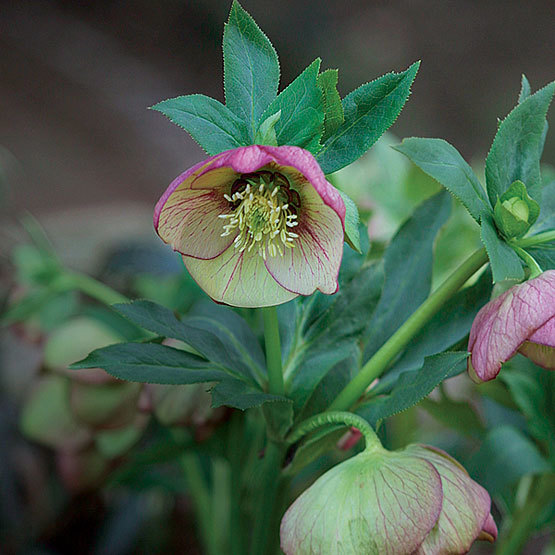
Genus Helleborus (Hellebore, Lenten rose, Winter rose)

Helleborus Helleborus X hybridus Photo/Illustration: Steve Aitken
hel-LEB-or-us Common Name: Hellebore, Lenten rose, Winter rose
This genus contains about 15 species of perennials with toothed, leathery leaves and distinctive blooms. The often very long-lasting (6 to 8 weeks) flowers are produced in very early spring and run the gamut from white, green, pink, purple, cream, and sometimes spotted. Best grown in groups in a woodland or shady border.
Noteworthy characteristics: Year round foliage persists through shade and snow and is fairly deer and rabbit resistant. Flowers in early spring with daffodils and tulips.
Care: Tolerates a wide range of soils and exposures, from neutral to acid soil and sun to part shade. Check individual species.
Propagation: Sow seed in containers when ripe. Divide after flowering in spring. H. foetidus and H. argutifolius are best raised by seed since they do not take dividing.
Problems: Slugs, snails, aphids, black spot, and leaf spot.

Species, varieties and cultivars for genus Helleborus

Helleborus 'Ivory Prince' Helleborus 'Ivory Prince'
(Hellebore)
(1 user review)
Hardiness Zones: 1 2 3 4 5 6 7 8 9 10 11

Year-round gray-green foliage persists through shade and snow and is fairly deer and rabbit resistant. Flowers appear in early spring with daffodils and tulips. This cultivar produces flowers that sit well above the foliage and point upward, which adds to its showiness.

Helleborus × hybridus cvs. Helleborus × hybridus cvs.
(Hellebore)
Be the first to rate this plant
Hardiness Zones: 1 2 3 4 5 6 7 8 9 10 11

From late fall through winter, the leathery leaves of hellebores stay glossy, cheery, and green. Hybrids of H. orientalis and other species have a clump-forming habit and leathery leaves. They begin blooming in February or March in a range of shades, adding much needed color very early in the season. The blooms last for a very long time, especially if the weather stays cool. Hellebores are tolerant of summer heat and humidity.

Helleborus argutifolius ‘Janet Starnes’ Helleborus argutifolius ‘Janet Starnes’
(Corsican hellebore)
Be the first to rate this plant
Hardiness Zones: 1 2 3 4 5 6 7 8 9 10 11

This perennial evergreen has white-speckled leaves with toothed edges. It produces abundant yellow flowers in late winter and early spring.

Helleborus foetidus Helleborus foetidus
(Stinking hellebore, Bear's foot, Dungwort, Stinkwort)
Be the first to rate this plant
Hardiness Zones: 1 2 3 4 5 6 7 8 9 10 11

The early, long-lasting, sometimes fragrant blooms of this hellebore are borne in clusters in late winter to early spring. The pendent flowers are a muted yellow-green, often with purple margins, and have large pale green bracts. Helleborus foetidus has dramatic, deeply-cut foliage that holds up through the winter. Leaves smell unpleasant when crushed.

Helleborus odorus Helleborus odorus
(Fragrant hellebore)
Be the first to rate this plant
Hardiness Zones: 1 2 3 4 5 6 7 8 9 10 11

Lime-green to near-yellow flowers 1 to 2 inches across, with five petal-like sepals, are borne in loose clusters of three or four on leafy stems up to 20 inches tall. Blooms emerge in late winter or early spring, fading to pale green and lasting until seeds are ripe. There is great variation in fragrance, flower color and size, as well as leaf form, across different plants.

Helleborus odorus 'Double Queen' Helleborus odorus 'Double Queen'
(Lenten rose, hellebore)
Be the first to rate this plant
Hardiness Zones: 1 2 3 4 5 6 7 8 9 10 11

Hellebores begin blooming in mid-winter in a range of colors, adding much needed color very early in the season. They bloom when the temperature is below freezing, even amidst the snow. Protect from cold winter winds, especially when not insulated by snow, to avoid damaged foliage. Avoid ingestion of all plant parts and contact with the sap.

Helleborus orientalis Helleborus orientalis
(Lenten rose)
Be the first to rate this plant
Hardiness Zones: 1 2 3 4 5 6 7 8 9 10 11

This hairless or slightly hairy perennial has over-wintering, leathery, deep green basal leaves each divided into 7 or 9 leaflets. From January until May, masses of white or greenish-cream flowers, becoming pink with age, appear on branched stems.


