
previous
  • Fragrant Plants for Pathways
    Fragrant Plants for Pathways
  • Homegrown / Homemade
    Homegrown / Homemade
  • Save Money by Growing Your Own
    Save Money by Growing Your Own
  • Slideshow: Beautiful Clematis
    Slideshow: Beautiful Clematis
  • Indeterminate or Determinate Tomatoes?
    Indeterminate or Determinate Tomatoes?
  • Plants that Spark!
    Plants that Spark!
  • NEW Video Series: There's a Better Way
    NEW Video Series: There's a Better Way
  • Elephant's Ears
    Elephant's Ears
  • Stylish Shady Containers
    Stylish Shady Containers
  • Make a Succulent Topiary
    Make a Succulent Topiary
  • Fast-Growing Trees for Impatient Gardeners
    Fast-Growing Trees for Impatient Gardeners
  • Pretty in Pink
    Pretty in Pink
  • Building a Compost Bin
    Building a Compost Bin
  • Plant an Easy-to-Water Strawberry Jar
    Plant an Easy-to-Water Strawberry Jar
  • Dwarf Citrus Trees
    Dwarf Citrus Trees
  • In Pursuit of the Perfect Potting Shed
    In Pursuit of the Perfect Potting Shed
  • 6 Tips for Weed Control
    6 Tips for Weed Control
  • Colorful Selections for Shade
    Colorful Selections for Shade
  • Designing with Curved Terraces
    Designing with Curved Terraces
  • Comfortable Alfresco Dining
    Comfortable Alfresco Dining
  • Lawn Alternatives
    Lawn Alternatives
  • Garden Confidential: A Plant Walks into a Bar
    Garden Confidential: A Plant Walks into a Bar
  • Thoughts From a Foreign Field
    Thoughts From a Foreign Field
  • Mulch for a Healthy Garden
    Mulch for a Healthy Garden
  • Containers as Focal Points
    Containers as Focal Points
next

Genus Colocasia (Taro, Elephant's ear)

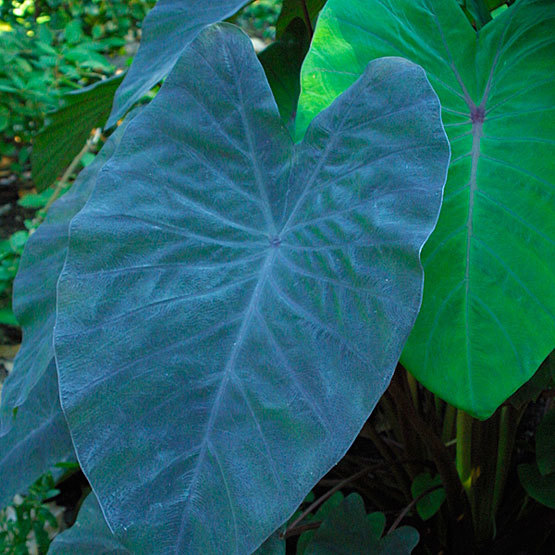
Colocasia Colocasia esculenta 'Black Magic' Photo/Illustration: Jennifer Benner
kol-oh-KAY-shah Common Name: Taro, Elephant's ear
The genus Colocasia includes six species of tuberous perennials from tropical Asia, grown there as a staple food. They are native to swamps and other moist areas and can be used in large aquatic containers in the garden or in the ground in moist soil. The arrow-shaped, sometimes rounded, leaves are large and mostly green, sometimes with prominent veins. Cultivated plants rarely bloom. All plant parts may cause stomach upset if eaten raw, and the sap may irritate skin.  
Noteworthy characteristics: Likes wet soil. Large foliage plant. The Hawaiian food poi is made from the tubers.
Care: In the garden, taro needs fertile, organically rich, moist or wet, slightly acidic soil in partial shade. Indoors, grow in bright filtered light and high humidity. Keep tubers dry and frost-free when dormant.
Propagation: Divide in winter or early spring.
Problems: Soft rot, bacterial blight, corm and root rots, and dasheen mosaic virus are common, while aphids, whiteflies, and spider mites also occur.

Species, varieties and cultivars for genus Colocasia

Colocasia affinis var. jenningsii Colocasia affinis var. jenningsii
(Dwarf elephant's ear)
Be the first to rate this plant
Hardiness Zones: 1 2 3 4 5 6 7 8 9 10 11

This little elephant ear has velvety dark leaves with prominent green veins and a large silvery central blotch. It reaches about 2 feet high.

Colocasia esculenta Colocasia esculenta
(Taro)
Be the first to rate this plant
Hardiness Zones: 1 2 3 4 5 6 7 8 9 10 11

A large, showy, marginal aquatic plant with heart-shaped, dark green leaves, taro can reach 5 feet tall and is often grown as a summer annual. Use it in a container or near water.

Colocasia esculenta 'Black Beauty' Colocasia esculenta 'Black Beauty'
('Black Beauty' elephant's ears)
Be the first to rate this plant
Hardiness Zones: 1 2 3 4 5 6 7 8 9 10 11

‘Black Beauty’ is my new favorite elephant’s ear. A mutation of ‘Illustris’, ‘Black Beauty’ is grown for its 2-foot-long, 1-foot-wide, dark purple leaves with green stems and green veins. Once established in my garden, this plant held onto its leaves through the heat and drought of summer in full sun, which is unusual for the dark-foliage forms of elephant’s ears: They tend to look less than lovely when temperatures rise above 90°F.
-Adrienne Roethling, Elephant's Ears, Fine Gardening issue #148, page 61

Colocasia esculenta 'Black Magic' Colocasia esculenta 'Black Magic'
(Elephant ear, Cocoyam, Dasheen, Taro)
(1 user review)
Hardiness Zones: 1 2 3 4 5 6 7 8 9 10 11

Rising to about 36 inches, the elephant ear's deep-purple stalks suspend luxurious leaves of the same color. When the leaves’ undersides are dusted with chalky-looking bloom, they have an intriguing, almost gray look. This plant does well in a bog or even in the margins of a water garden, as well as in average garden soil.

Colocasia esculenta 'Coffee Cups' Colocasia esculenta 'Coffee Cups'
('Coffee Cups' elephant's ear)
Be the first to rate this plant
Hardiness Zones: 1 2 3 4 5 6 7 8 9 10 11

'Coffee Cups' is an unusual and relatively recent introduction. It has nearly black stems and  cup-shaped leaves. 'Coffee Cups' is a vigorous grower, and, with a height of 6 feet, it's a good choice for the back part of a border. -Andy Cabe, Regional Picks: Southeast, Fine Gardening issue #120

Colocasia esculenta 'Diamond Head' Colocasia esculenta 'Diamond Head'
('Diamond Head' elephant's ear)
Be the first to rate this plant
Hardiness Zones: 1 2 3 4 5 6 7 8 9 10 11

When breeder John Cho combined a black Colocasia and a glossy Colocasia, he created something shiny and new: ‘Diamond Head’. It is named after the volcanic cone on the Hawaiian island of Oahu, which makes sense because both the cone and plant are black and lustrous. The plant’s leaves reach at least 16 inches long and 1 foot wide. ‘Diamond Head’ performs best along the edge of a pond or submerged in a water feature. If left in dry conditions, its leaf edges burn. In shade, it loses luster and appears dark green instead of purple or black. That purple-black color is what makes ‘Diamond Head’ so special, so if the light conditions in your garden don’t suit it, you might want to choose another cultivar. -Adrienne Roethling, Elephant's Ears, Fine Gardening issue #148, page 60

Colocasia esculenta 'Elena' Colocasia esculenta 'Elena'
('Elena' elephant's ear)
Be the first to rate this plant
Hardiness Zones: 1 2 3 4 5 6 7 8 9 10 11

Bright green leaves add light and impact any place 'Elena' sets its roots.

Colocasia esculenta 'Fontanesii' Colocasia esculenta 'Fontanesii'
(Black stem elephant's ear)
Be the first to rate this plant
Hardiness Zones: 1 2 3 4 5 6 7 8 9 10 11

This chic, black-stemmed elephant’s ear packs looks great in containers, beds, and borders. It also makes a wild addition to floral arrangements.

Colocasia esculenta 'Heart of the Jungle' Colocasia esculenta 'Heart of the Jungle'
('Heart of the Jungle' elephant's ear)
Be the first to rate this plant
Hardiness Zones: 1 2 3 4 5 6 7 8 9 10 11

A demure egg-shell finish and a dark purple underpinning make the foliage of 'Heart of the Jungle' special.

Colocasia esculenta 'Hilo Bay' Colocasia esculenta 'Hilo Bay'
('Hilo Bay' elephant's ear)
Be the first to rate this plant
Hardiness Zones: 1 2 3 4 5 6 7 8 9 10 11

The foliage of ‘Hilo Bay’ looks almost like crinkled taffeta hanging off black stems. Planted en masse, this selection makes an elegant yet whimsical statement.

Colocasia esculenta 'Illustris' Colocasia esculenta 'Illustris'
('Illustris' elephant's ear, Imperial taro)
(1 user review)
Hardiness Zones: 1 2 3 4 5 6 7 8 9 10 11

The heart-shaped leaves of 'Illustris' are huge, and their dark highlights are stunning. This elephant ear is a lover of moist shade, but does best with a little dappled sunlight. It will tolerate boggy conditions. -Julia Jones, Fine Gardening issue #120

Colocasia esculenta 'Mojito' Colocasia esculenta 'Mojito'
('Mojito' elephant's ear)
Be the first to rate this plant
Hardiness Zones: 1 2 3 4 5 6 7 8 9 10 11

You must grow this plant—if only to be able to tell everyone that you have a mojito waiting for them in the garden. Its green leaves are set off by dark flecks and purple stems. The speckled patterns, splotches, and streaks vary from leaf to leaf, so no two ever look quite the same. ‘Mojito’ makes a thrilling addition to perennial beds, where its exotic form and color will add more surprise and interest than any other shrub or perennial you might have considered putting in its place. -Adrienne Roethling, Elephant's Ears, Fine Gardening issue #148, page 58

Colocasia esculenta 'Rhubarb' Colocasia esculenta 'Rhubarb'
('Rhubarb' elephant's ear)
Be the first to rate this plant
Hardiness Zones: 1 2 3 4 5 6 7 8 9 10 11

Kitchen garden rhubarb doesn't hold a candle to 'Rhubarb' elephant's ear, at least not in an ornamental sense.

Colocasia esculenta 'Tiger Stripe' Colocasia esculenta 'Tiger Stripe'
('Tiger Stripe' elephant's ear)
Be the first to rate this plant
Hardiness Zones: 1 2 3 4 5 6 7 8 9 10 11

This purple-and-cream-streaked elephant's ear makes a splash in any combination imaginable.

Colocasia esculenta ‘Thailand Giant’ Colocasia esculenta ‘Thailand Giant’
(‘Thailand Giant’ elephant's ears)
Be the first to rate this plant
Hardiness Zones: 1 2 3 4 5 6 7 8 9 10 11

‘Thailand Giant’ is, undoubtedly, the plant with the largest foliage in the aroid (Araceae) family. It started appearing in gardens across the country within the last decade. Leaves emerge in mid- to late spring, reaching more than 6 feet long and 3 feet wide in one season under optimal conditions. I’ve been digging out and overwintering a plant for three years now, but this past spring, I found a bud that had been left behind and survived winter; it grew a whopping 8 feet tall and wide in its first year in my Zone 7 garden on the south side of a brick wall that reflects heat and winter sun. Children and silly adults love to compare their ears to those of ‘Thailand Giant’.-Adrienne Roethling, Elephant's Ears, Fine Gardening issue #148, page 57


