previous
  • Mulch for a Healthy Garden
    Mulch for a Healthy Garden
  • Colorful Selections for Shade
    Colorful Selections for Shade
  • Stylish Shady Containers
    Stylish Shady Containers
  • Lawn Alternatives
    Lawn Alternatives
  • Fast-Growing Trees for Impatient Gardeners
    Fast-Growing Trees for Impatient Gardeners
  • In Pursuit of the Perfect Potting Shed
    In Pursuit of the Perfect Potting Shed
  • Plants that Spark!
    Plants that Spark!
  • Plant an Easy-to-Water Strawberry Jar
    Plant an Easy-to-Water Strawberry Jar
  • NEW Video Series: There's a Better Way
    NEW Video Series: There's a Better Way
  • Save Money by Growing Your Own
    Save Money by Growing Your Own
  • Fragrant Plants for Pathways
    Fragrant Plants for Pathways
  • Slideshow: Beautiful Clematis
    Slideshow: Beautiful Clematis
  • Garden Confidential: A Plant Walks into a Bar
    Garden Confidential: A Plant Walks into a Bar
  • Homegrown / Homemade
    Homegrown / Homemade
  • Building a Compost Bin
    Building a Compost Bin
  • Dwarf Citrus Trees
    Dwarf Citrus Trees
  • Make a Succulent Topiary
    Make a Succulent Topiary
  • Comfortable Alfresco Dining
    Comfortable Alfresco Dining
  • Thoughts From a Foreign Field
    Thoughts From a Foreign Field
  • Elephant's Ears
    Elephant's Ears
  • Designing with Curved Terraces
    Designing with Curved Terraces
  • Containers as Focal Points
    Containers as Focal Points
  • Indeterminate or Determinate Tomatoes?
    Indeterminate or Determinate Tomatoes?
  • Pretty in Pink
    Pretty in Pink
  • 6 Tips for Weed Control
    6 Tips for Weed Control
next

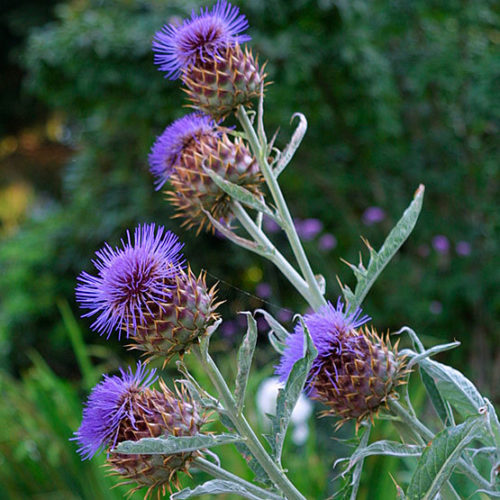
Cynara cardunculus (Cardoon)

Cynara cardunculus Photo/Illustration: Steve Aitken


Be the first to rate this plant

Plant Showcase - from our advertisers


Hardiness Zones: 1 2 3 4 5 6 7 8 9 10 11
Botanical Name: Cynara cardunculus sih-NAR-ah kar-DUN-kew-lus Common Name: Cardoon Genus: Cynara
Cardoon is an architectural splendor with bold texture, thanks to its large, prickly, almost dagger-shaped gray-green arching leaves and a statuesque, vase-shaped frame. It is topped with round, purple, thistlelike flowers in midsummer. Cardoon can reach up to 5 feet tall and 4 feet wide.
Noteworthy characteristics: A close cousin of the artichoke, this native to the well-drained, sunny slopes of the southwest Mediterranean can overwinter in Zone 7. Produces magnificent flowerheads that can be cut and dried for arrangements. Edible leaf stalks and midribs are tasty when blanched. Unopened flowerheads can be eaten like artichokes.
Care: Plant in a sheltered location in full sun with fertile, well-drained soil.
Propagation: From seed, if planted early enough, it will flower the first year. Divide in spring or insert root cuttings in winter.
Problems: Gray mold, root rot, slugs, and aphids can cause damage.
Height 3 ft. to 6 ft.
Spread 1 ft. to 3 ft.
Light Full Sun Only
Moisture Dry
Maintenance Moderate
Characteristics Showy Flowers; Showy Foliage
Bloom Time Early Fall; Early Summer; Fall; Late Summer; Summer
Flower Color Purple/ Lavender Flower
Uses Beds and Borders, Container, Cut Flower, Dried Flower, Specimen Plant/ Focal Point, Suitable as Annual
Style Cottage Garden
Seasonal Interest Spring Interest, Summer Interest, Fall Interest
Type Perennials

Plants you might also like

Salvia 'Indigo Spires' Salvia 'Indigo Spires'
('Indigo Spires' sage)
Be the first to rate this plant
Hardiness Zones: 1 2 3 4 5 6 7 8 9 10 11

'Indigo Spires' sage is a vigorous hybrid prized for its 12- to 15-inch-long, twisting spikes of dark violet flowers. It is a non-stop bloomer from early summer through fall. Blooming can be further encouraged by pinching stem tips early in the growing season and deadheading the spikes once they fade. 'Indigo Spires' quickly grows to 4 feet high, and can be grown as an annual where not hardy.  

Salvia officinalis 'Purpurascens' Salvia officinalis 'Purpurascens'
(Common sage, Culinary sage, Purple sage)
Be the first to rate this plant
Hardiness Zones: 1 2 3 4 5 6 7 8 9 10 11

Cooks and gardeners alike are indebted to this evergreen perennial for the unique, pungent flavor and aroma that its gray-green leaves produce. This cultivar has leaves suffused with steely-gray purple. It forms a 1.5-foot-tall and wide bush with woody stems that may be trimmed back to newly emerging growth or strong stems in spring. In early to mid-summer, it sends up lavender-purple flower spikes; it has both ornamental and culinary qualities in an herb garden. It tolerates alkaline soils, but cannot survive wet winter conditions.

Achillea 'Moonshine' Achillea 'Moonshine'
(Yarrow)
(3 user reviews)
Hardiness Zones: 1 2 3 4 5 6 7 8 9 10 11

This popular gray-leaved yarrow has 18-inch-tall yellow flower heads that last for several weeks in late summer.

Echinacea purpurea ‘Bright Star’ Echinacea purpurea ‘Bright Star’
(Purple coneflower)
Be the first to rate this plant
Hardiness Zones: 1 2 3 4 5 6 7 8 9 10 11

This native meadow derivative with daisy-like flowers blooms from early summer into early autumn. 'Bright Star' has prominent, copper-orange central cones surrounded by red-purple ray petals (to 5 inches across), and grows to less than 3 feet tall.

Coreopsis rosea Coreopsis rosea
(Tickseed)
Be the first to rate this plant
Hardiness Zones: 1 2 3 4 5 6 7 8 9 10 11

This plant bears a profusion of lavender-pink flowers with yellow centers from mid-summer to early autumn. This perennial has finely textured leaves that give it an airy appearance.