previous
  • Comfortable Alfresco Dining
    Comfortable Alfresco Dining
  • Fine Gardening's Tip Off!
    Fine Gardening's Tip Off!
  • Save Money by Growing Your Own
    Save Money by Growing Your Own
  • Fast-Growing Trees for Impatient Gardeners
    Fast-Growing Trees for Impatient Gardeners
  • 6 Tips for Weed Control
    6 Tips for Weed Control
  • Elephant's Ears
    Elephant's Ears
  • Slideshow: Beautiful Clematis
    Slideshow: Beautiful Clematis
  • Meet Our Mini-Magazines
    Meet Our Mini-Magazines
  • Mulch for a Healthy Garden
    Mulch for a Healthy Garden
  • Garden Confidential: A Plant Walks into a Bar
    Garden Confidential: A Plant Walks into a Bar
  • Thoughts From a Foreign Field
    Thoughts From a Foreign Field
  • Dwarf Citrus Trees
    Dwarf Citrus Trees
  • Containers as Focal Points
    Containers as Focal Points
  • Fragrant Plants for Pathways
    Fragrant Plants for Pathways
  • Indeterminate or Determinate Tomatoes?
    Indeterminate or Determinate Tomatoes?
  • Make a Succulent Topiary
    Make a Succulent Topiary
  • In Pursuit of the Perfect Potting Shed
    In Pursuit of the Perfect Potting Shed
  • Pretty in Pink
    Pretty in Pink
  • Plant an Easy-to-Water Strawberry Jar
    Plant an Easy-to-Water Strawberry Jar
  • NEW Video Series: There's a Better Way
    NEW Video Series: There's a Better Way
  • Stylish Shady Containers
    Stylish Shady Containers
  • Designing with Curved Terraces
    Designing with Curved Terraces
  • Colorful Selections for Shade
    Colorful Selections for Shade
  • Building a Compost Bin
    Building a Compost Bin
  • Homegrown / Homemade
    Homegrown / Homemade
next

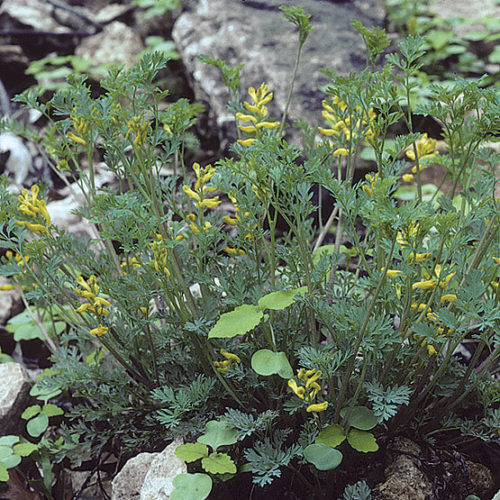
Corydalis aurea (Scrambled eggs)

Corydalis aurea Photo/Illustration: C. Colston Burrell

(Based on 1 user review)

Rate this plant

Plant Showcase - from our advertisers


Hardiness Zones: 1 2 3 4 5 6 7 8 9 10 11
Botanical Name: Corydalis aurea kor-ID-ah-liss OR-ee-ah Common Name: Scrambled eggs Genus: Corydalis
In spring, this biennial produces small yellow flowers, which are carried tightly over finely divided, sea green leaves. It self-sows freely.
Noteworthy characteristics: This species is native to North America and a number of states list it as threatened or endangered.
Care: Prefers moist but well-drained soil in partial shade.
Propagation: Sow seed when fresh for flowering the following year; germination may be erratic.
Problems: Downy mildew, rust, aphids, slugs, snails.
Height 6 in. to 12 in.
Spread 6 in. to 12 in.
Growth Habit Clumps
Growth Pace Moderate Grower
Light Full Sun to Part Shade
Moisture Medium Moisture
Maintenance Low
Characteristics Native; Self Seeds; Showy Flowers; Showy Foliage
Bloom Time Early Spring; Late Spring; Spring
Flower Color Yellow Flower
Uses Beds and Borders, Ground Covers, Naturalizing, Suitable as Annual
Style Woodland Garden
Seasonal Interest Spring Interest
Type Annuals

Plants you might also like

Centaurea cyanus Centaurea cyanus
(Bachelor's buttons, Bluebottle, Cornflower)
(1 user review)
Hardiness Zones: 1 2 3 4 5 6 7 8 9 10 11

Bachelor's buttons bear charming and prolific flowers in hues of blue, pink, lavender, white, and maroon. Those with a true blue color are especially welcome in the garden as that color is rare in nature. Each disc-shaped flower is about 1.5 inches across, with ragged petals radiating out from the center.

Viola tricolor Viola tricolor
(Heartsease, Johnny-jump-up, Love-in-idleness, Wild pansy)
(3 user reviews)
Hardiness Zones: 1 2 3 4 5 6 7 8 9 10 11

This annual, biennial, or short-lived perennial is grown for its long season of pansy flowers in shades of purple, blue, yellow, and white. Viola tricolor is pretty in containers, as edging, or as a companion for bulbs. It self-seeds readily.

Dianthus barbatus 'Summer Sundae' Dianthus barbatus 'Summer Sundae'
(Sweet William)
(1 user review)
Hardiness Zones: 1 2 3 4 5 6 7 8 9 10 11

'Summer Sundae' Sweet William is a nice mix of red, pink, and white flowers held in rounded groups at the tops of stems. Plants bloom from late spring to early summer. The flowers are lightly fragrant. Use in a cottage garden or border, or in containers. It flowers the first year from seed.

Bellis perennis Bellis perennis
(English daisy)
(1 user review)
Hardiness Zones: 1 2 3 4 5 6 7 8 9 10 11

English daisy bears stems topped with a single white, daisy-like flower. The flowers are tinged maroon and yellow; but cultivars are available with single, semi-double, or double button flowers in shades of white, pink, salmon, and ruby. The plant's smooth, spoon-shaped leaves form neat rosettes. This carpeting perennial is often grown as a biennial. Its many cultivars are used for bedding out or container displays.

Delphinium 'Bluebird' Delphinium 'Bluebird'
(3 user reviews)
Hardiness Zones: 1 2 3 4 5 6 7 8 9 10 11

'Blue Bird' is a Pacific Hybrid delphinium grown as an annual or biennial. Its mid-blue flowers have white centers. The flowers are large but short-lived and bloom on tall stems from early summer to midsummer. Grow at the back of a border or in the middle of an island bed. There is nothing quite like delphiniums in the garden.