previous
  • Fragrant Plants for Pathways
    Fragrant Plants for Pathways
  • Stylish Shady Containers
    Stylish Shady Containers
  • Pretty in Pink
    Pretty in Pink
  • Designing with Curved Terraces
    Designing with Curved Terraces
  • Fine Gardening's Tip Off!
    Fine Gardening's Tip Off!
  • Indeterminate or Determinate Tomatoes?
    Indeterminate or Determinate Tomatoes?
  • Meet Our Mini-Magazines
    Meet Our Mini-Magazines
  • Garden Confidential: A Plant Walks into a Bar
    Garden Confidential: A Plant Walks into a Bar
  • Mulch for a Healthy Garden
    Mulch for a Healthy Garden
  • Plant an Easy-to-Water Strawberry Jar
    Plant an Easy-to-Water Strawberry Jar
  • 6 Tips for Weed Control
    6 Tips for Weed Control
  • Slideshow: Beautiful Clematis
    Slideshow: Beautiful Clematis
  • Colorful Selections for Shade
    Colorful Selections for Shade
  • Homegrown / Homemade
    Homegrown / Homemade
  • Fast-Growing Trees for Impatient Gardeners
    Fast-Growing Trees for Impatient Gardeners
  • Containers as Focal Points
    Containers as Focal Points
  • Make a Succulent Topiary
    Make a Succulent Topiary
  • Dwarf Citrus Trees
    Dwarf Citrus Trees
  • In Pursuit of the Perfect Potting Shed
    In Pursuit of the Perfect Potting Shed
  • Thoughts From a Foreign Field
    Thoughts From a Foreign Field
  • Building a Compost Bin
    Building a Compost Bin
  • Elephant's Ears
    Elephant's Ears
  • Save Money by Growing Your Own
    Save Money by Growing Your Own
  • NEW Video Series: There's a Better Way
    NEW Video Series: There's a Better Way
  • Comfortable Alfresco Dining
    Comfortable Alfresco Dining
next

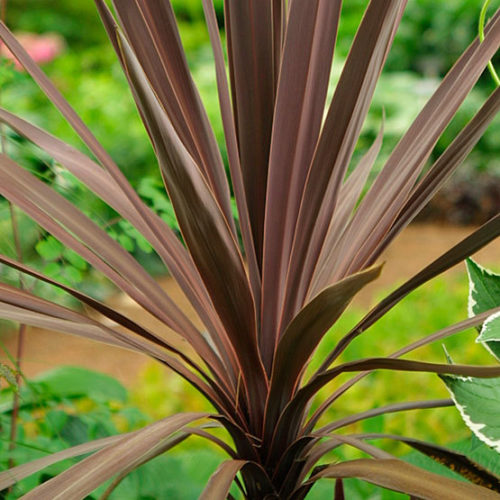
Cordyline australis 'Purple Tower' (Giant dracaena, New Zealand cabbage palm)

Cordyline australis 'Purple Tower' Photo/Illustration: Michelle Gervais

(Based on 1 user review)

Rate this plant

Plant Showcase - from our advertisers


Hardiness Zones: 1 2 3 4 5 6 7 8 9 10 11
Botanical Name: Cordyline australis 'Purple Tower' kor-dih-LYE-nee oss-TRAL-iss Common Name: Giant dracaena, New Zealand cabbage palm Synonyms: Dracaena australis Genus: Cordyline
'Purple Tower' is a cultivar of the New Zealand native cabbage tree, frequently grown in greenhouses, as houseplants, or as large accent plants outdoors. It is hardy to Zone 10. The narrow, plum-purple leaves reach 3 feet long. The fragrant white flowers are small, but they are borne in large panicles in spring and early summer on mature plants. Plants grown in containers only rarely flower, however. Young plants are often sold as houseplants. Mature specimens have thick trunks with foliage at the top, resembling a palm tree. They are striking container specimens and can be plugged into a summer border. The species has naturalized in portions of California and the southern U.S.
Noteworthy characteristics: Long, narrow foliage in an unusual purple color. Great accent plant.
Care: Needs well-drained, fertile soil in full sun or partial shade. If grown indoors, provide bright filtered or indirect light and moderate water during the growing season.
Propagation: Sow seed at 61°F in spring. Remove well-rooted suckers in spring.
Problems: Scale insects, spider mites, and mealybugs are common, while bacterial and fungal spots, bacterial soft rot, and root rot can occur.
Height 15 ft. to 30 ft.
Spread 6 ft. to 10 ft.
Growth Habit Clumps
Growth Pace Moderate Grower
Light Full Sun to Part Shade
Moisture Medium Moisture
Maintenance Moderate
Characteristics Showy Flowers; Showy Foliage; Showy Fruit
Bloom Time Summer
Foliage Color Colorful/Burgundy Foliage
Flower Color White Flower
Uses Beds and Borders, Indoor Plant, Specimen Plant/ Focal Point
Seasonal Interest Summer Interest
Type Trees

Plants you might also like

Eucalyptus neglecta Eucalyptus neglecta
(Omeo gum, Omeo round-leaved gum)
Be the first to rate this plant
Hardiness Zones: 1 2 3 4 5 6 7 8 9 10 11

This is a very hardy, strongly aromatic eucalyptus with large leaves and white flowers. It makes a good specimen.

Psoralea pinnata Psoralea pinnata
(African scurf pea, Blue pea)
(1 user review)
Hardiness Zones: 1 2 3 4 5 6 7 8 9 10 11

This short-lived shrub or small tree with feathery foliage is blanketed in late spring with fragrant, pea-shaped violet blooms with white wings. Though it is native to streamsides, scurf pea doesn't require extravagant watering and survives occasional drought. When the plants eventually die, they leave ample progeny and straight branches useful for garden stakes. Combine with azaleas and camellias, which bloom at the same time.

Wollemia nobilis Wollemia nobilis
(Wollemi pine)
(1 user review)
Hardiness Zones: 1 2 3 4 5 6 7 8 9 10 11

Long thought extinct, the wollemi pine was discovered in 1994 in a remote section of Australia. With only a small grove in existence, a plan was developed to save the tree from extinction by propagating it and selling its offspring. Trials in the U.S. have placed the wollemi pine in Zones 7 to 11. Grow it in full sun. Because this tree has been around since the time of the dinosaurs, it's safe to say it is long-lived. And apparently brontosaurus browsing isn't a problem.

Hamelia patens Hamelia patens
(Mexican fire bush, Scarlet bush, Firecracker shrub)
(1 user review)
Hardiness Zones: 1 2 3 4 5 6 7 8 9 10 11

A tropical tree by design, the Mexican fire bush freezes to the ground in winter in Zones 8-11, but grows up to 5 feet tall by summer's end. The erect, branched, woody stems bear simple copper-toned leaves with small orange flowers bunched along the tips. It loves the heat, and the more you can give it, the more vigorous it will be.

Hakea laurina Hakea laurina
(Pincushion hakea)
Be the first to rate this plant
Hardiness Zones: 1 2 3 4 5 6 7 8 9 10 11

Through the fall and into winter, pincushion hakea provides beautiful cut flowers for the holidays; the foliage and seedpods are also great for arrangements. You can prune it into a bushy shape or a slender, small tree. As a member of the Protea family, pincushion hakea does not like phosphorus fertilizer, and like most Australian plants, it prefers to be well mulched so that its specialized roots can extract nutrients from the mulch layer.