Colocasia esculenta 'Black Magic' (Elephant ear, Cocoyam, Dasheen, Taro)

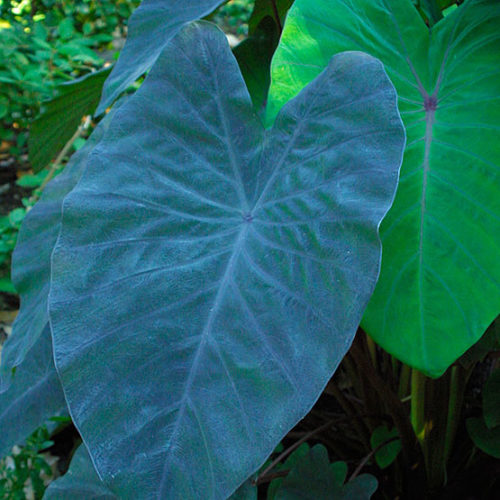
Colocasia esculenta 'Black Magic' Photo/Illustration: Jennifer Benner


Be the first to rate this plant

Plant Showcase - from our advertisers


Hardiness Zones: 1 2 3 4 5 6 7 8 9 10 11
Botanical Name: Colocasia esculenta 'Black Magic' kol-oh-KAY-shah ess-kew-LEN-tah Common Name: Elephant ear, Cocoyam, Dasheen, Taro Synonyms: C. antiquorum, 'Jet Black' Genus: Colocasia
Rising to about 36 inches, the elephant ear's deep-purple stalks suspend luxurious leaves of the same color. When the leaves’ undersides are dusted with chalky-looking bloom, they have an intriguing, almost gray look. This plant does well in a bog or even in the margins of a water garden, as well as in average garden soil.
Noteworthy characteristics: Dark purple, almost black, heart-shaped leaves. Loves wet conditions.
Care: Elephant’s ears are generally not hardy anywhere colder than Zone 9, so treat them like other summer-blooming bulbs. Let frost kill the top growth, then dig up the bulbs and dry them in open shade. Soon they look shriveled, and any clinging soil dries up and falls off with the roots. Hang them in well-ventilated sacks in a dry, cool (about 50°F) place.When spring arrives, plant the bulbs in 1- or 2-gallon pots and put them in a greenhouse to give them an early start. Position them so that any remnants of last year’s stem rise above soil level. Since the bulbs have no roots at this point, water them once, and don’t douse them again until leaves emerge. Grow in a warm greenhouse or outdoors at a pool margin, in a moist border, or in large aquatic containers.
Propagation: Divide in winter or early spring.
Problems: Soft rot, bacterial blight, corm and root rot, and dasheen mosaic virus are common. Aphids, whiteflies, and spider mites occur.
Height 3 ft. to 6 ft.
Growth Habit Clumps
Growth Pace Invasive/Aggressive Grower;Moderate Grower
Light Part Shade Only
Moisture Medium to Wet
Maintenance Moderate
Characteristics Showy Foliage
Foliage Color Black
Uses , Beds and Borders, Container, Indoor Plant, Suitable as Annual
Style , Water Garden
Seasonal Interest , Summer Interest
Type ,Perennials

Plants you might also like

Alocasia micholitziana 'Frydek' Alocasia micholitziana 'Frydek'
(Elephant's ear)
(3 user reviews)
Hardiness Zones: 1 2 3 4 5 6 7 8 9 10 11

Satiny deep green to black leaves and glowing white veins on 18-inch-long leaves make this elephant's ear great in containers, in a shady border, at the edge of a pond, or as a houseplant. It also has pale stalks with purplish banding. 'Frydek' is very tolerant of a range of soil pH, heat, humidity, and heavy soil. It can even take about a half day of sunlight.

Canna 'Pretoria' Canna 'Pretoria'
(1 user review)
Hardiness Zones: 1 2 3 4 5 6 7 8 9 10 11

'Pretoria' is perhaps the showiest of all of the variegated cannas and one of the best for hot, humid, sunny southern gardens. Favored for its bright green and yellow variegated foliage and deep tangerine flowers, 'Pretoria' will grow at the edge of ponds in shallow water as well as in normal garden conditions. It is adaptable to heat and humidity. Protect in the northern part of its range, or lift tubers in fall where not hardy and store over winter.

Canna 'Centenaire de Rozain-Bourcharlat' Canna 'Centenaire de Rozain-Bourcharlat'
(Indian shot)
Be the first to rate this plant
Hardiness Zones: 1 2 3 4 5 6 7 8 9 10 11

This 3-foot-tall canna from the 1920s has impossibly deep, pure-rose flowers recalling orchids and leis. It's an old French variety.

Canna 'Madame Paul Caseneuve' Canna 'Madame Paul Caseneuve'
Be the first to rate this plant
Hardiness Zones: 1 2 3 4 5 6 7 8 9 10 11

A great canna to start with if you're convinced you hate them is 'Madame Paul Caseneuve', from 1902. The pearly-bronze leaves and almost purple stems of this 3- to 5-foot-tall antique beauty are the perfect foil for its elegant, sensual flowers of soft pink shading to peach and apricot.

Canna 'Sémaphore' Canna 'Sémaphore'
Be the first to rate this plant
Hardiness Zones: 1 2 3 4 5 6 7 8 9 10 11

Growing to 6 or 7 feet, 'Sémaphore' features slender, dark-bronze leaves topped by spikes of narrow-petaled flowers of an unusual glowing color that's not quite yellow and not quite orange; perhaps flickering tongues of flame would be the best description. It is a Victorian classic from 1895.