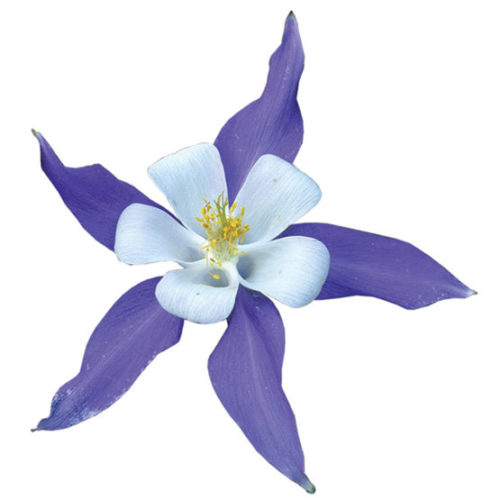
Aquilegia caerulea (Rocky Mountain columbine)

Aquilegia caerulea Photo/Illustration: Jerry Pavia


Be the first to rate this plant

Plant Showcase - from our advertisers


Hardiness Zones: 1 2 3 4 5 6 7 8 9 10 11
Botanical Name: Aquilegia caerulea ak-will-EE-zsah sir-EW-lee-ah Common Name: Rocky Mountain columbine Genus: Aquilegia
Rocky Mountain columbine is a beautiful, hearty, native perennial with blue and white flowers. It self-sows readily.
Noteworthy characteristics: Native from Montana to Arizona and New Mexico.
Care: Provide full sun to partial shade and fertile, moist, well-drained soil.
Propagation: Starting with fresh seed, sow indoors in winter for spring germination.
Problems: Powdery mildew, rust, aphids, leaf miners, caterpillars.
Height 1 ft. to 3 ft.
Spread 1 ft. to 3 ft.
Growth Habit Clumps
Light Full Sun to Part Shade
Moisture Medium Moisture
Maintenance Low
Characteristics Attracts Hummingbirds; Native; Self Seeds; Showy Flowers
Bloom Time Early Summer; Late Spring; Spring
Flower Color Blue Flower; White Flower
Uses , Beds and Borders, Naturalizing
Style , Cottage Garden, Rock Garden
Seasonal Interest , Spring Interest
Type ,Perennials

Plants you might also like

Aquilegia chrysantha Aquilegia chrysantha
(Golden columbine, Yellow columbine)
Be the first to rate this plant
Hardiness Zones: 1 2 3 4 5 6 7 8 9 10 11

A. chrysantha is a vigorous grower that will add a real burst of color to any southern garden. This southwestern U.S. native has 3-inch yellow flowers in spring and reaches almost 3 feet tall.

Digitalis obscura Digitalis obscura
(Sunset foxglove, Willow-leaved foxglove)
Be the first to rate this plant
Hardiness Zones: 1 2 3 4 5 6 7 8 9 10 11

This foxglove has long-lasting flowers in seductive shades of burnt umber. Its glossy, linear leaves are evergreen in mild climates, but turn brown in colder climates.

Penstemon digitalis 'Husker Red' Penstemon digitalis 'Husker Red'
Be the first to rate this plant
Hardiness Zones: 1 2 3 4 5 6 7 8 9 10 11

'Husker Red' is one of the few penstemons that does well in wet winters and hot, humid summers. Ruby-toned leaves appear in spring, followed in late spring and early summer by 3-foot-high stems adorned by panicles of white blooms.  The flowers attract bees, hummingbirds, and butterflies, but the plants are not magnets for deer or rabbits. In autumn and winter, songbirds feast on the seed. For a stunning display, plant 'Husker Red' in groups.

Dicentra eximia ‘Alba’ Dicentra eximia ‘Alba’
(Fringed bleeding heart, Turkey corn)
(1 user review)
Hardiness Zones: 1 2 3 4 5 6 7 8 9 10 11

Rows of white flowers dangle above the fern-like foliage, opening in April and continuing intermittently until October.

Corydalis lutea Corydalis lutea
(Yellow corydalis)
(3 user reviews)
Hardiness Zones: 1 2 3 4 5 6 7 8 9 10 11

This species has bluntly spurred golden yellow flowers from late spring to early fall. Its pale green, glaucous leaves form compact, ferny mounds.