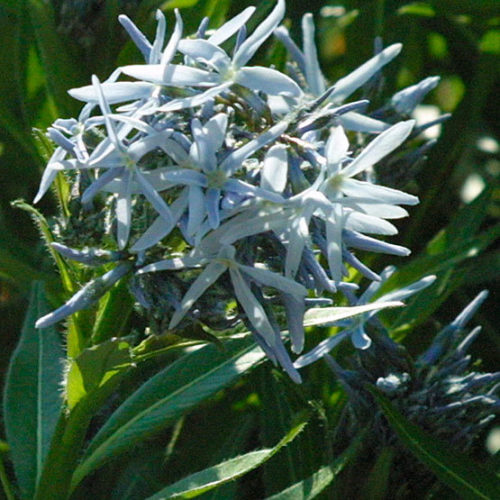
Amsonia tabernaemontana (Willow blue-star)

Amsonia tabernaemontana Photo/Illustration: Michelle Gervais


Be the first to rate this plant

Hardiness Zones: 1 2 3 4 5 6 7 8 9 10 11
Botanical Name: Amsonia tabernaemontana am-SO-nee-ah tab-er-nay-mon-TAN-ah Common Name: Willow blue-star Genus: Amsonia
In addition to willow blue-star’s small but charming clusters of blue flowers in late spring, it has upright, willow-like leaves that turn clear yellow in fall.
Noteworthy characteristics: Will grow to 3 feet in a moist bed and only 2 feet in a sunnier dry bed.
Care: Grow in full sun to light shade and average soil. Moister soil will result in a taller plant, but this Amsonia can take drier soil as well.
Propagation: Sow seeds in containers in spring or autumn. Divide in spring. Root softwood cuttings in early summer.
Problems: Rust
Height 1 ft. to 3 ft.
Spread 1 ft. to 3 ft.
Growth Habit Clumps
Light Full Sun to Part Shade
Moisture Dry to Medium
Maintenance Low
Bloom Time Early Spring; Spring
Flower Color Blue Flower; White Flower
Uses Beds and Borders
Style Meadow Garden, Rock Garden
Seasonal Interest Spring Interest, Summer Interest, Fall Interest
Type Perennials

Plants you might also like

Achillea millefolium

Achillea millefolium


(Yarrow)
(2 user reviews)
Hardiness Zones: 1 2 3 4 5 6 7 8 9 10 11

This rhizomic, mat-forming and aggressive perennial frows to 2 feet tall and wide with ferny, finely-textured, green foliage. Flowers are produced in flat corymbs in early to late summer.

Clematis integrifolia Mongolian Bells™ Clematis integrifolia Mongolian Bells™
Be the first to rate this plant
Hardiness Zones: 1 2 3 4 5 6 7 8 9 10 11

Clematis integrifolia is no longer only blue. This selection produces progeny with pink, white, and lavender blooms from midspring until late summer. The flowers are followed by attractive seed heads in fall. It has a compact, herbaceous form and grows to just 10 to 14 inches tall.

Corydalis lutea Corydalis lutea
(Yellow corydalis)
(2 user reviews)
Hardiness Zones: 1 2 3 4 5 6 7 8 9 10 11

This species has bluntly spurred golden yellow flowers from late spring to early fall. Its pale green, glaucous leaves form compact, ferny mounds.

Solidago nemoralis Solidago nemoralis
(Goldenrod, Gray goldenrod)
Be the first to rate this plant
Hardiness Zones: 1 2 3 4 5 6 7 8 9 10 11

This is one of the smallest species of goldenrod, topping out at only 4 to 6 inches high in poor soils, and 2 feet high in fertile soils. It is considered a garden-worthy species, with gray-green leaves that form clumps and languid, one-sided yellow plumes. It is tolerant of both sandy and clay soils.

Solidago flexicaulis Solidago flexicaulis
(Goldenrod, Zigzag goldenrod)
Be the first to rate this plant
Hardiness Zones: 1 2 3 4 5 6 7 8 9 10 11

This species is aptly named for its distinctive crooked stems that bend back and forth at 45° angles between nodes. It bears starry, medium-yellow flowers atop 1- to 3-foot tall stems.