
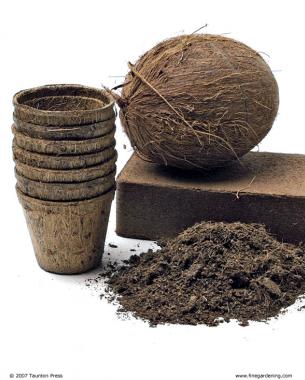
Enlightened gardeners may be noticing something new in their potting media: a dark brown, fibrous material that has the look and feel of peat. The material is coir (pronounced “core”) dust. Like peat, it can be used as an organic component in potting media, or alone to amend garden soil or propagate plants.
So why would you choose one material over the other? One reason may have to do with your definition of a renewable resource. Peat comes from decomposed plant remains that have accumulated in waterlogged soils for thousands of years, and some people worry about diminishing peat bogs. Coir comes from a resource that many people consider more sustainable: coconuts.
The difference between peat and coir doesn’t end there. While peat tends to be acidic, coir leans toward a near-ideal pH, depending on the source. Some people also find that coir is easier to work with than peat. Coir retains more water than peat, making it a wise choice for many containers and hanging baskets. But the potential for high levels of soluble salts to accumulate is greater with coir-based than with peat-based soils. To eliminate any cause for concern, be sure to buy coir products from a reputable company.
Coir has been used for a decade in the United States by the commercial greenhouse industry and even longer by growers in the world’s tropical, palm-rich regions where it is produced, including Sri Lanka, Philippines, Mexico, and India.
Gardeners for years have lined their hanging baskets with long-fiber coir, and coir fibers are used to make common household items such as rope, doormats, and upholstery stuffing. Coir fibers are generated when the coconut husk is ground. Coir dust is the by-product of this process. Some of you probably have used chunks of coir dust to grow orchids, ferns, anthuriums, bromeliads, and other tropical plants.
Nutrient and pH differences
In substituting coir for peat—whether using it alone as a garden soil amendment or in the potting mixes you make—be alert to possible differences in results. Coir is rich in potassium (K) and the micronutrients iron (Fe), manganese (Mn), zinc (Zn), and copper (Cu). The high potassium content means that a gardener could use a fertilizer that’s lower in potassium and still get good results. The other nutrients are a bonus—just like adding a vitamin pill to our daily diets. Because the pH of coir (5.5 to 6.8) is more neutral than that of peat (3.6 to 4.5), some gardeners may find that coir does not work as well for acid-loving plants, such as azaleas and blueberries.
Most gardeners are familiar with the challenge of wetting dry peat; coir is praised for being easier to rewet from a dry state. Overall, coir is a wonderful amendment if you want to improve the water retention of your hanging basket or container. Coir can absorb water at a rate of about seven times its dry weight. This is almost 30 percent more water than peat can hold.
While coir may not replace peat, it is nice to have a more easily renewable option. The positive qualities of this coconut by-product make it a natural fit in many garden applications.
The dos and don’ts of using coir
Do
* soak a compressed brick, block, or bale in water for at least 15 minutes before using.
* make sure the soaking container is big enough; coir will expand five to seven times in volume. For a brick, which yields about 1/3 cubic foot of coir dust, a drywall bucket will do. For a bale (about 2 1/2 cubic feet), use a child’s small swimming pool or an outdoor garbage can.
* add coir to garden soil as an amendment, or use it as an ingredient in potting mixes. Like peat, it can account for up to 40 percent of the potting mix.
Don’t
* use bricks that fail to absorb water readily and expand.
* try to slice a brick in half. Even a chain saw won’t cut it.
* toss out any unused coir. It retains its properties and can be stored—covered— for several years.


Comments
"Coir can absorb water at a rate of about seven times its dry weight. This is almost 30 percent more water than peat can hold." Am I missing something here?(a misplaced sentence?) If not, then to correct..."Rate" is how fast (yes it can absorb water ~30% faster than Peat, only when dry)...but, Peat can "Hold" more than twice the "Amount" of water Coir can. =D And about the pH (reason why I'm here)...every one has a dif opinion on pH? Any sites with facts? Or are every ones dif values round about (ballpark) figures?
Probably should have said expands 7 times when an amount of water is added.
If your 'chain saw' won't cut a brick of coir you need to sharpen the darn thing... I regularly cut coir bricks with a common hand saw just fine, but it makes a dusty mess... Another option is to simply find take a screw driver and turn the brick until you find the side that is the cross section of the layering, with a hammer and the screw driver you can get it to crack and flake off pretty easy... Or just toss it in a 5 gallon bucket and dump in some distilled water, take what you need and let the rest dry back out...
If I want to use Coir to improve the water holding properties of the sandy soil in my vegie patch, how much should I add per square foot of garden?
We are a leading Coir Company in India manufacturing and exporting coir products all over the world
Log in or create an account to post a comment.
Sign up Log in