
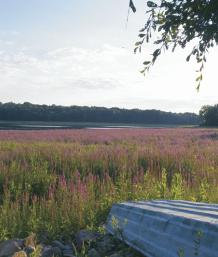
My friend Nancy was enchanted with a volunteer plant sporting magenta spikes and a regal bearing that made a surprise but welcome appearance last summer on the bank of the stream that meanders through her yard. I told her that it was good she liked this plant, purple loosestrife, because next year she’d probably have a lot more.
Because its rampant growth threatens wildlife and wetlands throughout the country, purple loosestrife (Lythrum salicaria) has been labeled as one of the least wanted plants by the Nature Conservancy and many other environmental watchdog groups. And it’s not the only invasive plant causing problems.
Privet (Ligustrum japonica) is a good hedging plant, but it has displaced the native shrub layer in 2.4 million acres of land in five southern states. Where there isn’t a shrub layer, it’s creating one. Scotch broom (Cytisus scoparius) has covered over 1 million acres in Oregon’s Willamette Valley and the prairies of Washington, leaving native evergreen seedlings no place to grow. The elk in Montana’s Missoula and Bitterroot Valleys are threatened by the spotted knapweed (Centaurea maculosa) because it chokes out the plants they eat. It now covers over 7.2 million acres in nine states and two Canadian provinces. And if you plucked all the tamarisk (Tamarix spp.) from the riverbanks of the Southwest, you could replant an area twice the size of Rhode Island.
A list of plants to avoid appears at the end of this article.
Sterile cultivars of loosestrife may not be so
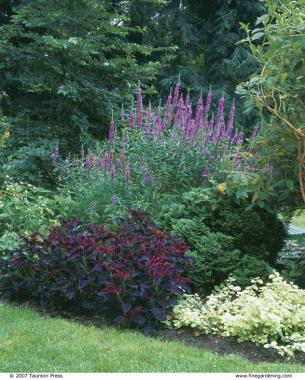
The showy purple spikes of purple loosestrife (Lythrum salicaria and L. virgatum) are attractive both in the garden and on roadsides. But their rampant spread has greatly reduced the ecological value of marshes by displacing native wetland vegetation such as cattails (Typha spp.) that waterfowl feed on and that muskrats and long-billed marsh wrens need to build their nests. And these are only a few examples of the damage that invasive plants inflict on our native landscape.
Reportedly sterile cultivars (those that do not produce viable seed) of purple loosestrife are being sold at nursery centers across the nation. However, Bernd Blossey, the director of the Biological Control of Non-Indigenous Plant Program at Cornell University explains that this claim is not valid. “Unfortunately, the claim that cultivars of purple loosestrife are sterile is totally false. Research has shown that if cultivars such as ‘Morden Pink’, ‘Morden Gleam’, and ‘Dropmore Purple’ are grown with other cultivars or wild loosestrife, the seeds are highly fertile, with more than a 90-percent germination rate. Bees carry its pollen far and wide. To label these plants as sterile and not a threat to the environment is misleading and irresponsible behavior on the part of those selling the plant.”
The fact that some gardeners have begun to think that they can grow this plant with a clear conscience has helped it stage a comeback of sorts. Blossey adds, “One mature plant can produce over 2 million seeds annually that are easily transported by the wind or water into wetlands. The seeds germinate without any special treatment, and no natural predator holds this plant in check.”
Controlling invasive plants is expensive
In 1993, an estimated $4 billion was spent to control the spread of over 1400 nonnative pest plants nationwide. Most of this was spent killing agricultural and rangeland weeds, but much of it went to fighting the 450 or so exotic pests originally brought here as ornamental garden plants from Europe, Asia, Africa, and Australia. Many of these plants are still being sold in nurseries today.
National parks and seashores devote a good part of their budgets and manpower to battling invasive plants. “The displacement of native species by invasive plants is a primary concern of anyone who manages a cultural or natural landscape,” states Kristine Johnson, a supervisory natural resource specialist at the Great Smoky Mountains National Park in Gatlinburg, Tennessee. “The competition between natives and nonnatives results in the loss of biodiversity in our natural areas, and interference with the normal patterns of succession in the forest. Rare plants that are limited by narrow habitat requirements are especially affected, as are the wildlife that depend on native plants for food and shelter.”
In ecologically fragile areas, invasive plants can compete with endangered species, cause soil erosion, create fire hazards, and negatively affect recreation, fisheries, and public water supplies.
Even the government is getting involved
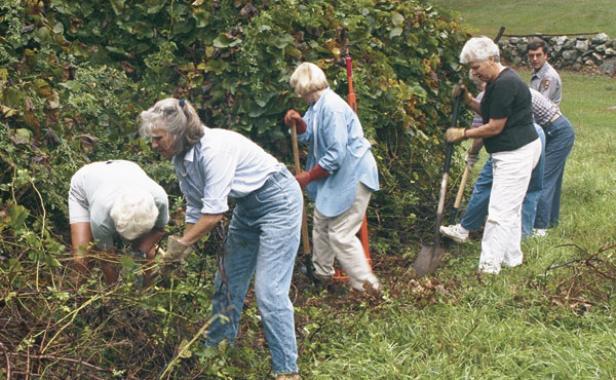
Both government agencies and private groups have responded to this assault by forming advocacy groups and passing laws aimed at limiting the sale of some plants. The most progressive laws can be found in the Pacific Northwest. According to Sarah Reichard, research assistant professor at the University of Washington in Seattle, “In our state, we have the ability to add species to our invasive plant list before they become a serious problem. If a suspect species is spotted growing unchecked in the wild, putting it on the state’s noxious weed list means that its spread must be monitored and controlled and, in most cases, banned from sale.” But Reichard, along with other experts, believes that laws alone are not enough.
Many regional groups are now working to raise public awareness about invasive plants. Brian Bowen, the cofounder of the Tennessee Exotic Pest Plant Council (TN-EPPC), works to get the message out to both public land managers and home gardeners alike. The mission of the TN-EPPC is to share the information gathered from colleagues on how best to control invasive plants. This group publishes newsletters, sponsors symposiums, and distributes brochures that promote the use of ecologically friendly plants. Bowen believes that gardeners need to understand that the realm of their garden extends past the boundaries of their own land.
In addition to Tennessee, exotic pest plant councils have been organized in California and Florida—states with unique invasive plant problems due to their climate and topography—and are under consideration in the Pacific Northwest and New England. Another nonprofit organization, The Nature Conservancy, is also playing a major role in the movement to stop the spread of invasive plants. In addition to purchasing land and maintaining nature sanctuaries, they sponsor organized plant pulls and offer educational programs.
Even the federal government is getting into the act with its Federal Interagency Committee on Managing Noxious and Exotic Weeds, which is a consortium of 16 government agencies formed to promote education and management programs related to invasive plants.
Invasive and aggressive plants are not the same
Dr. Stephen Johnson, an ecological consultant in Pella, Iowa, compares invasive plants to common weeds. “Invasive plant species have all the characteristics of what we call weeds, such as the dandelion—fast growth and the ability to reproduce lots of seeds at a young age. But the dandelion lacks one feature present in an invader—the ability to compete with and outgrow surrounding plants both above and below the ground.” He believes that this divide-and-conquer strategy is the key that allows some nonnatives to become such notorious nuisances. And because most invasives have no natural predators, they are more vigorous competitors than their native counterparts.
But just because a plant is nonnative doesn’t mean it’s invasive. Smokebush (Cotinus coggygria), rose of Sharon (Hibiscus syriacus), deutzia (Deutzia gracilis), Japanese kerria (Kerria japonica), and common camellia (Camellia japonica) are just a few of the nonnative plants that don’t exhibit the delusions of grandeur some of their compatriots do.
In fact, far more nonnative plants behave perfectly in the ornamental garden than not. Kristine Johnson notes that all the fuss over invasive plants needs to be tempered with a dose of reality. In particular, there is confusion over calling certain plants “invasive” when they are really just aggressive.
Johnson explains that plants exhibit different degrees of invasiveness, and there’s a distinct difference between an aggressive grower and a truly invasive plant. “Members of the mint family can be aggressive growers,” she says. “I have some mint now growing in my herb garden which is expanding more than I would like it to, but I certainly don’t have to worry that it will take over the adjacent forest.”
Many spreading plants such as periwinkle (Vinca minor), daylilies (Hemerocallis spp.), ribbon grass (Phalaris arundinacea), and English ivy (Hedera helix) are also aggressive growers that some may consider to be invasive plants. Aggressive plants can generally be contained by growing them in pots, using underground barriers, or by keeping a watchful eye on those planted in the garden and pulling them out when they begin to spread too far.
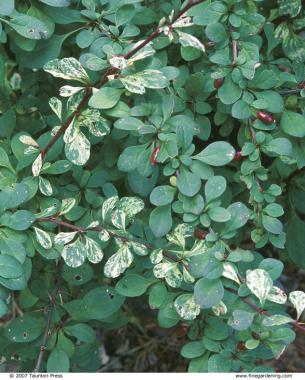
Invasive plants are not so easy to contain. In the case of Japanese barberry (Berberis thunbergii), its seeds are easily carried into remote areas by birds or animals to set up self-sustaining colonies of new plants. Its ability to spread so successfully by seed and outcompete native plants, along with its lack of natural predators—such as insects or deer— is what makes it an invasive plant.
Invasives vary by region
To complicate matters further, plants that are considered invasive in one region of the country may not pose a threat in another area. Scotch broom, which is incredibly invasive in the Pacific Northwest, grows without incident in the Northeast. Rainfall, climate, soil type, and other cultural conditions all play a role in determining whether or not a plant will display invasive tendencies.
“Invasive plants grow abundantly well in conditions that mimic their native environments,” says John Randall, an ecologist at the Nature Conservancy. The Australian paperbark tree (Melaleuca quinquenervia)—a plant that thrives in tropical climates—has invaded thousands of acres in Florida but is not a problem throughout most of the United States.
Plant locally, think globally
Gardeners are urged to avoid using the following plants in their gardens because of their regionally invasive tendencies. If you choose to grow one of the plants listed that is not considered to be invasive in your region, do so with caution, and monitor its growth, seed development, and seed dispersal just to be on the safe side.
Key
E = East
NE = Northeast
SE = Southeast
MW = Midwest
W = West
NW = Northwest
ALL = Every area
SHRUBS
Japanese barberry (Berberis thunbergii) NE and MW
Butterfly bush (Buddleia davidii) SE, NW, and W
Scotch broom (Cytisus scoparius) NW
Russian olive (Elaeagnus angustifolia) W
Autumn olive (Elaeagnus umbellata) NE, SE, and MW
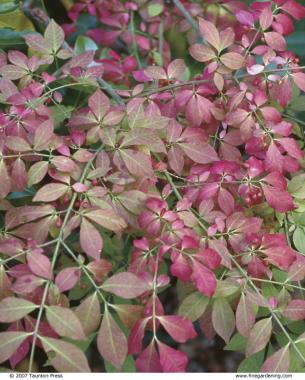
Burning bush (Euonymus alatus) NE and MW
Chinese privet (Ligustrum sinense) NE
Common privet (Ligustrum vulgare) SE
Bush honeysuckle (Lonicera maackii) E and MW
Tatarian honeysuckle (Lonicera tatarica) ALL
Multiflora rose (Rosa multiflora) NE, SE, and MW
Japanese spirea (Spiraea japonica) NE, SE, and MW
VINES
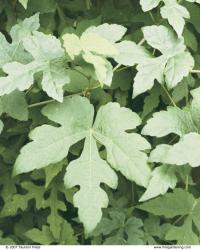
Porcelain berry (Ampelopsis brevipedunculata) NE
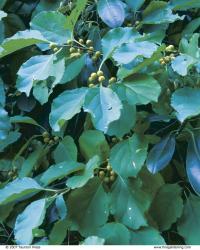
Oriental bittersweet (Celastrus orbiculatus) NE, SE, and MW
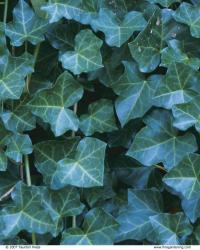
English ivy (Hedera helix) NW
Japanese honeysuckle (Lonicera japonica) NE, SE, and MW
Periwinkle (Vinca minor) ALL
Chinese wisteria (Wisteria sinensis) SE
ANNUALS, PERENNIALS, AND GRASSES
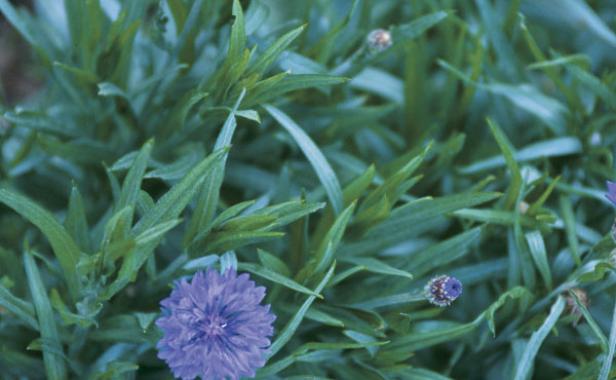
Bachelor’s buttons (Centaurea cyanus) MW
Spotted knapweed (Centaurea maculosa) MW and W
Queen Anne’s lace (Daucus carota) NE
Dame’s rocket (Hesperis matronalis) ALL
Ox-eye daisy (Leucanthemum vulgare) NE
Purple loosestrife (Lythrum salicaria and L. virgatum) ALL
Japanese silvergrass (Miscanthus sinensis) NE, SE, and MW
Fountain grass (Pennisetum setaceum) W
Ribbon grass (Phalaris arundinacea) MW
Bouncing bet (Saponaria officinalis) W
Common tansy (Tanacetum vulgare) W
Common mullein (Verbascum thapsus) ALL
TREES
Norway maple (Acer platanoides) E and NW
Tree of heaven (Ailanthus altissima) ALL
White mulberry (Morus alba) ALL
Princess tree (Paulownia tomentosa) SE
White poplar (Populus alba) ALL
Tamarisk (Tamarix ramosissima) NW and W
Siberian elm (Ulmus pumila) W
Gardeners play a key role in stopping the spread of invasive plants
Janet Marinelli, co-editor of Invasive Plants: Weeds of the Global Garden, a handbook from the Brooklyn Botanic Garden, urges gardeners to get involved. Many local garden clubs, native plant societies, and regional pest plant control groups also offer educational programs and sponsor invasive plant pulls.
As long as invasive ornamentals are still sold in garden centers, Marinelli hopes that nurserymen will adopt a system for labeling known offenders to alert unsuspecting gardeners. In the meantime, she says, “Gardeners need to find out what plants are causing problems in their region, and avoid buying and growing these plants.” She suggests speaking with plant experts at nature preserves, botanical gardens, and extension services for information on locally invasive plants.





Comments
Please add bamboo to the list! HUGE problem in the MidAtlantic and Southeast and expensive to remove
Log in or create an account to post a comment.
Sign up Log in