
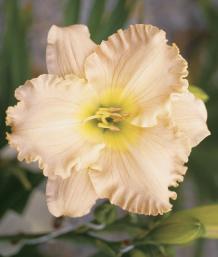
In 1990, I wrote a book about daylilies, and every year since I’ve written something about these wonderful garden perennials. So, when asked recently if I ever got tired of writing about them, the answer was a resounding “No!” Let me explain. Daylily people don’t get tired of daylilies. We are an evangelical lot, and enjoy nothing more than proclaiming the gospel.
I was an early convert to the joys of growing daylilies, having discovered their charms when I first began gardening in 1961. By chance, a daylily catalog found its way into my mailbox that spring, and I placed my first order on April 11. When the plants arrived on May 8, I was shocked to see sprawling, fleshy roots unprotected by soil and fans of foliage cut back to 8 inches. I later learned that daylilies are always shipped that way. In my old garden notebook, I observed that the new plants looked “brown and beat up.” But once planted, fresh leaves soon emerged from their crowns. By midsummer, they were all in bloom, and I was hooked.
The next spring, this confession appeared in my notebook: “I’ve gone ‘daylily mad’ and ordered 12 ‘Hyperion’, 12 ‘Sweetbriar’, and three ‘Pinafore’ to add to the collection.” I still have these three cultivars. I love my oldies. They are healthy, handsome, and vigorous, and have given me thousands of flowers over the years.
Daylilies: the basics
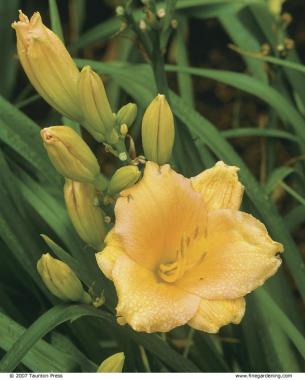
Daylilies are basically sun-lovers. They bloom admirably in six hours of sun and will make do with less, but in the North, the more sun they get, the better. In the South, though, they appreciate protection at midday and do best under a high canopy of light shade. Daylilies thrive in USDA Hardinesss Zone 4 (–30°F) and south.
While daylilies will grow in ordinary garden soil and are not fussy about pH, they perform magnificently in soils that have been generously amended with organic matter—compost, rotted leaves, or well-aged manure.
Moisture is the other key to growing really spectacular daylilies. Although their plump storage roots keep them going in times of drought and guarantee survival, an abundance of water makes all the difference to the quality and quantity of the flowers. If nature fails you, try to provide at least an inch of water a week in the North, more in the hot South. Mulching plants with shredded leaves or other light organic matter goes a long way toward ensuring moisture retention.
I have never sprayed my daylilies. They are strong plants and relatively pest and disease resistant. Some minor damage from sucking insects like aphids and thrips is almost inevitable. As it is seldom really disfiguring, and never fatal, the daylilies and I live with it.
Daylilies come in different sizes, shapes, and colors
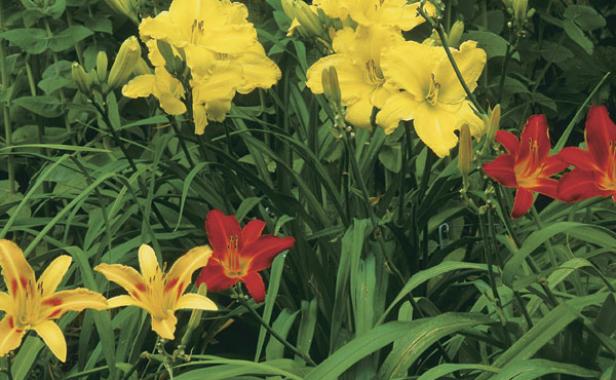
The botanical name for daylilies, Hemerocallis, is derived from two Greek words, hemera meaning “day,” and kallos, “beauty.” The plants more than live up to their botanical name: individual flowers last only one day, and they exemplify beauty in all its poignant brevity. Though each flower is short-lived, a good-sized plant can produce hundreds of blossoms over a period of several weeks. Besides their glorious blossoms, daylilies also have stout hearts and strong constitutions.
What draws people to daylilies? One answer is their diversity of color and shape. In the daylily, nature has created the quintessential hobby flower, one that hybridizers find endlessly mutable and easy to breed. The flowers themselves cooperate in this venture—their pistils and the pollen-bearing stamens extend beyond the fully opened blossom, inviting even amateurs to try their luck at creating new forms. There’s nothing to it. To make a cross, you simply pick a stamen from one daylily, and brush it across the pistil of another. No wonder there are 38,000 different, named cultivars! Their subtleties strain the garden writer’s vocabulary.
But that number is somewhat deceptive—many of those cultivars are no longer available. Even at that, a staggering 15,000 different daylilies can be found in nurseries around the country. There are daylilies for every climate. Some cultivars thrive in the heat. Others yearn for cold winters and a season of dormancy. The challenge is picking plants that will do well in your own garden.
To find great daylilies, scout a display garden near your home
Acquiring daylilies that excel in the garden is usually a hit-or-miss affair. You receive a catalog full of mouth-watering color photographs, fall for a picture, and order a plant. That’s what I did. But there is a better way.
You can visit the Web site of the American Hemerocallis Society (www.daylilies.org) and find a list of daylily display gardens in your area. Seeing daylilies in a local display garden is the only reliable way to choose the best cultivars for your region. Any cultivar growing lustily in the display garden will perform well in yours.
Assuming you locate a nearby daylily garden, go at peak bloom—late May in the Deep South to mid-July in the Northeast—armed with a little notebook and a pencil so you don’t forget which cultivars you liked best.
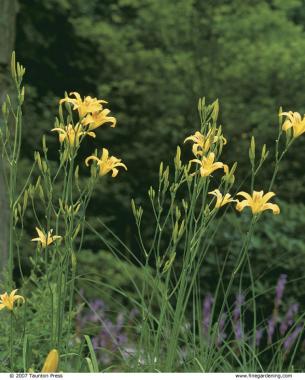
Look for well-branched plants. Begin by looking at the whole plant, not just the flower. Does the plant look vigorous, and are the leaves fresh and green? Next, look at the stems, which, in daylily parlance, are called “scapes.” The two, three, or four side branches should be held at a wide angle from the scape so that the flowers are not crowded together.
When it comes to buds, more is better. Count the buds on a single scape. Since individual flowers only last a day, you’ll need about 30 buds per scape for a long season of bloom. Bud count is critical in the Northeast, where daylilies usually bloom only once. In the South, some cultivars bloom repeatedly. In that case, fewer buds per scape would be acceptable. It’s also advantageous to select a cultivar that grows and multiplies vigorously. A robust daylily is one that at least doubles its number of fans annually. Each fan produces a flower-topped scape, so the more fans, the more flowers.
Seek petals with pizzazz. Qualities to look for in the flowers themselves are substance and sun tolerance. Substance can be defined as firmness in the actual petal tissue. A flower with good substance feels like heavy vellum. Some cultivars melt in the sun by midday. Their petals become almost transparent as the tissue breaks down, and dark reds sometimes turn black and slimy-looking in full sun. So, if possible, visit at different times of day to see how the flowers fare.
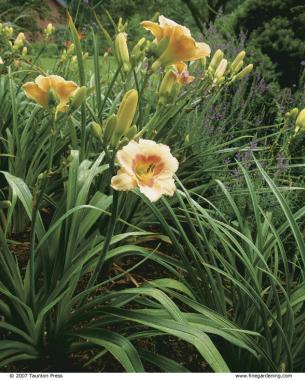
Foliage should look attractive. Now, take a closer look at the foliage. Does it add or detract from the all-over effect? Daylily foliage appears in early spring and lasts for months before the flowers bloom, so it had better earn its keep. After flowering, all daylily foliage goes through a ratty phase, but it can be cut back by half, and soon new leaves will replace the old. Finally, study the foliage-to-scape ratio. Are the flowers held well above the leaves, or are they trapped among them?
Foliage types are clues to a daylily’s hardiness. Daylily foliage is categorized by its winter behavior in these three types: dormant, evergreen, and semievergreen.
Dormant foliage dies to the ground at the onset of winter, the plants form resting buds at the crown and, in spring, send forth new leaves. On the whole, cultivars with dormant foliage are the most cold tolerant. Evergreens are the least cold tolerant—they do not form resting buds and, in warm climates, produce leaves all year. But hardy evergreens—and there are a good many of these—behave like dormants when grown in the North. In winter, their foliage dies to the ground. Daylilies with semievergreen foliage tend to retain their leaves in the South and lose them in the North.
As the breeding of daylilies has become increasingly complex, the lines of foliage type have become blurred. So has the hardiness issue. But, in general, Northern gardeners ordering from catalogs would do well to stick to dormant daylilies. Southern gardeners have a greater choice–evergreens or semievergreens. Some dormant daylilies do well in the South, but many pine for their cold requirement, dwindle, and eventually die in a too-warm climate. The only foolproof way to select the daylilies for your climate is to make your choices at a local display garden or nursery.
Tetraploids are not necessarily better garden plants. Catalogs offer first-time daylily buyers another baffling choice–diploids or tetraploids. Diploids have two sets of chromosomes in each cell nucleus, and tetraploids have four. To a hybridizer, the tetraploid’s extra genetic material increases the possibility for creating blossoms with new colors and forms. “Tets” also tend to produce larger flowers, and the substance of both flower and foliage is usually heavier. But, as a gardener, it doesn’t matter whether you grow “dips” or “tets.” In many cases, you would be hard put to tell the difference. Personal preference, not the chromosome count, should be a gardener’s guide to a good daylily.
Plant daylilies alongside delicately textured perennials
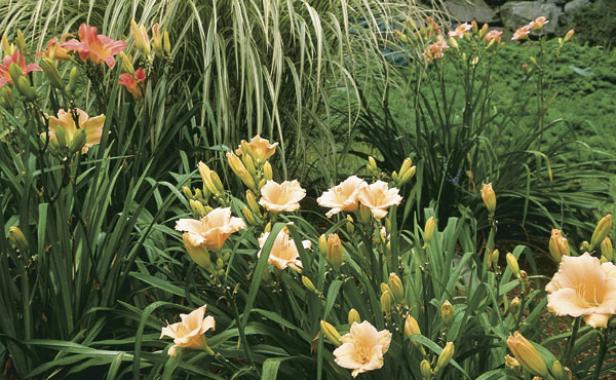
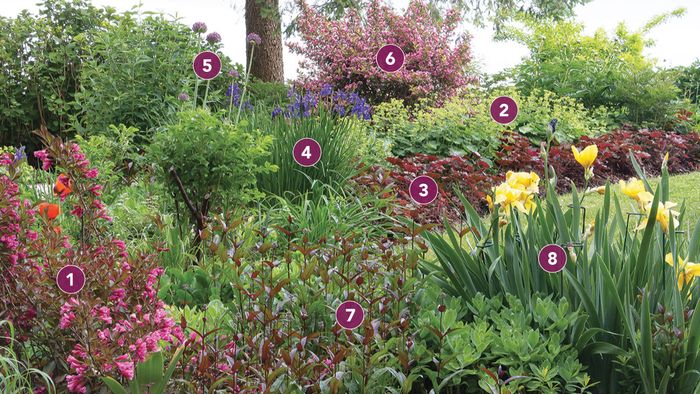
Although I am a daylily person through and through, I am also a gardener. So, once I get my daylilies home, I feel they are at their best in the company of other plants rather than planted in separate beds. They are stalwart enough to hold their own with shrubs and look lovely against a background of red-twig dogwood (Cornus alba ‘Elegantissima’), with its green-and-white-variegated leaves.
Among the most effective perennial partners are the ornamental grasses, with their delicate textures and neutral colors. Against them, the large, handsome flowers of the daylilies form bold patterns that change from day to day as new flowers open. The grasses fill the negative spaces between blossoms and weave the daylilies into the fabric of the garden as a whole.
Charming but short-lived blue flax (Linum perenne) and cultivars of Coreopsis verticillata combine well with miniature and small-flowered daylilies and perform a similar role—their fine, dense foliage fills in among the daylily clumps and also hides the yellowing outer leaves after bloom. Other fillers include bronze fennel (Foeniculum vulgare ‘Bronze Form’) or annuals like love-in-a-mist (Nigella damascena), and cupflowers (Nierembergia hippomanica).
Even W. R. Munson, Jr., the acknowledged dean of daylily hybridizers, combines his cultivars with other plants at Wimberlyway Gardens, his home in Gainesville, Florida. There, under a tall canopy of pines and sweetgums, seemingly endless daylily beds cover the level landscape like a vast, multicolored patchwork quilt. The beds are backed by hollies and azaleas, edged with liriope, and accented with evergreens.
It was my privilege to tour this garden with its creator, and to learn from the master what makes “a good garden daylily.” He should know. He has been breeding daylilies for nearly 50 years. During that time, he has contributed to dramatic changes in color and variety of forms, while maintaining vigor and stamina in the plant. When he gave me his definition of a good garden daylily, he emphasized these qualities: “It should be healthy, happy, and develop into a nice, symmetrical, rounded clump with lush foliage and numerous flowers on strong scapes.” He singled out one that met these criteria: “Look at its stem,” he said. “It’s branched and heavily budded–the flower is held above the foliage, and the flower petals are wide and overlapping. That’s my kind of daylily.” Mine, too.
An ever-evolving carnival of colors and shapes
In addition to dozens of old daylily favorites in my garden, I have an embarrassing number of newer daylilies, and a few cutting-edge cultivars with luxurious ruffling around their broad petals. All told, I must have about 300 cultivars. I grow daylilies in all colors and shapes, and in heights ranging from a diminutive 12 inches to a statuesque 5 feet, and I’m not even a serious collector. Serious daylily collectors think nothing of growing 700 or 800 cultivars, and even they cannot hope to have every kind of daylily. This is a flower of endless variety.
Daylilies come in colors ranging from sunrise yellow to sunset red
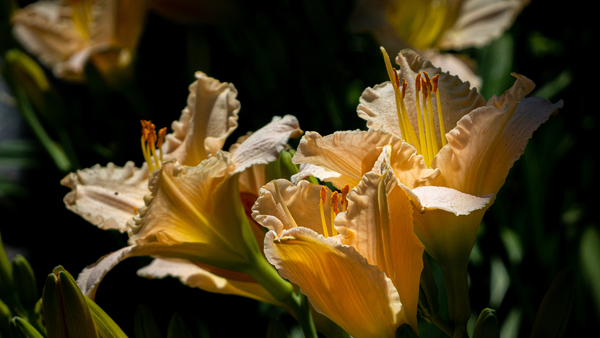
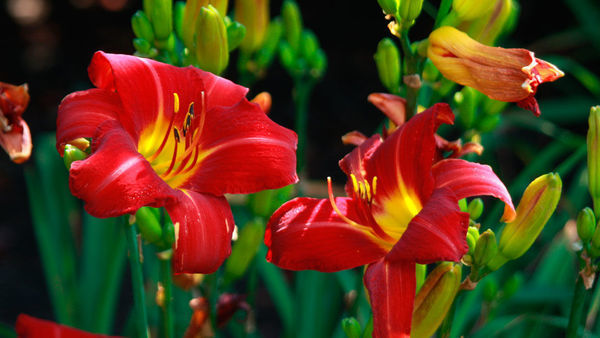
The solar spectrum boasts only six colors; daylilies offer hundreds. Suffice it to say, the original Hemerocallis palette of yellow, orange, and red has expanded dramatically, thanks to the efforts of hybridizers. Colors now include yellows from palest primrose and chartreuse on the cool side to chrome yellow and gold on the warm side. You can have oranges in Day-Glo or bronze, or in fruit flavors like apricot, tangerine, and cantaloupe. Reds run the gamut from a dark, almost black, red to pure cardinal. There are also purples, lavenders, pinks, and oh-so-close-to-whites. And this is only the beginning of the daylily’s diversity.
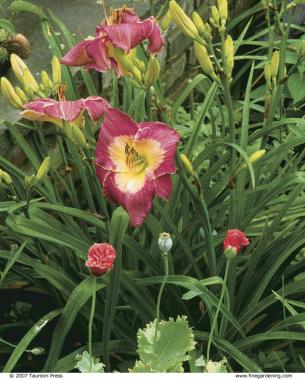
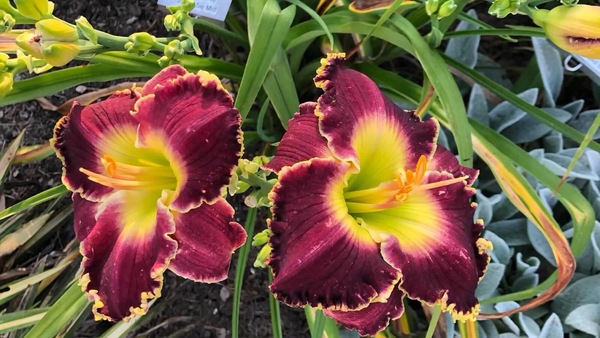
There are also different color patterns, such as a “watermark” (a pale aureole of color at the center of a darker flower), a “halo” (a faint, lightly etched contrasting or darker shade of color), and an “eye zone” (a darker or contrasting coloration on both petals and sepals at the throat of a lighter-colored flower). If it appears on the petals only, it’s a “band.” At the moment, eye zones, especially two-tone eye zones, are “in.” So are eye zones with matching petal and sepal edges. In some of the most glamorous new flowers, a base of pale beige or creamy pink sets off eye zones and edges of deep red or purple. A relatively new development in daylily ornament—a fine thread of color, usually gold, around the rim of the petals and sepals—is called a “wire edging.
Daylily blossoms are shaped like circles, spiders, or even trumpets
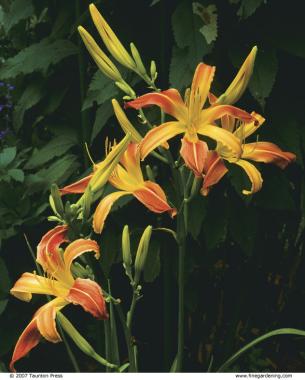
Diversity among daylilies isn’t limited to color—their forms are infinitely varied, too. As a member of the lily family, the genus Hemerocallis shares certain physical traits with true lilies (Lilium): both have flowers with three inner segments, or petals, and three outer segments, or sepals—botanically, all six are “tepals.” The arrangement and carriage of these six segments determines the flower’s form.
In many daylily blossoms, the sepals are narrower than the petals. But there are also cultivars with all six segments about the same width, and narrow-petaled “spiders” with petals at least four times as long as they are wide. Viewed head on, flowers can be either round or roughly triangular. In profile, the blossoms can be flat, trumpet-shaped, or something in between. Flower sizes run from miniature (less than 3 inches across) to large (anything over 4-1/4 inches).






Comments
I have some beautiful red daylilies in my garden spider daylilies as well
Daylily
Great articles on Daylilies double red daylilies look beautiful planted in cottage gardens!
Great article Sydney! Very comprehensive. I have a display Garden in Vancouver WA. One in Brush Prairie WA has over 100 daylilies and is a sight to see in the summer. We both welcome guests. I loved your idea of see the flowers in bloom before making your choice.
Log in or create an account to post a comment.
Sign up Log in