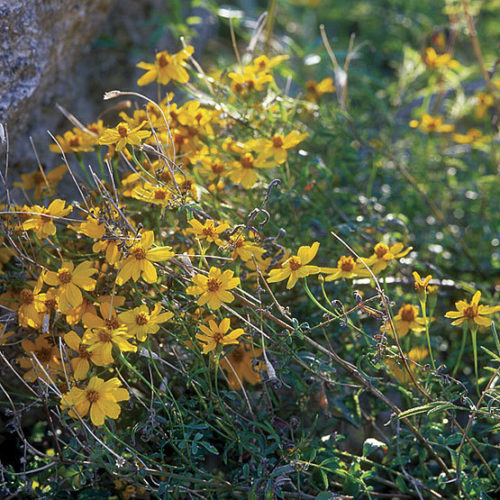
Zinnia grandiflora (Prairie zinnia)

Zinnia grandiflora Photo/Illustration: Bill Johnson


Be the first to rate this plant

Hardiness Zones: 1 2 3 4 5 6 7 8 9 10 11
Botanical Name: Zinnia grandiflora ZIN-ee-ah gran-dih-FLOOR-ah Common Name: Prairie zinnia Genus: Zinnia
This native perennial wildflower of the American Southwest bears a profusion of bright yellow to golden yellow flowers atop 4-inch high plants that spread to 15 inches wide. They bloom from late summer into fall. 
Noteworthy characteristics: This smaller flowered species is perfect for edging and naturalized areas, as well as mixed borders and cottage gardens.
Care: Provide fertile, well-drained soil in full sun with good air circulation. Plants will tolerate a variety of soils. They do not break dormancy until the heat of early summer warms the soil. Deadhead spent blossoms to continue flowering.
Propagation: Sow seed (preferably in succession for longer flowering period) where it is to grow in late spring or at 55-65°F in early spring. Divide in early summer.
Problems: Bacterial and fungal spots, bacterial wilt, powdery mildew, Southern blight, stem rots, caterpillars, mealybugs, spider mites.
Height Less than 6 in.
Spread 1 ft. to 3 ft.
Growth Habit Clumps
Growth Pace Moderate Grower
Light Full Sun Only
Moisture Dry to Medium
Maintenance Low
Tolerance Deer Tolerant;Drought Tolerant
Characteristics Attracts Birds; Attracts Butterflies; Native; Self Seeds; Showy Flowers
Bloom Time Summer
Flower Color Yellow Flower
Uses Beds and Borders, Ground Covers, Cut Flower, Naturalizing, Roadside
Style Herb Garden, Cottage Garden, Desert Garden, Meadow Garden
Seasonal Interest Summer Interest
Type Perennials

Plants you might also like

Solidago juncea Solidago juncea
(Goldenrod, Early goldenrod, Yellow top)
Be the first to rate this plant
Hardiness Zones: 1 2 3 4 5 6 7 8 9 10 11

This is the first goldenrod to bloom, featuring bright yellow, plume-like panicles in midsummer. It has dark green leaves along reddish stems, which form a vase-shaped clump when mature. 

Solidago nemoralis Solidago nemoralis
(Goldenrod, Gray goldenrod)
Be the first to rate this plant
Hardiness Zones: 1 2 3 4 5 6 7 8 9 10 11

This is one of the smallest species of goldenrod, topping out at only 4 to 6 inches high in poor soils, and 2 feet high in fertile soils. It is considered a garden-worthy species, with gray-green leaves that form clumps and languid, one-sided yellow plumes. It is tolerant of both sandy and clay soils.

Solidago flexicaulis Solidago flexicaulis
(Goldenrod, Zigzag goldenrod)
Be the first to rate this plant
Hardiness Zones: 1 2 3 4 5 6 7 8 9 10 11

This species is aptly named for its distinctive crooked stems that bend back and forth at 45° angles between nodes. It bears starry, medium-yellow flowers atop 1- to 3-foot tall stems. 

Solidago cutleri 'Goldrush' Solidago cutleri 'Goldrush'
(Goldenrod, Alpine goldenrod, Cutler's alpine goldenrod)
Be the first to rate this plant
Hardiness Zones: 1 2 3 4 5 6 7 8 9 10 11

'Goldrush' heralds the coming of fall with masses of tiny, yellow flowers for four weeks in August and September. Its compact size—about a foot tall—makes it a great candidate for a rock garden or border edge.

no image available Solidago speciosa
(Goldenrod, Showy goldenrod)
Be the first to rate this plant
Hardiness Zones: 1 2 3 4 5 6 7 8 9 10 11

This garden-worthy species has dramatic, bright yellow flowers that are arranged into erect, pointed clusters. It has deep reddish stems that grow to 3 feet tall. It blooms in late summer and early autumn.