previous
  • A Gardener's Checklist for Early Spring
    A Gardener's Checklist for Early Spring
  • Perfect Edges for Your Beds and Borders
    Perfect Edges for Your Beds and Borders
  • Garden Catalog Collector
    Garden Catalog Collector
  • Lilacs: Time for a Fresh Look
    Lilacs: Time for a Fresh Look
  • Design an Engaging Entryway
    Design an Engaging Entryway
  • Enchanting Japanese Maples
    Enchanting Japanese Maples
  • All About Starting Seeds
    All About Starting Seeds
  • Viburnums are Versatile Shrubs
    Viburnums are Versatile Shrubs
  • Backyard Makeover Game
    Backyard Makeover Game
  • The Only Shrubs You Need to Grow
    The Only Shrubs You Need to Grow
  • Soil Testing is Worth the Effort
    Soil Testing is Worth the Effort
  • How to Start a Vegetable Garden
    How to Start a Vegetable Garden
  • Video: Make a Straw-Bale Garden
    Video: Make a Straw-Bale Garden
  • Friendly Ways to Battle Garden Pests
    Friendly Ways to Battle Garden Pests
  • How to Grow Raspberries
    How to Grow Raspberries
  • Find the Perfect Tomato
    Find the Perfect Tomato
  • Make Your Own Hypertufa Container
    Make Your Own Hypertufa Container
  • 15 Deer-Resistant Plants
    15 Deer-Resistant Plants
  • Celebrate Spring with Cool-Season Containers
    Celebrate Spring with Cool-Season Containers
  • Sweetly Scented Tulips
    Sweetly Scented Tulips
  • 10 Perennials Easily Grown from Seed
    10 Perennials Easily Grown from Seed
  • Spectacular Spring Bloomers
    Spectacular Spring Bloomers
  • Variegated Plants Create Drama
    Variegated Plants Create Drama
  • Building a Compost Bin
    Building a Compost Bin
  • Cool-Season Annuals
    Cool-Season Annuals
next

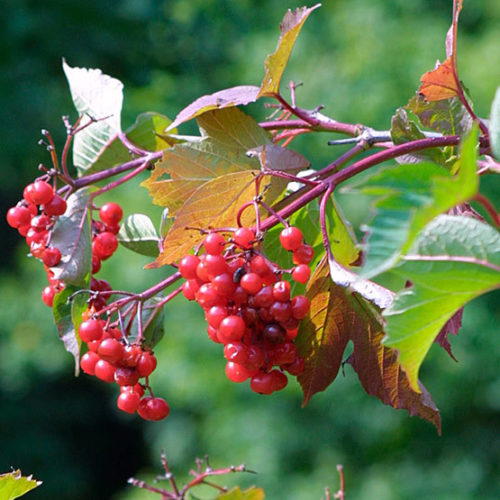
Viburnum trilobum (American cranberry bush)

Viburnum trilobum Photo/Illustration: Michelle Gervais

(Based on 4 user reviews)

Rate this plant

Plant Showcase - from our advertisers


Hardiness Zones: 1 2 3 4 5 6 7 8 9 10 11
Botanical Name: Viburnum trilobum vy-BURN-um try-LOW-bum Common Name: American cranberry bush Genus: Viburnum
This deciduous, rounded shrub grows to 15 feet tall with maple-like, lobed, dark green leaves that turn shades of red, yellow, and purple in autumn. White flowers resembling lace-cap hydrangeas bloom in spring and are followed by abundant red fruit loved by birds. Grow in a woodland garden or border, or as a wildlife plant.
Noteworthy characteristics: Foliage shaped like maple leaves. Showy flowers in late spring followed by edible, red fruit. North American native.
Care: Grow in full sun or partial shade. Tolerant of most any moderately fertile, moist but well-drained soil.
Propagation: Sow seed in autumn, in a cold frame or seedbed. Take greenwood cuttings in summer.
Problems: Insects such as aphids, scale insects, weevils, Japanese beetles, mealybugs, and treehoppers are common, while Botrytis, rust, mildews, wood rot, Verticillium wilt, leaf spots, and dieback also occur.
Height 10 ft. to 15 ft.
Spread 10 ft. to 15 ft.
Growth Pace Moderate Grower
Light Full Sun to Part Shade
Moisture Medium Moisture
Maintenance Moderate
Characteristics Attracts Birds; Native; Showy Fall Foliage; Showy Flowers; Showy Fruit
Bloom Time Late Spring; Spring
Flower Color White Flower
Uses Beds and Borders
Style Woodland Garden
Seasonal Interest Spring Interest, Summer Interest, Fall Interest
Type Shrubs

Plants you might also like

Amelanchier alnifolia 'Regent' Amelanchier alnifolia 'Regent'
('Regent' serviceberry)
Be the first to rate this plant
Hardiness Zones: 1 2 3 4 5 6 7 8 9 10 11

A compact shrub form of serviceberry, 'Regent' produces finely toothed, rounded leaves that are bluish on top and gray-green on the bottom. In fall, they change to vibrant yellow and red. Spring finds the shrub sporting white flowers in upright clusters that give way to fruit in June. Birds as well as humans appreciate the tasty berries, which make great jellies and jams and are more abundant in full sun. This plant is native to the Great Plains and tolerates harsh, dry, or alkaline conditions when mature.

Rosa rugosa var. alba Rosa rugosa var. alba
(Hedgehog rose, Ramanas rose, Japanese rose, Sea tomato)
Be the first to rate this plant
Hardiness Zones: 1 2 3 4 5 6 7 8 9 10 11

This variety has single, papery white blossoms that open from light pink buds and have contrasting yellow stamens. The heavily-scented flowers are followed by reddish-orange hips. It grows up to 6 feet high.

no image available Cornus canadensis
(Creeping dogwood, Bunchberry, Dwarf cornel)
Be the first to rate this plant
Hardiness Zones: 1 2 3 4 5 6 7 8 9 10 11

A spreading subshrub, Cornus canadensis has whorls of leathery mid-green leaves that turn purple in the winter. Green and white, sometimes pink-flushed flowers emerge in late spring and early summer, followed by clusters of scarlet berries.

Rosa 'Charles Albanel' Rosa 'Charles Albanel'
(Hedgehog rose, Ramanas rose, Japanese rose, Sea tomato)
Be the first to rate this plant
Hardiness Zones: 1 2 3 4 5 6 7 8 9 10 11

This spreading rose grows to only 2 feet tall, making it an ideal groundcover for a steep bank or roadside. It produces fragrant, double, deep-pink blossoms from spring to fall.  

Rosa 'Frau Dagmar Hastrup' Rosa 'Frau Dagmar Hastrup'
(Hedgehog rose, Ramanas rose, Japanese rose, Sea tomato)
(1 user review)
Hardiness Zones: 1 2 3 4 5 6 7 8 9 10 11

This choice rose has single, gently cupped light-pink flowers that exude an intense, clove-scented perfume. It blooms in spring and sporadically throughout the season, and produces red hips. In autumn, the foliage turns deep maroon, which changes to yellow tinged with coppery highlights. It grows to 3 to 4 feet high and wide.