previous
  • Containers as Focal Points
    Containers as Focal Points
  • NEW Video Series: There's a Better Way
    NEW Video Series: There's a Better Way
  • In Pursuit of the Perfect Potting Shed
    In Pursuit of the Perfect Potting Shed
  • 6 Tips for Weed Control
    6 Tips for Weed Control
  • Indeterminate or Determinate Tomatoes?
    Indeterminate or Determinate Tomatoes?
  • Plant an Easy-to-Water Strawberry Jar
    Plant an Easy-to-Water Strawberry Jar
  • Elephant's Ears
    Elephant's Ears
  • Make a Succulent Topiary
    Make a Succulent Topiary
  • Stylish Shady Containers
    Stylish Shady Containers
  • Slideshow: Beautiful Clematis
    Slideshow: Beautiful Clematis
  • Building a Compost Bin
    Building a Compost Bin
  • Save Money by Growing Your Own
    Save Money by Growing Your Own
  • Garden Confidential: A Plant Walks into a Bar
    Garden Confidential: A Plant Walks into a Bar
  • Thoughts From a Foreign Field
    Thoughts From a Foreign Field
  • Meet Our Mini-Magazines
    Meet Our Mini-Magazines
  • Designing with Curved Terraces
    Designing with Curved Terraces
  • Fine Gardening's Tip Off!
    Fine Gardening's Tip Off!
  • Homegrown / Homemade
    Homegrown / Homemade
  • Mulch for a Healthy Garden
    Mulch for a Healthy Garden
  • Colorful Selections for Shade
    Colorful Selections for Shade
  • Pretty in Pink
    Pretty in Pink
  • Fast-Growing Trees for Impatient Gardeners
    Fast-Growing Trees for Impatient Gardeners
  • Comfortable Alfresco Dining
    Comfortable Alfresco Dining
  • Fragrant Plants for Pathways
    Fragrant Plants for Pathways
  • Dwarf Citrus Trees
    Dwarf Citrus Trees
next

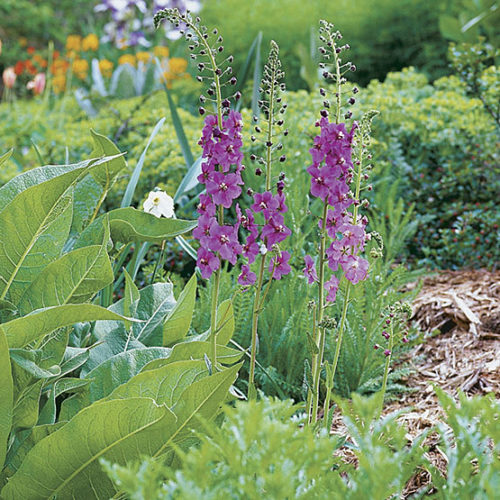
Verbascum phoeniceum (Purple mullein, Mullein)

Verbascum phoeniceum Photo/Illustration: Alain Charest


Be the first to rate this plant

Plant Showcase - from our advertisers


Hardiness Zones: 1 2 3 4 5 6 7 8 9 10 11
Botanical Name: Verbascum phoeniceum Common Name: Purple mullein, Mullein Genus: Verbascum
This biennial or short-lived perennial species is one of the earliest mulleins to bloom. Its showy blossoms of dark-purple, violet, pink, or white open along slender 3-foot spires for about two weeks in early summer. Its shiny dark green leaves are ground-hugging and evergreen. It has naturalized in some regions of the U.S.
Noteworthy characteristics: Verbascum phoeniceum is commonly found on dry, stony hillsides and open woodlands, but it is well-adapted to cottage, gravel, and rock gardens or naturalized areas. It self-sows but not as a nuisance, and many seedlings vary slightly from the parent cultivar, thus creating welcome surprises.
Care: Provide well-drained soil in full sun. Verbascums tend to flop in fertile soil.
Propagation: Sow seeds in spring in containers under a cold frame. Divide in spring.
Problems: Powdery mildew and other fungal leaf spots. Caterpillars.
Height 1 ft. to 3 ft.
Spread 1 ft. to 3 ft.
Growth Habit Clumps
Growth Pace Moderate Grower
Light Full Sun to Part Shade
Moisture Dry to Medium
Maintenance Low
Tolerance Deer Tolerant;Drought Tolerant;Frost Tolerant
Characteristics Self Seeds; Showy Flowers
Bloom Time Early Summer
Foliage Color Evergreen
Flower Color Pink Flower; Purple/ Lavender Flower; White Flower
Uses Beds and Borders, Naturalizing, Suitable as Annual
Style Cottage Garden
Seasonal Interest Spring Interest, Summer Interest
Type Perennials

Plants you might also like

Salvia officinalis 'Berggarten' Salvia officinalis 'Berggarten'
(Common sage, Culinary sage, Purple sage)
Be the first to rate this plant
Hardiness Zones: 1 2 3 4 5 6 7 8 9 10 11

Cooks and gardeners alike are indebted to this evergreen perennial for the unique, pungent flavor and aroma that its gray-green leaves produce. S. 'Berggarten' is more compact than the species, forming a 2-foot tall by 3-foot wide bush with woody stems that may be trimmed back to newly emerging growth or strong stems in spring. In early to mid-summer, it sends up purple flower spikes. It boasts attractively rounded leaves and, like the species, has both ornamental and culinary qualities in an herb garden. It tolerates alkaline soils, but not wet winter conditions.

Salvia pratensis Salvia pratensis
(Meadow clary)
Be the first to rate this plant
Hardiness Zones: 1 2 3 4 5 6 7 8 9 10 11

This woody-stemmed perennial produces sticky spikes of deep violet or, rarely, white to pink flowers. It blooms from early summer to autumn; reblooming is most reliable if spent flowers are deadheaded promptly. It has wrinkled leaves and forms an upright clump 3 feet tall by 1 foot wide. This salvia is most noted for its many hybirds with S. nemerosa.  

Salvia officinalis Salvia officinalis
(Common sage, Culinary sage, Purple sage)
Be the first to rate this plant
Hardiness Zones: 1 2 3 4 5 6 7 8 9 10 11

Cooks and gardeners alike are indebted to this classic, evergreen perennial for the unique, pungent flavor and aroma that its gray-green leaves produce. It forms a 2.5-foot-tall by 3-foot-wide bush with woody stems that may be trimmed back to newly emerging growth or strong stems in spring. In early to mid-summer, it sends up lavender-purple flower spikes; it has both ornamental and culinary qualities in an herb garden. It tolerates alkaline soils, but not wet winter conditions.

no image available Salvia nemorosa
(Sage)
Be the first to rate this plant
Hardiness Zones: 1 2 3 4 5 6 7 8 9 10 11

This drought-tolerant perennial produces flower spikes in shades of violet, purple, or white to pink, with purple bracts. It blooms from early summer to autumn; reblooming is most reliable if spent flowers are promptly deadheaded. It has wrinkled leaves and forms an erect clump 3 feet tall by 2 feet wide. This species is most noted for its many S. sylvestris hybrids.

no image available Zauschneria arizonica
(Hardy hummingbird trumpet, Arizona fuchsia, Firechalice, Wild fuchsia)
Be the first to rate this plant
Hardiness Zones: 1 2 3 4 5 6 7 8 9 10 11

This heat-loving native Southwestern species has gray-green leaves and grows to 3 feet tall and 2 feet wide. Orangey red, tubular blossoms cover the plant in late summer and early fall.