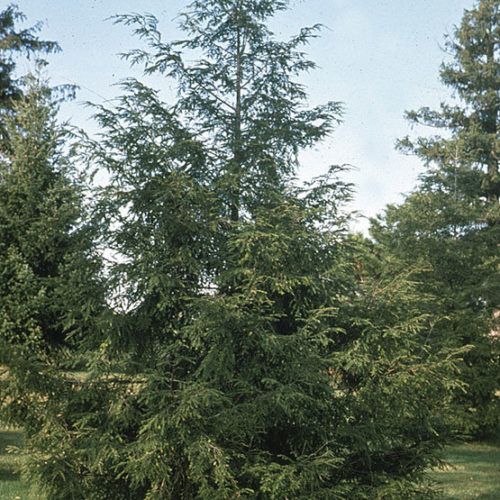
Tsuga canadensis (Canada hemlock)

Tsuga canadensis Photo/Illustration: Courtesy of Bailey Nurseries


Be the first to rate this plant

Plant Showcase - from our advertisers


Hardiness Zones: 1 2 3 4 5 6 7 8 9 10 11
Botanical Name: Tsuga canadensis SOO-gah kan-ah-DEN-sis Common Name: Canada hemlock Genus: Tsuga
This North American native grows to 70 feet tall, with a broadly pyramidal outline. It has deeply furrowed bark, small, oval cones, and slightly drooping branchlets with finely textured needles. It is suitable to a wide variety of uses, such as hedging or screening, and group or specimen plantings. It has given rise to a number of notable cultivars.
Noteworthy characteristics: Most hemlocks are native to forests of Southeastern Asia and North America. They can tolerate a considerable amount of shade, particularly when young. 
Care: Grow in moist, but well-drained (acidic to slightly alkaline) soil in full sun to full shade. Prune hedges in late summer or early fall. They are notably at risk of infestation by woolly adelgids, scale, and mites.
Propagation: Sow seed in a cold frame in spring; root semi-ripe cuttings in late summer or early fall.
Problems: Botrytis (gray mold), rust, needle blights, butt rot, snow blight, weevils, mites, aphids, woolly adelgid, scale.
Height Over 30 ft.
Spread Over 30 ft.
Growth Pace Moderate Grower
Light Part Shade to Full Shade
Moisture Medium Moisture
Maintenance Low
Tolerance Frost Tolerant
Characteristics Interesting Bark; Native; Showy Foliage; Showy Seed Heads
Foliage Color Evergreen
Uses , Beds and Borders, Hedge, Naturalizing, Screening, Specimen Plant/ Focal Point
Style , Shade, Woodland Garden
Seasonal Interest , Winter Interest, Spring Interest, Summer Interest, Fall Interest
Type ,Trees

Plants you might also like

Tsuga canadensis 'Pendula' Tsuga canadensis 'Pendula'
(Sargent's weeping hemlock, Eastern hemlock)
Be the first to rate this plant
Hardiness Zones: 1 2 3 4 5 6 7 8 9 10 11

This hemlock cultivar makes a very beautiful specimen, slowly forming a 10- to 15-foot-tall and 30-foot-wide, multi-layered mound of greenery. Its horizontally speading branches are covered with smaller weeping branches clothed in short, dark green needles. It looks great growing over a rock wall, in a rock garden, or by water. Its size may be controlled by regular clipping.

Chamaecyparis obtusa 'Aurea' Chamaecyparis obtusa 'Aurea'
(Hinoki cypress)
Be the first to rate this plant
Hardiness Zones: 1 2 3 4 5 6 7 8 9 10 11

Hinoki cypress is a conical, evergreen, coniferous tree with leaves that are actually minute scales on tiny branches in the form of fans. The outer foliage of 'Aurea' is golden and the inner is green. Growth can be slow. Use as a specimen or use several as screening.

no image available Pinus strobus 'Fastigiata'
(Eastern white pine)
Be the first to rate this plant
Hardiness Zones: 1 2 3 4 5 6 7 8 9 10 11

This robust evergreen tree has a narrowly columnar crown with ascending branches, slender gray-green leaves, and smooth gray bark. Tapered green female cones ripen to brown.

Prunus virginiana 'Schubert' Prunus virginiana 'Schubert'
('Schubert' choke cherry)
Be the first to rate this plant
Hardiness Zones: 1 2 3 4 5 6 7 8 9 10 11

'Schubert' choke cherry, with its vivid foliage and pyramidal form, makes a fine focal point. Ephemeral, light pink flowers are followed by abundant, dark red-purple fruit that birds love. (Don't plant it near patios or walks, as they'll quickly be covered by bird droppings.) If the tree you buy isn't grafted onto nonsuckering rootstock; otherwise, suckers could become problematic as the years go by.

Viburnum prunifolium Viburnum prunifolium
(Blackhaw Viburnum)
Be the first to rate this plant
Hardiness Zones: 1 2 3 4 5 6 7 8 9 10 11

Blackhaw Viburnum is a large shrub or small tree with clusters of creamy white flowers followed by pink-rose berries, which birds love to eat. Its distinctive bronze-green foliage on reddish purple stems turns blue-black in the fall. Blackhaw grows to 12 to 15 feet high and 8 to12 feet wide.