previous
  • Homegrown / Homemade
    Homegrown / Homemade
  • Plant an Easy-to-Water Strawberry Jar
    Plant an Easy-to-Water Strawberry Jar
  • Building a Compost Bin
    Building a Compost Bin
  • Stylish Shady Containers
    Stylish Shady Containers
  • Mulch for a Healthy Garden
    Mulch for a Healthy Garden
  • Dwarf Citrus Trees
    Dwarf Citrus Trees
  • Thoughts From a Foreign Field
    Thoughts From a Foreign Field
  • Save Money by Growing Your Own
    Save Money by Growing Your Own
  • Elephant's Ears
    Elephant's Ears
  • Make a Succulent Topiary
    Make a Succulent Topiary
  • Pretty in Pink
    Pretty in Pink
  • Garden Confidential: A Plant Walks into a Bar
    Garden Confidential: A Plant Walks into a Bar
  • Colorful Selections for Shade
    Colorful Selections for Shade
  • NEW Video Series: There's a Better Way
    NEW Video Series: There's a Better Way
  • In Pursuit of the Perfect Potting Shed
    In Pursuit of the Perfect Potting Shed
  • Fast-Growing Trees for Impatient Gardeners
    Fast-Growing Trees for Impatient Gardeners
  • Fragrant Plants for Pathways
    Fragrant Plants for Pathways
  • Slideshow: Beautiful Clematis
    Slideshow: Beautiful Clematis
  • Indeterminate or Determinate Tomatoes?
    Indeterminate or Determinate Tomatoes?
  • Containers as Focal Points
    Containers as Focal Points
  • Designing with Curved Terraces
    Designing with Curved Terraces
  • Lawn Alternatives
    Lawn Alternatives
  • 6 Tips for Weed Control
    6 Tips for Weed Control
  • Plants that Spark!
    Plants that Spark!
  • Comfortable Alfresco Dining
    Comfortable Alfresco Dining
next

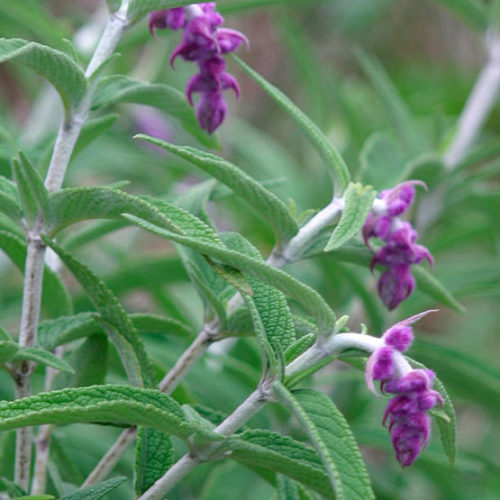
Salvia leucantha (Mexican bush sage)

Salvia leucantha Photo/Illustration: Michelle Gervais

(Based on 8 user reviews)

Rate this plant

Plant Showcase - from our advertisers


Hardiness Zones: 1 2 3 4 5 6 7 8 9 10 11
Botanical Name: Salvia leucantha SAL-vee-ah lew-KAN-thah Common Name: Mexican bush sage Genus: Salvia
This downy, bushy, evergreen subshrub produces white or purple flowers clasped by soft purple calyces from late summer to frost. It grows 3 feet tall by 3 feet wide, and is great for the border. Salvias are some of the showiest plants for containers, annual borders, and mixed borders. Butterflies and hummingbirds love them. 
Care: Provide moist but well-drained soil in full sun to partial shade.
Propagation: Sow seed, or divide plants, in spring. Take cuttings spring through fall.
Problems: Powdery mildew, rust, stem rot, fungal leaf spots, whiteflies, aphids, mealybugs, spider mites.
Height 3 ft. to 6 ft.
Spread 1 ft. to 3 ft.
Growth Habit Clumps
Growth Pace Fast Grower
Light Full Sun to Part Shade
Moisture Medium Moisture
Maintenance Low
Tolerance Drought Tolerant
Characteristics Attracts Butterflies; Attracts Hummingbirds; Showy Flowers
Bloom Time Early Fall; Fall; Late Summer; Summer
Flower Color Purple/ Lavender Flower; White Flower
Uses Beds and Borders, Cut Flower, Suitable as Annual
Style Cottage Garden
Seasonal Interest Spring Interest, Summer Interest, Fall Interest
Type Perennials

Plants you might also like

Salvia 'Indigo Spires' Salvia 'Indigo Spires'
('Indigo Spires' sage)
Be the first to rate this plant
Hardiness Zones: 1 2 3 4 5 6 7 8 9 10 11

'Indigo Spires' sage is a vigorous hybrid prized for its 12- to 15-inch-long, twisting spikes of dark violet flowers. It is a non-stop bloomer from early summer through fall. Blooming can be further encouraged by pinching stem tips early in the growing season and deadheading the spikes once they fade. 'Indigo Spires' quickly grows to 4 feet high, and can be grown as an annual where not hardy.  

Salvia microphylla var. neurepia Salvia microphylla var. neurepia
Be the first to rate this plant
Hardiness Zones: 1 2 3 4 5 6 7 8 9 10 11

This native of the American Southwest and Mexico forms an evergreen shrub or shrubby perennial with dark, glossy leaves that are small (but slightly larger than most microphyllas) and softly toothed. It blooms off and on all summer, and again, more vigorously, in late summer and autumn, in blossoms of cherry-red. Its attractive foliage cloaks the plant to the ground, so it is well suited to the front of the border. It can grow to 4 feet tall and twice as wide.

Trachelium caeruleum Trachelium caeruleum
(Blue throatwort)
Be the first to rate this plant
Hardiness Zones: 1 2 3 4 5 6 7 8 9 10 11

This species bears dome-shaped flower heads several inches across that are crowded with tiny, tubular amethyst or white flowers that look somewhat like the blooms of an allium. It has lance-shaped, toothed leaves in hues of cordovan purple or deep green brushed with plum highlights. It blooms over a long season. Though it is a perennial, blue throatwort performs wonderfully as an annual and blooms summer to fall. Plants grow to about 3 feet tall and wide.

Sedum ‘Autumn Joy’ Sedum ‘Autumn Joy’
(Stonecrop)
(13 user reviews)
Hardiness Zones: 1 2 3 4 5 6 7 8 9 10 11

This plant is as dependable and adaptable as they come. Its flowers bloom from August into November; they open pink and mature to a copper befitting of autumn. It is 2 feet tall and wide, with succulent stems and leaves. 'Autumn Joy' looks great with ornamental grasses.  

Salvia chamaedryoides Salvia chamaedryoides
(Germander sage, Mexican blue sage)
(2 user reviews)
Hardiness Zones: 1 2 3 4 5 6 7 8 9 10 11

This choice species boasts narrow, downy sage-green leaves and true sky-blue blossoms from summer to fall. It has woody stems and forms a beautiful specimen 12 inches tall by 18 inches wide.