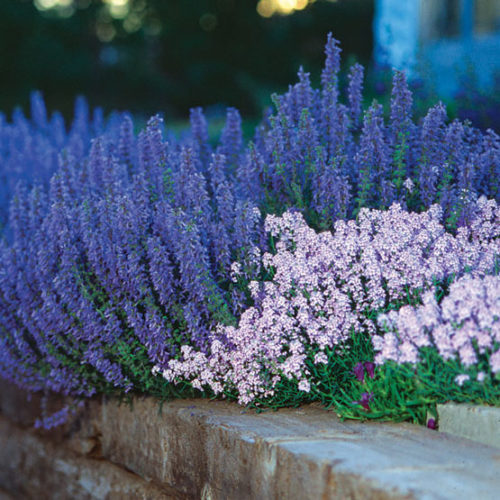
Salvia jurisicii (Yugoslavian cutleaf sage)

Salvia jurisicii Photo/Illustration: Courtesy of High Country Gardens


Be the first to rate this plant

Hardiness Zones: 1 2 3 4 5 6 7 8 9 10 11
Botanical Name: Salvia jurisicii SAL-vee-ah jur-iss-ISS-ee-eye Common Name: Yugoslavian cutleaf sage Genus: Salvia
This sage is eye-catching in and out of bloom, with its attractive basal rosette of feathery foliage and showy display of dense flower spikes. The flowers come in shades of blue, white, and light pink, but the dark blue strain (S. jurisicii 'Blue') is the most desirable. Best planted in enriched garden loam, Yugoslavian cutleaf sage blooms in late spring.
Noteworthy characteristics: This sage has feathery foliage and dense spikes of upside-down flowers.
Care: Provide full sun to light shade and almost any well-drained soil. Deadheading will encourage more blooms.
Propagation: Divide in early spring or take softwood cuttings anytime.
Problems: Infrequent, but watch for aphids, spider mites, and whiteflies.
Height 1 ft. to 3 ft.
Light Full Sun to Part Shade
Moisture Dry to Medium
Maintenance Low
Tolerance Drought Tolerant
Characteristics Attracts Butterflies; Attracts Hummingbirds; Showy Flowers; Showy Foliage
Bloom Time Late Spring
Flower Color Blue Flower; Pink Flower; White Flower
Uses Beds and Borders
Style Rock Garden
Seasonal Interest Spring Interest
Type Perennials

Plants you might also like

no image available Salvia nemorosa
(Sage)
Be the first to rate this plant
Hardiness Zones: 1 2 3 4 5 6 7 8 9 10 11

This drought-tolerant perennial produces flower spikes in shades of violet, purple, or white to pink, with purple bracts. It blooms from early summer to autumn; reblooming is most reliable if spent flowers are promptly deadheaded. It has wrinkled leaves and forms an erect clump 3 feet tall by 2 feet wide. This species is most noted for its many S. sylvestris hybrids.

Salvia officinalis 'Minimus' Salvia officinalis 'Minimus'
(Dwarf common sage)
Be the first to rate this plant
Hardiness Zones: 1 2 3 4 5 6 7 8 9 10 11

Dwarf common sage is a tightly compact form of the culinary common sage (S. officinalis), which is notable for its narrow, fragrant, gray-green leaves and lavender-blue, white-lined flowers in late spring or early summer. It is extremely xeric and does not self-seed. 'Minimus' grows to just 15 to 18 inches tall.

Salvia azurea Salvia azurea
(Pitcher sage)
Be the first to rate this plant
Hardiness Zones: 1 2 3 4 5 6 7 8 9 10 11

Pitcher sage is a wonderful wildflower found growing over a wide area of the Great Plains. Blooming in late summer and early fall, this perennial is admired for its sky blue flowers and remarkable xeric qualities. This salvia grows to 30 to 36 inches in height, but may be pinched back for bushier growth.

Sedum 'Postman's Pride' Sedum 'Postman's Pride'
Be the first to rate this plant
Hardiness Zones: 1 2 3 4 5 6 7 8 9 10 11

Valued for its ease in propagation, low maintenance, and enduring beauty, 'Postman's Pride' sedum is the ideal dark-foliaged plant for sunny, dry locations. Discovered by a Belgian postal carrier in his garden, this striking perennial has a semi-upright habit and produces a mass of red to purple flowers, which are alive with honeybees and butterflies from the end of summer through fall. Like all other sedums, 'Postman's Pride' is useful in rock and xeriscape gardens because, once established, it will thrive without irrigation except during severe droughts.

Clematis integrifolia Mongolian Bells™ Clematis integrifolia Mongolian Bells™
Be the first to rate this plant
Hardiness Zones: 1 2 3 4 5 6 7 8 9 10 11

Clematis integrifolia is no longer only blue. This selection produces progeny with pink, white, and lavender blooms from midspring until late summer. The flowers are followed by attractive seed heads in fall. It has a compact, herbaceous form and grows to just 10 to 14 inches tall.