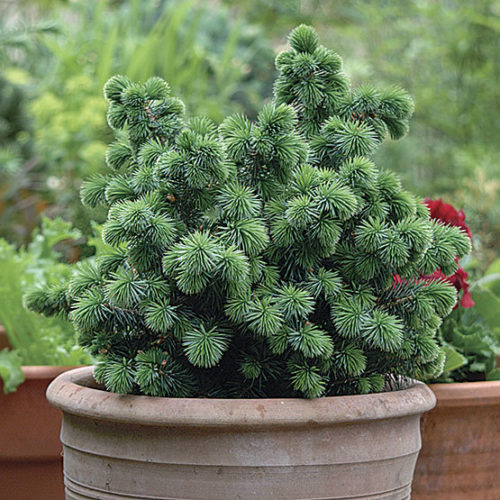
Picea sitchensis 'Papoose' (Dwarf Sitka spruce, 'Papoose' spruce)

Picea sitchensis 'Papoose' Photo/Illustration: Jennifer Brown


Be the first to rate this plant

Plant Showcase - from our advertisers


Hardiness Zones: 1 2 3 4 5 6 7 8 9 10 11
Botanical Name: Picea sitchensis 'Papoose' py-SEE-ah sit-CHEN-sis Common Name: Dwarf Sitka spruce, 'Papoose' spruce Genus: Picea
This is a dwarf conifer with a rounded form. Juvenile needles grow like miniature puffballs on the tips of stubby, round branches and age to a silvery blue on one side and green on the other.
Noteworthy characteristics: An excellent cultivar for a dwarf conifer collection or to accompany perennial plantings. A beautifully formed slow grower, it increases its height and width by about 2 inches a year. New growth is as soft as fur; site where its texture can be appreciated and touched.
Care: Prefers deep, moist but well-drained, neutral to acidic soil.
Propagation: Graft in winter.
Problems: Gall insects, aphids, caterpillars, sawfly, spider mites, lesion nematode, and scale instects. Various wood rots, witches' broom, mistletoe, rust, and needle cast.
Height 3 ft. to 6 ft.
Growth Pace Slow Grower
Light Full Sun to Part Shade
Moisture Medium Moisture
Characteristics Showy Foliage
Foliage Color Evergreen
Uses , Beds and Borders, Container
Style , Rock Garden
Seasonal Interest , Winter Interest, Spring Interest, Summer Interest, Fall Interest
Type ,Trees

Plants you might also like

no image available Picea pungens ‘Procumbens’
(Colorado blue spruce)
(1 user review)
Hardiness Zones: 1 2 3 4 5 6 7 8 9 10 11

'Procumbens' is similar to 'Pendula' in color but prostrate in habit, with cascading branches sometimes staying stiffly horizontal. Makes a spreading, undulating, mounding ground cover of silvery white needles.

Tsuga canadensis 'Pendula' Tsuga canadensis 'Pendula'
(Sargent's weeping hemlock, Eastern hemlock)
Be the first to rate this plant
Hardiness Zones: 1 2 3 4 5 6 7 8 9 10 11

This hemlock cultivar makes a very beautiful specimen, slowly forming a 10- to 15-foot-tall and 30-foot-wide, multi-layered mound of greenery. Its horizontally speading branches are covered with smaller weeping branches clothed in short, dark green needles. It looks great growing over a rock wall, in a rock garden, or by water. Its size may be controlled by regular clipping.

Sciadopitys verticillata Sciadopitys verticillata
(Japanese umbrella pine)
Be the first to rate this plant
Hardiness Zones: 1 2 3 4 5 6 7 8 9 10 11

This glorious conifer constitutes the sole member of both its genus and plant family. It is without a peer in its beauty; on a mature specimen, its rich needles compose a sculpture of form, texture, and color that is unrivaled. The foliage develops a bronzy tint in winter. While it often grows to 30 feet in cultivation and 90 feet in the wild, its slow-growing nature inspires patience.

Buxus sempervirens 'Green Mountain' Buxus sempervirens 'Green Mountain'
(Boxwood)
(2 user reviews)
Hardiness Zones: 1 2 3 4 5 6 7 8 9 10 11

This upright, oval, dark green boxwood grows to about 3 feet high and wide. It flowers in spring, but it is grown for its handsome foliage. Use as hedging or topiary, or in a border.

Wollemia nobilis Wollemia nobilis
(Wollemi pine)
(1 user review)
Hardiness Zones: 1 2 3 4 5 6 7 8 9 10 11

Long thought extinct, the wollemi pine was discovered in 1994 in a remote section of Australia. With only a small grove in existence, a plan was developed to save the tree from extinction by propagating it and selling its offspring. Trials in the U.S. have placed the wollemi pine in Zones 7 to 11. Grow it in full sun. Because this tree has been around since the time of the dinosaurs, it's safe to say it is long-lived. And apparently brontosaurus browsing isn't a problem.