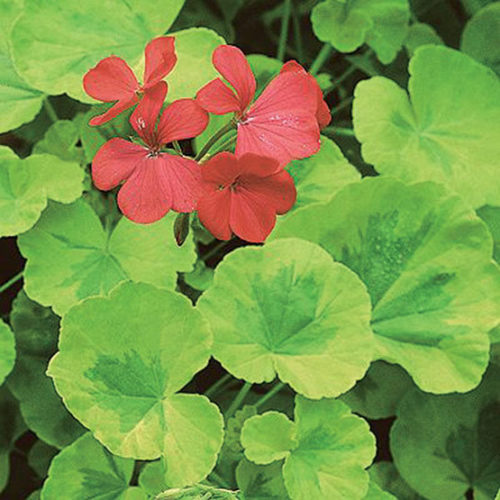
Pelargonium 'Crystal Palace Gem'

Pelargonium 'Crystal Palace Gem' Photo/Illustration: Courtesy of Select Seeds


Be the first to rate this plant

Plant Showcase - from our advertisers


Botanical Name: Pelargonium 'Crystal Palace Gem' pel-ar-GO-nee-um Genus: Pelargonium
'Crystal Palace Gem' was first introduced in 1869 and has been a star in the garden ever since. It was named for Joseph Paxton's elaborate glass house designed in 1851 for London's Great Exhibition in Hyde Park. Like its namesake, the plant is showy, with its round chartreuse leaves with a midgreen center and its salmon-red flowers. 'Crystal Palace Gem' looks good from spring until frost.
Noteworthy characteristics: Introduced in 1869. Variegated foliage and salmon-red flowers. Long bloom time.
Care: Provide full sun and lean, gravelly, well-drained soil. An all-purpose, organic fertilizer at planting time, regular watering, and a weak dose of nitrogen-rich liquid fertilizer every two or three weeks will keep this plant going strong throughout the growing season. In late fall, potted plants can be moved to a brightly lit, unheated greenhouse or cool kitchen window to overwinter until the following spring.
Propagation: From cuttings.
Problems: Thrips, spider mites, mealybugs, caterpillars, gray mold, mildew, black leg, flower break virus, Xanthomonas blight, edema.
Height 1 ft. to 3 ft.
Spread 1 ft. to 3 ft.
Growth Habit Clumps
Light Full Sun Only
Moisture Medium Moisture
Maintenance Moderate
Characteristics Showy Flowers; Showy Foliage
Bloom Time Early Fall; Early Summer; Fall; Late Spring; Late Summer; Spring; Summer
Foliage Color Variegated Foliage
Flower Color Red Flower
Uses , Beds and Borders, Container, Suitable as Annual
Style , Cottage Garden
Seasonal Interest , Spring Interest, Summer Interest, Fall Interest
Type ,Perennials

Plants you might also like

Pentas lanceolata 'New Look Red' Pentas lanceolata 'New Look Red'
(Egyptian star cluster, Star cluster)
(1 user review)
Hardiness Zones: 1 2 3 4 5 6 7 8 9 10 11

Red star-shaped flowers with small white centers bloom atop erect stems from spring to autumn. This evergreen perennial or subshrub is often grown as a summer annual. It generally stays under 2 feet tall in the garden, but the species can reach over 6 feet tall in the wild. Grow in a bed or border, or in containers.

no image available Pelargonium sidoides
(Kalwerbossie geranium , Silverleaf geranium)
Be the first to rate this plant
Hardiness Zones: 1 2 3 4 5 6 7 8 9 10 11

This exemplary species has felted, gray, crinkled leaves. Over a long period, it exhibits sprays of butterfly-shaped, rich wine-red flowers, which contrast dramatically with the foliage. Its small stature makes it a perfect candidate for a container or a walkway edge. It has been used medicinally for the treatment of various infections, including bronchitis. It is a native of Africa.

Agastache ‘Summer Breeze’ Agastache ‘Summer Breeze’
(1 user review)
Hardiness Zones: 1 2 3 4 5 6 7 8 9 10 11

Agastache ‘Summer Breeze’ produces hundreds of 1.5-inch-long translucent, tubular blossoms. The flowers are painted in luscious sunset shades and appear from late spring to frost. In hot weather, peach, champagne, and soft pink are its colors, while in cooler months the flowers darken to pale copper and medium rose. It forms an open, airy, 2- to 3-foot-tall clump, and the upper third of each stem bears a long succession of hummingbird-attracting blooms.

Cynara cardunculus Cynara cardunculus
(Cardoon)
Be the first to rate this plant
Hardiness Zones: 1 2 3 4 5 6 7 8 9 10 11

Cardoon is an architectural splendor with bold texture, thanks to its large, prickly, almost dagger-shaped gray-green arching leaves and a statuesque, vase-shaped frame. It is topped with round, purple, thistlelike flowers in midsummer. Cardoon can reach up to 5 feet tall and 4 feet wide.

Argyranthemum frutescens Argyranthemum frutescens
(1 user review)
Hardiness Zones: 1 2 3 4 5 6 7 8 9 10 11

Argyranthemum is often mistaken for or offered as Chrysanthemum. It is a great plant in containers where it isn't hardy. A. 'Jamaica Primrose' and A. 'Vancouver' will survive in Zones 7-11.