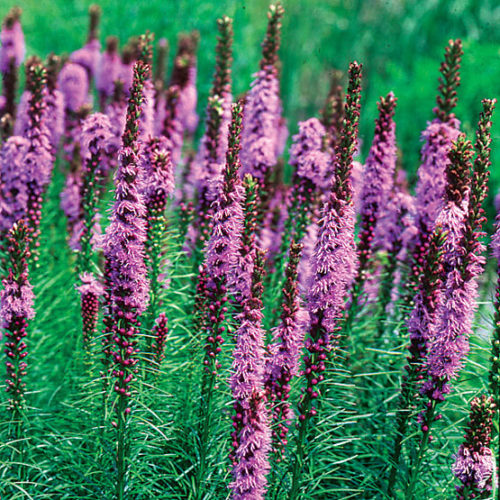
Liatrus spicata (Blazing star, gayfeather)

Liatris spicata Photo/Illustration: David Cavagnaro


Be the first to rate this plant

Hardiness Zones: 1 2 3 4 5 6 7 8 9 10 11
Botanical Name:Liatrus spicata lee-AT-tris spih-KAY-tah Common Name: Blazing star, gayfeather Genus: Liatris
This hardy herbaceous perennial has grass-like, strappy leaves and 3- to 5-foot-tall spikes of purple-pink flowers in late summer and early fall. Native to the eastern and southern United States, this tough perennial prefers reliably moist soil but will tolerate drought. It provides a bold, vertical element to mixed borders and attracts bees and butterflies. It has been observed to be resistant to deer browsing and self-sows freely. The flowers are suitable for cutting.
Care: Provide full sun and reliably moist, well-drained soil.
Propagation:

 Sow seed in fall or divide in spring.


Problems:

 Rusts and leaf spots may occur.


Height 3 ft. to 6 ft.
Spread 1 ft. to 3 ft.
Growth Habit Spreads
Growth Pace Moderate Grower
Light Full Sun Only
Moisture Adaptable;Medium Moisture
Maintenance Low
Tolerance Deer Tolerant;Drought Tolerant
Characteristics Showy Flowers
Bloom Time Early Fall; Fall; Late Summer; Summer
Flower Color Pink Flower
Uses Beds and Borders, Low- Maintenance, Sun, Cut Flower, Summer Interest, Fall Interest
Type Perennials,Natives

Plants you might also like

Echinacea purpurea Echinacea purpurea
(Purple coneflower)
Be the first to rate this plant
Hardiness Zones: 1 2 3 4 5 6 7 8 9 10 11

This classic garden perennial is an eastern US native that is a staple in American gardens. It grows to 5 feet tall and 2 feet wide with both basal and stem leaves that are bright green and lance-shaped. Its 6-inch-wide flowers are a combination of deep pink rays and a tall, golden brown, spiky disk, and they appear in midsummer and keep going into midfall.

Aster dumosus 'Wood's Pink' Aster dumosus 'Wood's Pink'
(Bushy Aster, Hardy Aster)
Be the first to rate this plant
Hardiness Zones: 1 2 3 4 5 6 7 8 9 10 11

This is a short-growing aster has creeping rootstocks and pink, daisy-like flowers with yellow centers. It can be used on steep slopes for erosion control.

Bouteloua gracilis 'Hachita' Bouteloua gracilis 'Hachita'
('Hachita' Blue Grama Grass)
Be the first to rate this plant
Hardiness Zones: 1 2 3 4 5 6 7 8 9 10 11

'Hachita' is a vigorous plant with narrow, blue-green leaves that form dense mounds. During summer, the clumps are punctuated by intricate seed heads that resemble eyelashes. This tough, drought-tolerant grass thrives in sand or clay soil with full-sun exposure. It needs good drainage for the best growth. Too much water is often its downfall.

Agastache foeniculum Agastache foeniculum
(Anise hyssop)
(1 user review)
Hardiness Zones: 1 2 3 4 5 6 7 8 9 10 11

A classic plant for both herb gardens and borders, anise hyssop is composed of erect branches of mint-and-licorice-scented, medium green leaves ending in fuzzy spikes of small lavender flowers. The plant grows to 3 to 5 feet tall and 1 foot wide and reseeds freely. The flowers are edible and are charming crumbled into salads. The flowers are highly attractive to bees, butterflies, and hummingbirds.

Echinacea purpurea Echinacea purpurea
(Purple coneflower)
(2 user reviews)
Hardiness Zones: 1 2 3 4 5 6 7 8 9 10 11

Because of its carefree performance, this native meadow perennial with daisy-like flowers appropriately inhabits the gardens of many. It blooms from midsummer into early autumn, with prominent, copper-orange central cones surrounded by rose-purple, ray petals (to 5 inches across).