previous
  • Homegrown / Homemade
    Homegrown / Homemade
  • In Pursuit of the Perfect Potting Shed
    In Pursuit of the Perfect Potting Shed
  • Thoughts From a Foreign Field
    Thoughts From a Foreign Field
  • Plant an Easy-to-Water Strawberry Jar
    Plant an Easy-to-Water Strawberry Jar
  • Fast-Growing Trees for Impatient Gardeners
    Fast-Growing Trees for Impatient Gardeners
  • Building a Compost Bin
    Building a Compost Bin
  • Colorful Selections for Shade
    Colorful Selections for Shade
  • Fragrant Plants for Pathways
    Fragrant Plants for Pathways
  • Comfortable Alfresco Dining
    Comfortable Alfresco Dining
  • Save Money by Growing Your Own
    Save Money by Growing Your Own
  • Pretty in Pink
    Pretty in Pink
  • Plants that Spark!
    Plants that Spark!
  • Elephant's Ears
    Elephant's Ears
  • Mulch for a Healthy Garden
    Mulch for a Healthy Garden
  • Garden Confidential: A Plant Walks into a Bar
    Garden Confidential: A Plant Walks into a Bar
  • Make a Succulent Topiary
    Make a Succulent Topiary
  • Stylish Shady Containers
    Stylish Shady Containers
  • 6 Tips for Weed Control
    6 Tips for Weed Control
  • Designing with Curved Terraces
    Designing with Curved Terraces
  • NEW Video Series: There's a Better Way
    NEW Video Series: There's a Better Way
  • Containers as Focal Points
    Containers as Focal Points
  • Slideshow: Beautiful Clematis
    Slideshow: Beautiful Clematis
  • Indeterminate or Determinate Tomatoes?
    Indeterminate or Determinate Tomatoes?
  • Lawn Alternatives
    Lawn Alternatives
  • Dwarf Citrus Trees
    Dwarf Citrus Trees
next

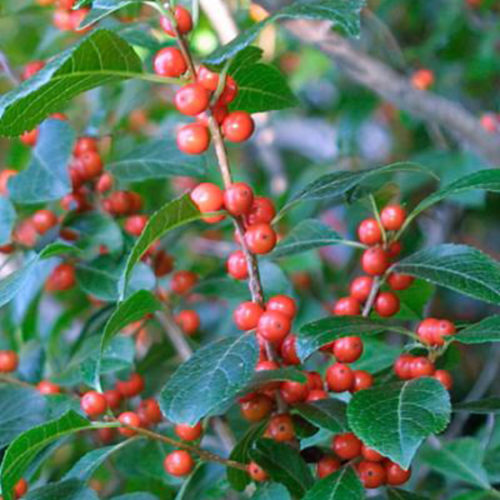
Ilex verticillata (Black alder, Winterberry)

Ilex verticillata Ilex verticillata 'Afterglow' Photo/Illustration: Michelle Gervais

(Based on 1 user review)

Rate this plant

Plant Showcase - from our advertisers


Hardiness Zones: 1 2 3 4 5 6 7 8 9 10 11
Botanical Name: Ilex verticillata EYE-leks ver-tih-sih-LAY-tah Common Name: Black alder, Winterberry Genus: Ilex
This plant is a suckering shrub or small tree with toothed, pointy, bright green leaves. It bears white flowers in spring, which are followed by spherical dark red to scarlet berries that persist through the winter. Some fruit ripens to yellow or orange.
Care: Adaptable to wet soil conditions and likes full sun to partial shade. Use as specimen tree or in a woodland garden. Plant or transplant in spring. Grow in moderately fertile, humus-rich, moist but well-drained soil. Hollies are dioecius, so a few male plants are needed for a female plant to produce berries. Dwarf male cultivars are available for this purpose.
Propagation: Semi-ripe cuttings in summer or early autumn.
Problems: Young shoots are susceptible to aphids. Phytophtora root rot sometimes occurs.
Height 10 ft. to 15 ft.
Spread 10 ft. to 15 ft.
Light Full Sun to Part Shade
Moisture Medium Moisture
Characteristics Attracts Birds; Showy Foliage; Showy Fruit
Bloom Time Spring
Foliage Color Evergreen
Flower Color White Flower
Uses Hedge, Specimen Plant/ Focal Point
Style Woodland Garden
Seasonal Interest Winter Interest, Spring Interest, Summer Interest, Fall Interest
Type Shrubs

Plants you might also like

Ilex × meserveae  Ilex × meserveae 
(Blue holly)
Be the first to rate this plant
Hardiness Zones: 1 2 3 4 5 6 7 8 9 10 11

Blue holly, so named for the glossy blue-green leaves, is a dense, vigorous shrub that can reach 15 feet tall and 10 feet wide. Insignificant flowers bloom in late spring. Female plants have glossy red fruit. There are many cultivars available.

Pieris japonica Pieris japonica
(Lily-of-the-valley bush, Japanese pieris, Japanese andromeda)
Be the first to rate this plant
Hardiness Zones: 1 2 3 4 5 6 7 8 9 10 11

This neat, rounded shrub has given rise to many noteworthy cultivars. It grows to 12 feet tall and 10 feet wide, producing drooping clusters of delicate white blossoms in winter and spring. Use this shrub in a woodland, rock garden, container, or as a foundation plant.

Viburnum × burkwoodii 'Conoy' Viburnum × burkwoodii 'Conoy'
(1 user review)
Hardiness Zones: 1 2 3 4 5 6 7 8 9 10 11

This small deciduous shrub is covered in early spring with pink buds that burst open to reveal slightly fragrant, showy, flat-topped white flowers. Fleshy red fruit is borne in pendulous bunches in late August, darkening to all-black in October. Leaves fade to a dark maroon in the fall and winter months when planted in colder areas. Plants grow to about 5 feet tall and 8 feet wide. A cross between V. utile and V. × burkwoodii ‘Park Farm Hybrid’, this shrub is excellent as a foundation plant, as a specimen, in mass groupings, in a shrub border, or in containers. Evergreen to Zones 7 and 8.

Rosa rugosa var. alba Rosa rugosa var. alba
(Hedgehog rose, Ramanas rose, Japanese rose, Sea tomato)
Be the first to rate this plant
Hardiness Zones: 1 2 3 4 5 6 7 8 9 10 11

This variety has single, papery white blossoms that open from light pink buds and have contrasting yellow stamens. The heavily-scented flowers are followed by reddish-orange hips. It grows up to 6 feet high.

Rosa 'Blanc Double de Coubert' Rosa 'Blanc Double de Coubert'
(Hedgehog rose, Ramanas rose, Japanese rose, Sea tomato)
(1 user review)
Hardiness Zones: 1 2 3 4 5 6 7 8 9 10 11

The white of this rose has a purity of color that is without equal. It produces semi-double, very fragrant flowers from spring to fall, which are sometimes followed by orange hips. It grows to 6 feet high and wide.