previous
  • Stylish Shady Containers
    Stylish Shady Containers
  • Dwarf Citrus Trees
    Dwarf Citrus Trees
  • Elephant's Ears
    Elephant's Ears
  • Make a Succulent Topiary
    Make a Succulent Topiary
  • Plants that Spark!
    Plants that Spark!
  • Plant an Easy-to-Water Strawberry Jar
    Plant an Easy-to-Water Strawberry Jar
  • Mulch for a Healthy Garden
    Mulch for a Healthy Garden
  • Containers as Focal Points
    Containers as Focal Points
  • Homegrown / Homemade
    Homegrown / Homemade
  • Save Money by Growing Your Own
    Save Money by Growing Your Own
  • Garden Confidential: A Plant Walks into a Bar
    Garden Confidential: A Plant Walks into a Bar
  • Comfortable Alfresco Dining
    Comfortable Alfresco Dining
  • NEW Video Series: There's a Better Way
    NEW Video Series: There's a Better Way
  • 6 Tips for Weed Control
    6 Tips for Weed Control
  • Indeterminate or Determinate Tomatoes?
    Indeterminate or Determinate Tomatoes?
  • In Pursuit of the Perfect Potting Shed
    In Pursuit of the Perfect Potting Shed
  • Fast-Growing Trees for Impatient Gardeners
    Fast-Growing Trees for Impatient Gardeners
  • Designing with Curved Terraces
    Designing with Curved Terraces
  • Lawn Alternatives
    Lawn Alternatives
  • Pretty in Pink
    Pretty in Pink
  • Thoughts From a Foreign Field
    Thoughts From a Foreign Field
  • Colorful Selections for Shade
    Colorful Selections for Shade
  • Building a Compost Bin
    Building a Compost Bin
  • Fragrant Plants for Pathways
    Fragrant Plants for Pathways
  • Slideshow: Beautiful Clematis
    Slideshow: Beautiful Clematis
next

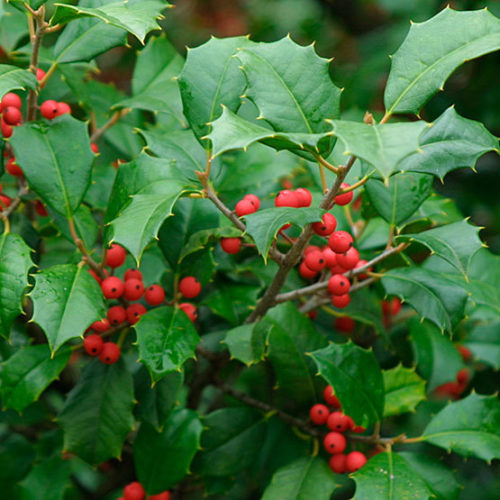
Ilex opaca (American holly)

Ilex opaca Photo/Illustration: Jennifer Benner


Be the first to rate this plant

Plant Showcase - from our advertisers


Hardiness Zones: 1 2 3 4 5 6 7 8 9 10 11
Botanical Name: Ilex opaca EYE-leks oh-PAK-ah Common Name: American holly Genus: Ilex
This erect, evergreen large shrub or tree reaches 40 to 50 feet in height and 20 to 40 feet wide. Leathery dark green leaves have pointy, scalloped edges. Small green berries appear in late summer, maturing to crimson by autumn and persisting through the winter. Some ripen to yellow or orange. Use American holly as a specimen tree or in a woodland garden.
Care: Grow in moderately fertile, humus-rich, moist but well-drained soil. Hollies are dioecius, so a few male plants are needed for a female plant to produce berries. Can be kept shrub-like by pruning in the spring. Plant or transplant in spring.
Propagation: Semi-ripe cuttings in summer or early autumn.
Problems: Young shoots are susceptible to aphids. Also watch for scale insects and leaf miners. Phytophtora root rot sometimes occurs.
Height Over 30 ft.
Spread Over 30 ft.
Light Full Sun to Part Shade
Moisture Medium Moisture
Characteristics Attracts Birds; Native; Showy Foliage; Showy Fruit
Foliage Color Evergreen
Uses Hedge, Specimen Plant/ Focal Point
Style Woodland Garden
Seasonal Interest Winter Interest, Spring Interest, Summer Interest, Fall Interest
Type Trees

Plants you might also like

Magnolia macrophylla Magnolia macrophylla
(Bigleaf magnolia, Large-leaved cucumber tree, Umbrella tree)
Be the first to rate this plant
Hardiness Zones: 1 2 3 4 5 6 7 8 9 10 11

This deciduous species has remarkable leaves that are over 3 feet long and 1 foot wide. They are light green above and silvery beneath. It flowers in early summer with creamy-white, fragrant blossoms that reach a foot across. Magnolia macrophylla grows up to 40 feet tall and wide. It is native to North America.

Viburnum prunifolium Viburnum prunifolium
(Blackhaw Viburnum)
Be the first to rate this plant
Hardiness Zones: 1 2 3 4 5 6 7 8 9 10 11

Blackhaw Viburnum is a large shrub or small tree with clusters of creamy white flowers followed by pink-rose berries, which birds love to eat. Its distinctive bronze-green foliage on reddish purple stems turns blue-black in the fall. Blackhaw grows to 12 to 15 feet high and 8 to12 feet wide.

no image available Pinus strobus 'Fastigiata'
(Eastern white pine)
Be the first to rate this plant
Hardiness Zones: 1 2 3 4 5 6 7 8 9 10 11

This robust evergreen tree has a narrowly columnar crown with ascending branches, slender gray-green leaves, and smooth gray bark. Tapered green female cones ripen to brown.

Sciadopitys verticillata Sciadopitys verticillata
(Japanese umbrella pine)
Be the first to rate this plant
Hardiness Zones: 1 2 3 4 5 6 7 8 9 10 11

This glorious conifer constitutes the sole member of both its genus and plant family. It is without a peer in its beauty; on a mature specimen, its rich needles compose a sculpture of form, texture, and color that is unrivaled. The foliage develops a bronzy tint in winter. While it often grows to 30 feet in cultivation and 90 feet in the wild, its slow-growing nature inspires patience.

Oxydendrum arboreum Oxydendrum arboreum
(Sourwood)
Be the first to rate this plant
Hardiness Zones: 1 2 3 4 5 6 7 8 9 10 11

Sourwood, the lone species of the genus, is found in woodlands and along streams of eastern North America. This plant (named for the sour taste of its leaves) forms a pyramidal tree to 30 feet tall, with canoe-shaped, glossy leaves that turn vivid maroon, yellow, or purple in autumn. In late summer, its delicate panicles of fragrant, urn-shaped flowers spray forward, decorating the tree in white. The blossoms, which resemble lily-of-the-valley, are followed by yellowish seed capsules that turn brown and persist into winter. It makes an outstanding specimen both for a prominent position and also for a naturalized setting.