
previous
  • Comfortable Alfresco Dining
    Comfortable Alfresco Dining
  • NEW Video Series: There's a Better Way
    NEW Video Series: There's a Better Way
  • Thoughts From a Foreign Field
    Thoughts From a Foreign Field
  • 6 Tips for Weed Control
    6 Tips for Weed Control
  • Lawn Alternatives
    Lawn Alternatives
  • Garden Confidential: A Plant Walks into a Bar
    Garden Confidential: A Plant Walks into a Bar
  • Homegrown / Homemade
    Homegrown / Homemade
  • Elephant's Ears
    Elephant's Ears
  • Fast-Growing Trees for Impatient Gardeners
    Fast-Growing Trees for Impatient Gardeners
  • Building a Compost Bin
    Building a Compost Bin
  • Plant an Easy-to-Water Strawberry Jar
    Plant an Easy-to-Water Strawberry Jar
  • Make a Succulent Topiary
    Make a Succulent Topiary
  • Mulch for a Healthy Garden
    Mulch for a Healthy Garden
  • Plants that Spark!
    Plants that Spark!
  • Stylish Shady Containers
    Stylish Shady Containers
  • Indeterminate or Determinate Tomatoes?
    Indeterminate or Determinate Tomatoes?
  • Pretty in Pink
    Pretty in Pink
  • Slideshow: Beautiful Clematis
    Slideshow: Beautiful Clematis
  • Containers as Focal Points
    Containers as Focal Points
  • Designing with Curved Terraces
    Designing with Curved Terraces
  • Dwarf Citrus Trees
    Dwarf Citrus Trees
  • Fragrant Plants for Pathways
    Fragrant Plants for Pathways
  • Colorful Selections for Shade
    Colorful Selections for Shade
  • In Pursuit of the Perfect Potting Shed
    In Pursuit of the Perfect Potting Shed
  • Save Money by Growing Your Own
    Save Money by Growing Your Own
next

Genus Cordyline (Cabbage palm, Cabbage tree)

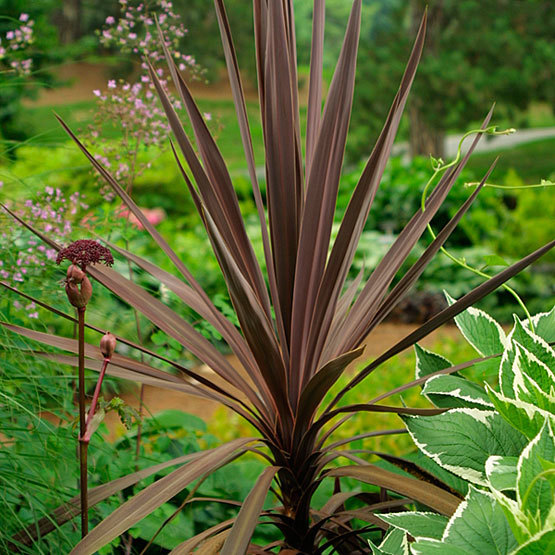
Cordyline Cordyline australis 'Purple Tower' Photo/Illustration: Michelle Gervais
kor-dih-LYE-nee Common Name: Cabbage palm, Cabbage tree
The genus Cordyline is comprised of 15 species of evergreen shrubs and tree-like, woody perennials from Southeast Asia and the Pacific. The larger perennials resemble palm trees. Long, leathery leaves are produced in tufts or rosettes. Flowers are cup-shaped and sweet-smelling, sometimes produced in large terminal panicles. Round white, red, blue, or purple berries follow. Cabbage palms are good as houseplants or grown in a greenhouse. In warmer areas, they can be used as specimen plants, in a border, or in a courtyard garden.
Noteworthy characteristics: Leathery, lance-shaped leaves. Fragrant flowers.
Care: In the garden, grow in fertile, well-drained soil in full sun or partial shade. Under glass, grow green-leaved species in full light and species with colored foliage in bright filtered or indirect light. Water sparingly in winter.
Propagation: In spring, sow seed at 61°F or remove well-rooted suckers.
Problems: Cabbage palms are prone to scale insects, spider mites, and mealybugs, while bacterial and fungal spots, bacterial soft rot, and root rot can also occur.  

Species, varieties and cultivars for genus Cordyline

Cordyline hybrida var. JURed 'Festival™ Burgundy' Cordyline hybrida var. JURed 'Festival™ Burgundy'
(Festival™ Burgundy corydaline)
(1 user review)
Hardiness Zones: 1 2 3 4 5 6 7 8 9 10 11

This basal branching cordyline combines the rugged easy-care attributes of its cordyline cousins with an unusual mix of shiny dark color, compact bushy form, short stems and cascading grass-like leaves.

Cordyline australis 'Purple Tower' Cordyline australis 'Purple Tower'
(Giant dracaena, New Zealand cabbage palm)
(1 user review)
Hardiness Zones: 1 2 3 4 5 6 7 8 9 10 11

'Purple Tower' is a cultivar of the New Zealand native cabbage tree, frequently grown in greenhouses, as houseplants, or as large accent plants outdoors. It is hardy to Zone 10. The narrow, plum-purple leaves reach 3 feet long. The fragrant white flowers are small, but they are borne in large panicles in spring and early summer on mature plants. Plants grown in containers only rarely flower, however. Young plants are often sold as houseplants. Mature specimens have thick trunks with foliage at the top, resembling a palm tree. They are striking container specimens and can be plugged into a summer border. The species has naturalized in portions of California and the southern U.S.


