
previous
  • Slideshow: Beautiful Clematis
    Slideshow: Beautiful Clematis
  • Pretty in Pink
    Pretty in Pink
  • 6 Tips for Weed Control
    6 Tips for Weed Control
  • In Pursuit of the Perfect Potting Shed
    In Pursuit of the Perfect Potting Shed
  • NEW Video Series: There's a Better Way
    NEW Video Series: There's a Better Way
  • Homegrown / Homemade
    Homegrown / Homemade
  • Plants that Spark!
    Plants that Spark!
  • Colorful Selections for Shade
    Colorful Selections for Shade
  • Plant an Easy-to-Water Strawberry Jar
    Plant an Easy-to-Water Strawberry Jar
  • Lawn Alternatives
    Lawn Alternatives
  • Garden Confidential: A Plant Walks into a Bar
    Garden Confidential: A Plant Walks into a Bar
  • Thoughts From a Foreign Field
    Thoughts From a Foreign Field
  • Comfortable Alfresco Dining
    Comfortable Alfresco Dining
  • Containers as Focal Points
    Containers as Focal Points
  • Building a Compost Bin
    Building a Compost Bin
  • Dwarf Citrus Trees
    Dwarf Citrus Trees
  • Elephant's Ears
    Elephant's Ears
  • Fast-Growing Trees for Impatient Gardeners
    Fast-Growing Trees for Impatient Gardeners
  • Indeterminate or Determinate Tomatoes?
    Indeterminate or Determinate Tomatoes?
  • Stylish Shady Containers
    Stylish Shady Containers
  • Mulch for a Healthy Garden
    Mulch for a Healthy Garden
  • Fragrant Plants for Pathways
    Fragrant Plants for Pathways
  • Save Money by Growing Your Own
    Save Money by Growing Your Own
  • Designing with Curved Terraces
    Designing with Curved Terraces
  • Make a Succulent Topiary
    Make a Succulent Topiary
next

Genus Beta (Swiss chard, Beet)

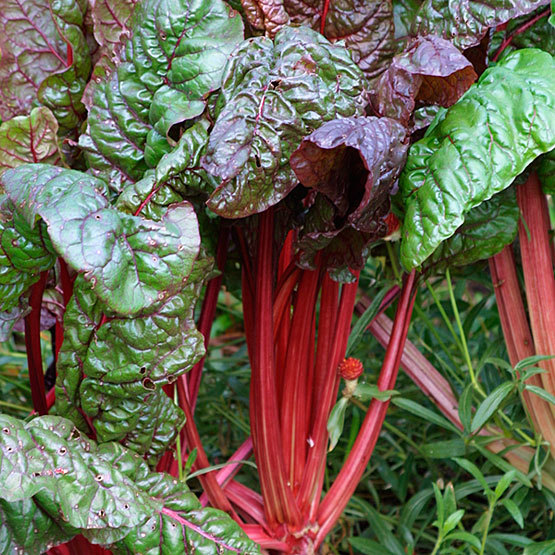
Beta Beta vulgaris 'Ruby Red' Photo/Illustration: Michelle Gervais
BAY-tah Common Name: Swiss chard, Beet
These delicious vegetables are grown to eat, but have considerable ornamental merit in the border also due to their large, succulent leaves and thick stems in tantalizing shades of burgundy, white, gold and magenta. Beta vulgaris is the scientific name for beet, and B. vulgaris, cicla group denotes Swiss chard.
Noteworthy characteristics: They are easily grown from seed, and if given ample water and nutrients, can survive the season to continue as large foliage statements of fall. 
Care: Grow in light, fertile soil in full sun to partial shade.
Propagation: Direct sow in situ in early spring or late summer.
Problems: Fungal leaf spots, downy mildew, powdery mildew, damping off, root rot. Pythium, Phytophthora, leaf miners, aphids, caterpillars.

Species, varieties and cultivars for genus Beta

Beta vulgaris 'Bull's Blood' Beta vulgaris 'Bull's Blood'
(Beet)
(1 user review)

This heirloom beet from 1840 is primarily grown for its tender, sweet, deep red-burgundy foliage, but the beets are tasty when harvested at the 2- to 3-inch size. The glossy leaves reach 18 inches high. Though it is edible, it is often grown as an ornamental, and its dark leaves contrast nicely with many garden plants.

Beta vulgaris 'Ruby Red' Beta vulgaris 'Ruby Red'
(Swiss chard)
Be the first to rate this plant

This is a sweet Swiss chard with beautiful candy-apple-red stalks and dark green, crinkly leaves with touches of red. Both the leaves and the stalks are very ornamental and 'Ruby Red' is great in a vegetable or cottage garden, or in an ornamental bed or border. It is especially attractive when grown with plants whose colors call attention to the red coloring. Although related to beets, the root is inedible, but the leafy greens are valued for their mild flavor and high nutritional value.


