
previous
  • Dwarf Citrus Trees
    Dwarf Citrus Trees
  • Save Money by Growing Your Own
    Save Money by Growing Your Own
  • Containers as Focal Points
    Containers as Focal Points
  • Make a Succulent Topiary
    Make a Succulent Topiary
  • Mulch for a Healthy Garden
    Mulch for a Healthy Garden
  • Designing with Curved Terraces
    Designing with Curved Terraces
  • Homegrown / Homemade
    Homegrown / Homemade
  • Indeterminate or Determinate Tomatoes?
    Indeterminate or Determinate Tomatoes?
  • Stylish Shady Containers
    Stylish Shady Containers
  • NEW Video Series: There's a Better Way
    NEW Video Series: There's a Better Way
  • Fast-Growing Trees for Impatient Gardeners
    Fast-Growing Trees for Impatient Gardeners
  • Slideshow: Beautiful Clematis
    Slideshow: Beautiful Clematis
  • Plants that Spark!
    Plants that Spark!
  • Comfortable Alfresco Dining
    Comfortable Alfresco Dining
  • Lawn Alternatives
    Lawn Alternatives
  • Colorful Selections for Shade
    Colorful Selections for Shade
  • 6 Tips for Weed Control
    6 Tips for Weed Control
  • Elephant's Ears
    Elephant's Ears
  • Plant an Easy-to-Water Strawberry Jar
    Plant an Easy-to-Water Strawberry Jar
  • In Pursuit of the Perfect Potting Shed
    In Pursuit of the Perfect Potting Shed
  • Thoughts From a Foreign Field
    Thoughts From a Foreign Field
  • Garden Confidential: A Plant Walks into a Bar
    Garden Confidential: A Plant Walks into a Bar
  • Pretty in Pink
    Pretty in Pink
  • Building a Compost Bin
    Building a Compost Bin
  • Fragrant Plants for Pathways
    Fragrant Plants for Pathways
next

Genus Aloe

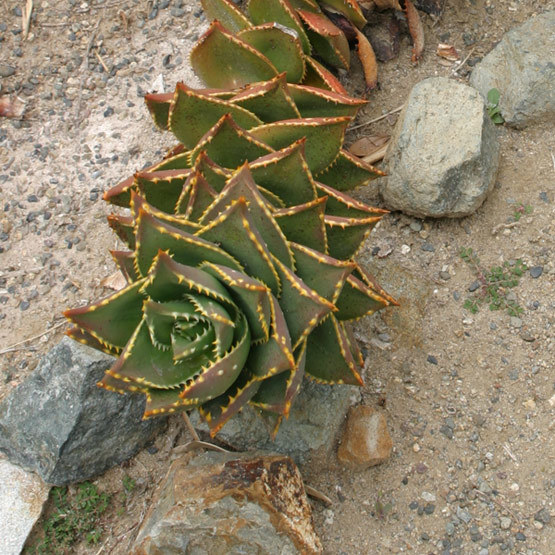
Aloe Aloe distans Photo/Illustration: Steve Aitken
AL-oh
A large genus of more than 300 species of succulents that range in size from low-growing perennials to trees, shrubs, and vines. The leaves grow in rosettes. Flowers are red or yellow, but some species rarely flower. Grow aloes in a desert garden, border, container, or xeric bed.
Care: Provide full sun and fertile, well-drained soil. Aloes tolerate soil of low fertility, and some smaller species can take part shade.
Propagation: Start plants from fresh seed, or from stem cuttings or offsets in late spring or early summer.
Problems: Mealybugs, scale, root rot, bacterial soft rot, fungal stem and leaf rots.

Species, varieties and cultivars for genus Aloe

Aloe cameronii Aloe cameronii
(Red aloe)
(2 user reviews)
Hardiness Zones: 1 2 3 4 5 6 7 8 9 10 11

Aloe is best known as a medicinal plant (Aloe vera, Zones 10-11), but there are many beautiful aloes as well. Most have amazing winter flowers, and some, have interesting foliage color. Red aloe  has color that varies from green to a deep, red wine hue, depending on sun and water. and, over time, will form beautiful red-purple mounds with orange flowers. It is easily propagated from cuttings. -Jeff Moore, Regional Picks: Southwest, Fine Gardening issue #120

Aloe polyphylla Aloe polyphylla
(Spiral aloe)
(4 user reviews)
Hardiness Zones: 1 2 3 4 5 6 7 8 9 10 11

The spine-tipped leaves of this aloe grow in a beautiful spiral; mature plants have five rows of leaves growing either clockwise or counterclockwise. It is very hardy, but will rarely flower. A native of Lesotho, Africa, it is extremely endangered due to overcollecting.


