previous
  • NEW Video Series: There's a Better Way
    NEW Video Series: There's a Better Way
  • Comfortable Alfresco Dining
    Comfortable Alfresco Dining
  • Plant an Easy-to-Water Strawberry Jar
    Plant an Easy-to-Water Strawberry Jar
  • Containers as Focal Points
    Containers as Focal Points
  • Building a Compost Bin
    Building a Compost Bin
  • Mulch for a Healthy Garden
    Mulch for a Healthy Garden
  • Homegrown / Homemade
    Homegrown / Homemade
  • Elephant's Ears
    Elephant's Ears
  • Fast-Growing Trees for Impatient Gardeners
    Fast-Growing Trees for Impatient Gardeners
  • Slideshow: Beautiful Clematis
    Slideshow: Beautiful Clematis
  • Indeterminate or Determinate Tomatoes?
    Indeterminate or Determinate Tomatoes?
  • Thoughts From a Foreign Field
    Thoughts From a Foreign Field
  • Pretty in Pink
    Pretty in Pink
  • Make a Succulent Topiary
    Make a Succulent Topiary
  • Save Money by Growing Your Own
    Save Money by Growing Your Own
  • Designing with Curved Terraces
    Designing with Curved Terraces
  • Lawn Alternatives
    Lawn Alternatives
  • Garden Confidential: A Plant Walks into a Bar
    Garden Confidential: A Plant Walks into a Bar
  • Stylish Shady Containers
    Stylish Shady Containers
  • In Pursuit of the Perfect Potting Shed
    In Pursuit of the Perfect Potting Shed
  • Fragrant Plants for Pathways
    Fragrant Plants for Pathways
  • Colorful Selections for Shade
    Colorful Selections for Shade
  • Plants that Spark!
    Plants that Spark!
  • 6 Tips for Weed Control
    6 Tips for Weed Control
  • Dwarf Citrus Trees
    Dwarf Citrus Trees
next

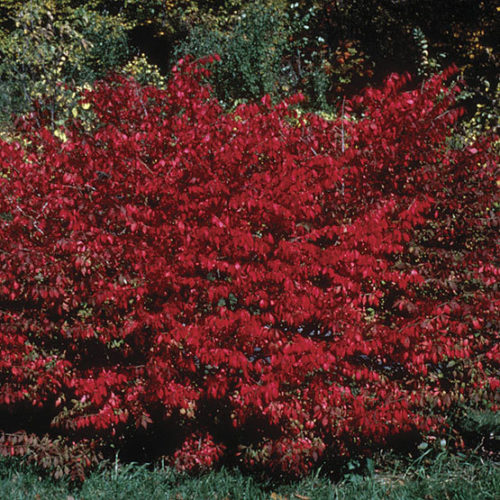
Euonymus alatus (Burning bush, Winged spindle tree)

Euonymus alatus Photo/Illustration: Courtesy of Bailey Nurseries


Be the first to rate this plant

Plant Showcase - from our advertisers


Hardiness Zones: 1 2 3 4 5 6 7 8 9 10 11
Botanical Name: Euonymus alatus yew-ON-ih-mus ah-LAY-tus Common Name: Burning bush, Winged spindle tree Genus: Euonymus
The familiar burning bush is a dense, flat-topped, deciduous shrub with a rounded, horizontal branching habit. Reddish purple fruit grows beneath the simple, finely toothed, dark green leaves. Foliage turns an extremely showy bright red in autumn. Smaller cultivars exist.
Noteworthy characteristics: Easily transplanted and tolerant of many growing conditions. Highly invasive species that may escape cultivation and naturalize in the wild; it has become a problem in New England, especially in New Hampshire and Connecticut. Native to northeastern Asia.
Care: Tolerates most any well-drained soil in full sun or light shade, but plants grown in sun generally need moister soil. Evergreens need a sheltered site out of the wind.
Propagation: Root greenwood cuttings.
Problems: Common: mites, scale insects, leaf miners, aphids, and mealybugs. Frequent: witches' broom, stem dieback, powdery mildew, and fungal spots.
Height 15 ft. to 30 ft.
Spread 10 ft. to 15 ft.
Growth Pace Invasive/Aggressive Grower;Slow Grower
Light Full Sun to Part Shade
Moisture Dry to Medium
Maintenance Low
Characteristics Showy Fall Foliage; Showy Foliage
Bloom Time Late Spring; Spring
Flower Color Yellow Flower
Seasonal Interest Fall Interest
Type Shrubs

Plants you might also like

Ephedra equisetina Ephedra equisetina
(Bluestem joint fir)
Be the first to rate this plant
Hardiness Zones: 1 2 3 4 5 6 7 8 9 10 11

A member of the conifer clan, Ephedra equisetina is commonly called bluestem joint fir due to its finely textured blue stems. In spring, it features a conspicuous froth of yellow blooms that are often followed by red berries. It is perfect for naturalized areas since it reliably spreads.

no image available Cornus drummondii
(Roughleaf dogwood)
Be the first to rate this plant
Hardiness Zones: 1 2 3 4 5 6 7 8 9 10 11

This dogwood can be classified as either a deciduous shrub or small tree. Appealing creamy white flowers appear in late spring and become attractive clusters of milky white fruit in fall. The first cold front often turns the leaves a dark burgundy, and the winter stem tips have a glossy mahogany hue.

Rosa rugosa 'Agnes' Rosa rugosa 'Agnes'
('Agnes' rugosa rose)
(1 user review)
Hardiness Zones: 1 2 3 4 5 6 7 8 9 10 11

'Agnes'  is one of the few yellow rugosa roses, and it epitomizes the finest rugosa attributes in both leaf and overall form. Doubled blooms give this selection an old-fashioned aspect, as does its delightful fragrance, which is reminiscent of antique roses. Bloom color changes somewhat with the temperature: in cool temperatures, the flowers are an apricot hue, but as the weather warms, they turn a soft yellow. -Suzanne Verrier, No muss, no fuss rugosa roses, Fine Gardening issue #121

Rosa rugosa var. alba Rosa rugosa var. alba
(Hedgehog rose, Ramanas rose, Japanese rose, Sea tomato)
Be the first to rate this plant
Hardiness Zones: 1 2 3 4 5 6 7 8 9 10 11

This variety has single, papery white blossoms that open from light pink buds and have contrasting yellow stamens. The heavily-scented flowers are followed by reddish-orange hips. It grows up to 6 feet high.

Rosa 'Charles Albanel' Rosa 'Charles Albanel'
(Hedgehog rose, Ramanas rose, Japanese rose, Sea tomato)
Be the first to rate this plant
Hardiness Zones: 1 2 3 4 5 6 7 8 9 10 11

This spreading rose grows to only 2 feet tall, making it an ideal groundcover for a steep bank or roadside. It produces fragrant, double, deep-pink blossoms from spring to fall.