previous
  • Indeterminate or Determinate Tomatoes?
    Indeterminate or Determinate Tomatoes?
  • Fast-Growing Trees for Impatient Gardeners
    Fast-Growing Trees for Impatient Gardeners
  • Slideshow: Beautiful Clematis
    Slideshow: Beautiful Clematis
  • Garden Confidential: A Plant Walks into a Bar
    Garden Confidential: A Plant Walks into a Bar
  • Mulch for a Healthy Garden
    Mulch for a Healthy Garden
  • Stylish Shady Containers
    Stylish Shady Containers
  • Elephant's Ears
    Elephant's Ears
  • Fine Gardening's Tip Off!
    Fine Gardening's Tip Off!
  • In Pursuit of the Perfect Potting Shed
    In Pursuit of the Perfect Potting Shed
  • Building a Compost Bin
    Building a Compost Bin
  • Containers as Focal Points
    Containers as Focal Points
  • NEW Video Series: There's a Better Way
    NEW Video Series: There's a Better Way
  • Pretty in Pink
    Pretty in Pink
  • Colorful Selections for Shade
    Colorful Selections for Shade
  • Make a Succulent Topiary
    Make a Succulent Topiary
  • Designing with Curved Terraces
    Designing with Curved Terraces
  • Save Money by Growing Your Own
    Save Money by Growing Your Own
  • Plant an Easy-to-Water Strawberry Jar
    Plant an Easy-to-Water Strawberry Jar
  • Dwarf Citrus Trees
    Dwarf Citrus Trees
  • 6 Tips for Weed Control
    6 Tips for Weed Control
  • Meet Our Mini-Magazines
    Meet Our Mini-Magazines
  • Thoughts From a Foreign Field
    Thoughts From a Foreign Field
  • Fragrant Plants for Pathways
    Fragrant Plants for Pathways
  • Comfortable Alfresco Dining
    Comfortable Alfresco Dining
  • Homegrown / Homemade
    Homegrown / Homemade
next

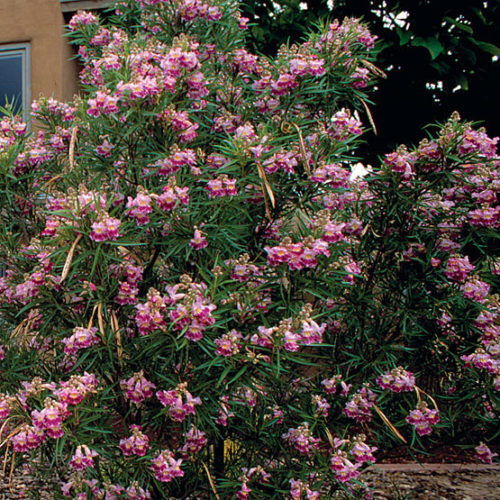
Chilopsis linearis (Desert Willow)

Chilopsis linearis Photo/Illustration: Charles Mann


Be the first to rate this plant

Plant Showcase - from our advertisers


Hardiness Zones: 1 2 3 4 5 6 7 8 9 10 11
Botanical Name: Chilopsis linearis kil-OP-sis lin-ee-AR-iss Common Name: Desert Willow
Desert willow is shrub native to the Southwest U.S. and Mexico. Its erect willowy foliage is joined by large, blowsy pink flowers from early summer to first frost. This tough plants performs well in xeriscapes and other dry, unforgiving locations. It grows to 10 to 14 feet tall and wide remains blemish-free all season long.
Noteworthy characteristics: This is the only species in the genus Chilopsis. The genus Chilopsis belongs to Bignoniaceae.
Care: Provide full sun and well-drained soil in USDA Hardiness Zones 7 to 9. Deadhead regularly for best flowering. Prune away wayward stems in spring.
Propagation:

 Sow ripe seed promptly or take cuttings in spring or summer.


Problems:

 Root rot may occur.


Height 10 ft. to 15 ft.
Spread 10 ft. to 15 ft.
Growth Pace Moderate Grower
Light Full Sun Only
Moisture Dry;Dry to Medium
Maintenance Low
Tolerance Deer Tolerant;Drought Tolerant
Characteristics Showy Flowers
Bloom Time Early Fall; Early Summer; Fall; Late Summer; Summer
Flower Color Pink Flower
Style Low- Maintenance, Sun, Flowering Tree, Desert Garden, Xeric Bed, Summer Interest, Fall Interest
Type Shrubs,Trees

Plants you might also like

Vitex agnus-castus var. latifolia Vitex agnus-castus var. latifolia
(Chaste tree)
(2 user reviews)
Hardiness Zones: 1 2 3 4 5 6 7 8 9 10 11

Chaste tree is a southern favorite beginning to gain favor across the country. Whether left to grow as a large, multistemmed shrub or cut back annually for a more compact look, this selection is a winner. Fine, lacy leaves are glossy and green. Bright blue flower panicles begin to form in early summer and continue through the heat of the season and into fall. This is a reasonably cold-hardy, deer-resistant woody plant, and while V. agnus-castus is typically considered a Zone 7 plant, the variety latifolia can be grown in Zone 6 and even in southern areas of Zone 5.

Cotinus 'Grace' Cotinus 'Grace'
('Grace' smoke tree)
(1 user review)
Hardiness Zones: 1 2 3 4 5 6 7 8 9 10 11

This cross of the European smoke bush (C. coggygria) and the American smoke tree (C. obovatus) is a gem in the garden thanks to its multiseason interest. Its iridescent spring foliage is green overlaid with red; then its large pink clouds of blooms in summer are followed by brilliant autumn foliage that ranges from red to orange. 'Grace' combines well with just about anything; asters, ornamental grasses, and Japanese maples are good places to start.

Franklinia alatamaha Franklinia alatamaha
(Franklin tree)
(1 user review)
Hardiness Zones: 1 2 3 4 5 6 7 8 9 10 11

Discovered in the wild along Georgia's Altamaha River in 1765 by botanists John and William Bartram, this beautiful landscape tree is considered extinct in the wild. The Bartrams named the plant in honor of their friend Benjamin Franklin. All Franklinias today are descended from those propagated by the Bartrams in their Philadelphia garden. It is a deciduous, understory tree with an upright habit. It can be grown as a single-trunked tree or a multi-stemmed shrub. The fragrant white flowers have bushy yellow stamens and the leaves are dark green and glossy, turning orange, red, and purple in the fall. It blooms in late summer and early autumn, when few other trees are in flower. The fruit that follows is woody and spherical. Franklin tree makes a great addition to an open area of a woodland garden.

Albizia julibrissin Albizia julibrissin
(Mimosa, Silk tree)
(2 user reviews)
Hardiness Zones: 1 2 3 4 5 6 7 8 9 10 11

A large shrub or small tree, Albizia julibrissin is native to Iran to Japan. It is a fast-growing plant whose seedlings can become invasive. It can be seen growing in the wild in the southeastern U.S. and California in waste places, fields, and along roads.

However, its bipinnate, ferny leaves and fluffy pink flowerheads that cover the tree in summer make it a garden-worthy plant, as do the fragrance emitted by the flowers, which attract bees. Seed pods that resemble flat beans follow the flowers and persist into winter. Still, care should be used so that seeds from garden plants can't escape into the wild.

no image available Cornus drummondii
(Roughleaf dogwood)
Be the first to rate this plant
Hardiness Zones: 1 2 3 4 5 6 7 8 9 10 11

This dogwood can be classified as either a deciduous shrub or small tree. Appealing creamy white flowers appear in late spring and become attractive clusters of milky white fruit in fall. The first cold front often turns the leaves a dark burgundy, and the winter stem tips have a glossy mahogany hue.