Catharanthus roseus 'Peach' (Madagascar periwinkle, Old maid)

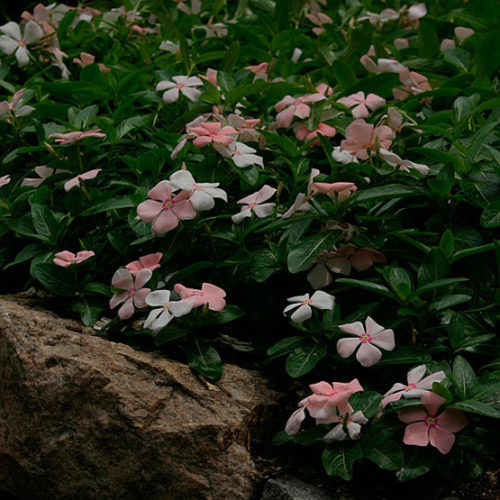
Catharanthus roseus 'Peach' Photo/Illustration: Michelle Gervais


Be the first to rate this plant

Plant Showcase - from our advertisers


Botanical Name: Catharanthus roseus 'Peach' kath-ar-AN-thus ROSE-ee-us Common Name: Madagascar periwinkle, Old maid Synonyms: Vinca rosea Genus: Catharanthus
A tender perennial native to Madagascar, most often grown as an annual, Catharanthus roseus has attractive, glossy foliage and a bushy form that is covered by phlox-like flowers from summer to first frost. It is a very popular bedding plant and works in containers as well. Many cultivars are vividly colored, but 'Peach' has subtle pale pink-peach flowers with a darker eye.
Noteworthy characteristics: Peachy, five-petaled flowers on a bushy, glossy-leaved perennial, typically grown as an annual. All parts of the plant can cause severe discomfort if ingested.
Care: Grow in well-drained soil of moderate fertility in full sun or partial shade. To insure good flower production, do not overwater or overfertilize. Indoors, grow in full light with good ventilation. Water sparingly in winter.
Propagation: Sow seed in early spring at 55° to 64°F. Root semi-ripe cuttings in summer or softwood cuttings in late spring.
Problems: Aerial blights, stem rot, leaf spots, aster yellows, and tomato spotted wilt virus can occur, while dodder is common in certain regions. If grown under glass, spider mites and whiteflies may be problematic.
Height 1 ft. to 3 ft.
Spread 1 ft. to 3 ft.
Growth Habit Clumps
Growth Pace Moderate Grower
Light Full Sun to Part Shade
Moisture Medium Moisture
Maintenance Moderate
Characteristics Showy Flowers
Bloom Time Fall; Summer
Flower Color Pink Flower
Uses , Beds and Borders, Container, Indoor Plant, Poisonous, Suitable as Annual
Seasonal Interest , Suitable as Annual, Spring Interest
Type ,Perennials

Plants you might also like

Pelargonium crispum Pelargonium crispum
(Geranium)
Be the first to rate this plant
Hardiness Zones: 1 2 3 4 5 6 7 8 9 10 11

This plant is a lemon-scented, shrubby, upright pelargonium with pale pink flowers and crinkled leaves.

Pelargonium crispum ‘Variegatum’ Pelargonium crispum ‘Variegatum’
(Geranium, Scented geranium, Variegated lemon-scented geranium)
Be the first to rate this plant
Hardiness Zones: 1 2 3 4 5 6 7 8 9 10 11

This lemon-scented, shrubby, upright pelargonium has cream-margined leaves.

Alstroemeria 'Casablanca' Alstroemeria 'Casablanca'
(Peruvian lily)
(1 user review)
Hardiness Zones: 1 2 3 4 5 6 7 8 9 10 11

'Casablanca' Peruvian lily is the closest to white that this genus has gotten as of yet. Inside its amaryllis-shaped white flowers, reddish dashes on a yellow wash and a pale pink throat add interest. 'Casablanca' is also taller than most other Alstroemerias. They make great cut flowers and are frequently used by florists; they also add a tropical feel to beds and borders. Roots are very brittle and care should be taken when planting.

Brachycome 'Blue Zephyr' Brachycome 'Blue Zephyr'
(Swan River daisy)
Be the first to rate this plant
Hardiness Zones: 1 2 3 4 5 6 7 8 9 10 11

Swan River daisy's lacy foliage and small but profuse blue-purple flowers have a long season of impact in the garden. Its compact, bushy shape, pretty fragrant flowers, and gray-green leaves make it attractive from planting time through frost. It flowers so heavily that the foliage is often obscured. 'Blue Zephyr' has especially fine foliage and only reaches about a foot high. It is excellent in hanging baskets, window boxes, or other containers, or at the front of a bed or border.

Salvia greggii Salvia greggii
(Autumn sage)
(3 user reviews)
Hardiness Zones: 1 2 3 4 5 6 7 8 9 10 11

This native of Texas and Mexico has a woody base and can form a dwarf, evergreen shrub, 1 foot tall by 1 foot wide. It has small, leathery leaves and bears bright flowers in shades of pink, purple, or yellow from early summer to frost.