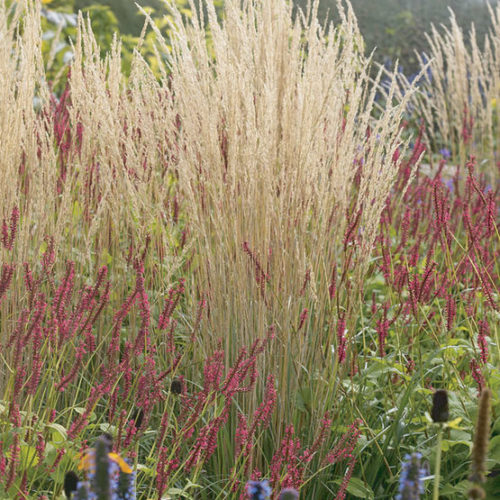
Calamagrostis × acutiflora 'Karl Foerster' (Feather reed grass)

Calamagrostis × acutiflora 'Karl Foerster' Photo/Illustration: Michelle Gervais

(Based on 2 user reviews)

Rate this plant

Plant Showcase - from our advertisers


Hardiness Zones: 1 2 3 4 5 6 7 8 9 10 11
Botanical Name: Calamagrostis × acutiflora 'Karl Foerster' kal-ah-mah-GROS-tiss ex ah-kew-tih-FLOOR-ah Common Name: Feather reed grass Synonyms: C. arundinaceae × C. epigejos Genus: Calamagrostis
Gardeners love this plant for its handsome, thin, vertical green foliage from spring through fall and for its wonderful flowers, which start out pink and then change to a fine tawny color with the cool days of autumn. 'Karl Foerster' reaches 6 feet high and 6 feet wide. Use in a border.  
Noteworthy characteristics: Stiff arching green stems with pink-bronze inflorescences fading to buff, from late summer through winter.
Care: Grow in full sun or partial shade and moist, humusy soil. Will tolerate poorer soil. Cut back in spring.
Propagation: Divide in mid-spring.
Problems: Ergot, powdery mildew, tar spot, smut, and foot rot can occur.
Height 3 ft. to 6 ft.
Spread 1 ft. to 3 ft.
Growth Habit Spreads
Light Full Sun to Part Shade
Moisture Medium Moisture
Maintenance Low
Characteristics Attracts Birds; Showy Flowers; Showy Seed Heads
Bloom Time Summer
Flower Color Brown Flower; Pink Flower
Uses , Beds and Borders, Roadside, Waterside
Style , Meadow Garden, Rock Garden
Seasonal Interest , Winter Interest, Summer Interest, Fall Interest
Type ,Grasses

Plants you might also like

Schizachyrium scoparium Schizachyrium scoparium
(Little bluestem, Prairie beard grass)
(1 user review)
Hardiness Zones: 1 2 3 4 5 6 7 8 9 10 11

Little bluestem is a tidy, finely textured clumping grass with a blue-green summer color. Its silvery seed heads rise to a height of nearly 2 feet in late summer and are at their best when backlit in the morning or afternoon sun. In fall, the grass turns a rosy rust color that lasts all winter.

Chasmanthium latifolium Chasmanthium latifolium
(Northern sea oats, Spangle grass, Wild oats)
(2 user reviews)
Hardiness Zones: 1 2 3 4 5 6 7 8 9 10 11

Northern sea oats is a loosely tufted, clump-forming grass with lance-shaped, arching mid-green foliage that turns yellow in winter. Summer brings highly decorative oat-like panicles of flat, green flowerheads that shimmer and rustle in the wind, aging to bronze by late summer.

Pennisetum alopecuroides Pennisetum alopecuroides
(Fountain grass)
(1 user review)
Hardiness Zones: 1 2 3 4 5 6 7 8 9 10 11

This species produces 2- to 5-foot-tall mounds of narrow green foliage and bottle brush-like silvery-pink to purple flowers, both of which mature to shades of brown. It is the parent of numerous cultivars with notable flowers that range from purple to gray/black. It and some of its cultivars self-sow plentifully in warm climates. It is marginally hardy in Zone 5.

Sporobolus heterolepsis Sporobolus heterolepsis
(Prairie dropseed)
(1 user review)
Hardiness Zones: 1 2 3 4 5 6 7 8 9 10 11

The finely textured, green leaves of this slow-growing, clump-forming perennial turn golden yellow in autumn. It bears cloudy panicles of fragrant, pale-pink to tawny flowers 5 to 10 inches long in late summer, reaching 3 feet tall.

Panicum virgatum 'Shenandoah' Panicum virgatum 'Shenandoah'
('Shenandoah' red switchgrass)
Be the first to rate this plant
Hardiness Zones: 1 2 3 4 5 6 7 8 9 10 11

'Shenandoah' is truly a plant for all seasons. In early summer, its leaf blades are tipped in red, and by autumn, the entire leaf is a rich burgundy color, topped by pink plumes. In winter, the leaf color fades to beige; the blades persist and offer cover to birds. 'Shenandoah' is a compact selection of an American native prairie grass.