Bouteloua gracilis (Blue grama, Signal-arm grass, Mosquito grass)

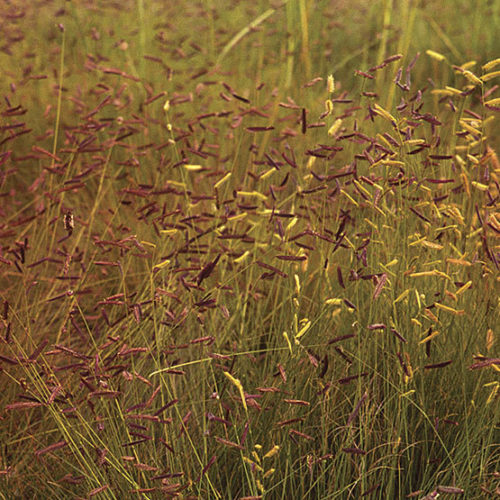
Bouteloua gracilis Photo/Illustration: Courtesy of www.provenwinners.com


Be the first to rate this plant

Plant Showcase - from our advertisers


Hardiness Zones: 1 2 3 4 5 6 7 8 9 10 11
Botanical Name: Bouteloua gracilis boo-tel-LOO-ah grah-SIL-iss Common Name: Blue grama, Signal-arm grass, Mosquito grass Synonyms: B. oligostachya, Chondrosum gracile Genus: Bouteloua
Blue grama is a perennial grass from the Americas bearing unusually bent and flattened inflorescences. Being native to open grasslands, they are drought tolerant and at home in meadows. They provide the garden with shades of tan that persist throughout winter. 
Noteworthy characteristics: Fancifully bent, brownish-purple seed heads perch atop wiry stems and fine foliage. Suitable for specimen planting or in mixed borders
Care: Grow in light, well-drained soil in full sun; cannot tolerate wet winters.
Propagation: Divide from mid-spring to early summer; sow seed in cold frames in spring.
Problems: Damping off, rust, head and leaf smuts, tar spot, fungal spots, root rot.
Height 1 ft. to 3 ft.
Spread 6 in. to 12 in.
Growth Habit Clumps
Growth Pace Moderate Grower
Light Full Shade Only
Moisture Dry to Medium
Maintenance Low
Tolerance Deer Tolerant;Drought Tolerant
Characteristics Showy Foliage; Showy Seed Heads
Bloom Time Summer
Flower Color Brown Flower; Purple/ Lavender Flower
Uses , Beds and Borders, Ground Covers, Dried Flower, Naturalizing
Style , Meadow Garden
Seasonal Interest , Winter Interest, Summer Interest, Fall Interest
Type ,Grasses

Plants you might also like

Schizachyrium scoparium Schizachyrium scoparium
(Little bluestem, Prairie beard grass)
(1 user review)
Hardiness Zones: 1 2 3 4 5 6 7 8 9 10 11

Little bluestem is a tidy, finely textured clumping grass with a blue-green summer color. Its silvery seed heads rise to a height of nearly 2 feet in late summer and are at their best when backlit in the morning or afternoon sun. In fall, the grass turns a rosy rust color that lasts all winter.

Bouteloua gracilis 'Hachita' Bouteloua gracilis 'Hachita'
('Hachita' Blue Grama Grass)
(2 user reviews)
Hardiness Zones: 1 2 3 4 5 6 7 8 9 10 11

'Hachita' has narrow, blue-green leaves that form dense mounds. In summer, elongated seedheads add visual interest. This tough, drought-tolerant grass thrives in sand or clay soil with full-sun exposure. It needs a setting with good drainage, as it won't thrive in wet conditions

Deschampsia cespitosa 'Northern Lights' Deschampsia cespitosa 'Northern Lights'
(Tufted hair grass, Tussock grass)
(2 user reviews)
Hardiness Zones: 1 2 3 4 5 6 7 8 9 10 11

A tuft of thin grassy foliage with gray and gold variegation distinguishes this cultivar. Early summer brings 3-foot-tall, airy plumes of tiny flowers that look beautiful when backlit by the sun. As fall approaches, the foliage turns golden with pink-coral tips. This grass even grows well in shadier sites. Plant in a border, woodland garden, or shaded rock garden.

Sporobolus heterolepsis Sporobolus heterolepsis
(Prairie dropseed)
(1 user review)
Hardiness Zones: 1 2 3 4 5 6 7 8 9 10 11

The finely textured, green leaves of this slow-growing, clump-forming perennial turn golden yellow in autumn. It bears cloudy panicles of fragrant, pale-pink to tawny flowers 5 to 10 inches long in late summer, reaching 3 feet tall.

Pennisetum alopecuroides Pennisetum alopecuroides
(Fountain grass)
(1 user review)
Hardiness Zones: 1 2 3 4 5 6 7 8 9 10 11

This species produces 2- to 5-foot-tall mounds of narrow green foliage and bottle brush-like silvery-pink to purple flowers, both of which mature to shades of brown. It is the parent of numerous cultivars with notable flowers that range from purple to gray/black. It and some of its cultivars self-sow plentifully in warm climates. It is marginally hardy in Zone 5.