previous
  • Homegrown / Homemade
    Homegrown / Homemade
  • In Pursuit of the Perfect Potting Shed
    In Pursuit of the Perfect Potting Shed
  • Comfortable Alfresco Dining
    Comfortable Alfresco Dining
  • Lawn Alternatives
    Lawn Alternatives
  • Pretty in Pink
    Pretty in Pink
  • Plants that Spark!
    Plants that Spark!
  • Save Money by Growing Your Own
    Save Money by Growing Your Own
  • Thoughts From a Foreign Field
    Thoughts From a Foreign Field
  • Make a Succulent Topiary
    Make a Succulent Topiary
  • Dwarf Citrus Trees
    Dwarf Citrus Trees
  • Plant an Easy-to-Water Strawberry Jar
    Plant an Easy-to-Water Strawberry Jar
  • Building a Compost Bin
    Building a Compost Bin
  • Designing with Curved Terraces
    Designing with Curved Terraces
  • NEW Video Series: There's a Better Way
    NEW Video Series: There's a Better Way
  • Fragrant Plants for Pathways
    Fragrant Plants for Pathways
  • Mulch for a Healthy Garden
    Mulch for a Healthy Garden
  • Fast-Growing Trees for Impatient Gardeners
    Fast-Growing Trees for Impatient Gardeners
  • 6 Tips for Weed Control
    6 Tips for Weed Control
  • Slideshow: Beautiful Clematis
    Slideshow: Beautiful Clematis
  • Stylish Shady Containers
    Stylish Shady Containers
  • Colorful Selections for Shade
    Colorful Selections for Shade
  • Indeterminate or Determinate Tomatoes?
    Indeterminate or Determinate Tomatoes?
  • Elephant's Ears
    Elephant's Ears
  • Garden Confidential: A Plant Walks into a Bar
    Garden Confidential: A Plant Walks into a Bar
  • Containers as Focal Points
    Containers as Focal Points
next

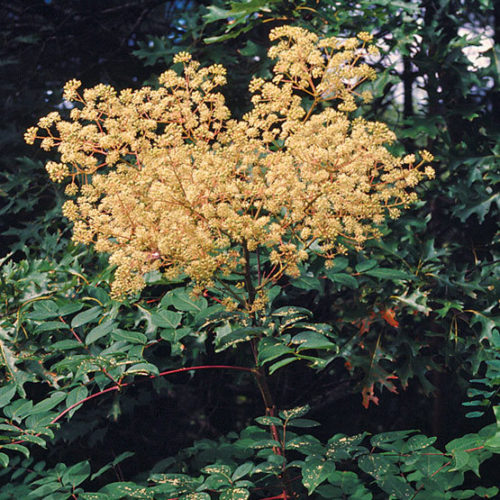
Aralia spinosa (Devil's walking stick, Hercules club, Angelica tree, Prickly ash)

Aralia spinosa Photo/Illustration: Virginia Ducey, courtesy of www.plantdelights.com

(Based on 1 user review)

Rate this plant

Plant Showcase - from our advertisers


Hardiness Zones: 1 2 3 4 5 6 7 8 9 10 11
Botanical Name: Aralia spinosa ah-RAY-lee-ah spin-OH-sah Common Name: Devil's walking stick, Hercules club, Angelica tree, Prickly ash Genus: Aralia
The textural quality of this eastern native's stems and foliage is superb. During winter, a circle of the thorn-covered stems is as magical as an outdoor sculpture. Dark blue-green compound leaves offer a tropical effect before turning yellow and purple in autumn. One-foot-wide flower clusters sit atop the foliage in summer and transform into purple-black fruits that attract birds. Aralia spinosa grows to 30 feet tall and spreads indefinitely.
Noteworthy characteristics: Handling bark and roots may cause allergic skin reactions. Attracts birds. Thorns lend strong winter interest.
Care: Provide full sun to part shade and moist, but well drained-soil. Plant in an area where contact with the thorns is unlikely. Promptly remove suckers to prevent unwanted naturalization.
Propagation: This plant is easy to start from seed, by division, or from root cuttings.
Problems: Generally trouble-free, but watch for leaf spots, aphids, and mealybugs. It may be somewhat invasive.
Height 15 ft. to 30 ft.
Spread Over 30 ft.
Growth Habit Spreads
Growth Pace Fast Grower
Light Full Sun to Part Shade
Moisture Medium Moisture
Maintenance Low
Characteristics Native; Showy Fall Foliage; Showy Flowers; Showy Foliage; Showy Fruit
Bloom Time Early Summer; Late Summer; Summer
Flower Color White Flower
Uses Beds and Borders, Naturalizing
Style Woodland Garden
Seasonal Interest Winter Interest, Summer Interest, Fall Interest
Type Shrubs

Plants you might also like

Chionanthus virginicus Chionanthus virginicus
(White fringetree)
Be the first to rate this plant
Hardiness Zones: 1 2 3 4 5 6 7 8 9 10 11

This North American native is unrivaled in beauty for its pendulous and diaphanous clusters of fragrant white blossoms, which appear in May or June. The individual blossoms are made up of four petals that dangle from threadlike stems in great silken clusters. The leaves are late to emerge in the spring, and this species flowers before leafing out. Female specimens produce blue-black fruits in autumn.

Clethra alnifolia 'Hummingbird' Clethra alnifolia 'Hummingbird'
(Sweet pepperbush)
Be the first to rate this plant
Hardiness Zones: 1 2 3 4 5 6 7 8 9 10 11

This upright, suckering shrub bears creamy white, deliciously spicy clove-scented flowers in dense, upright spikes that last four to six weeks in July and August. It is more compact than the species. Flowers mature to spikes of dark brown capsules that provide winter interest. Its oval, glossy dark green leaves turn a pleasant yellow in autumn.

Rosa rugosa var. alba Rosa rugosa var. alba
(Hedgehog rose, Ramanas rose, Japanese rose, Sea tomato)
Be the first to rate this plant
Hardiness Zones: 1 2 3 4 5 6 7 8 9 10 11

This variety has single, papery white blossoms that open from light pink buds and have contrasting yellow stamens. The heavily-scented flowers are followed by reddish-orange hips. It grows up to 6 feet high.

Rosa 'Blanc Double de Coubert' Rosa 'Blanc Double de Coubert'
(Hedgehog rose, Ramanas rose, Japanese rose, Sea tomato)
(1 user review)
Hardiness Zones: 1 2 3 4 5 6 7 8 9 10 11

The white of this rose has a purity of color that is without equal. It produces semi-double, very fragrant flowers from spring to fall, which are sometimes followed by orange hips. It grows to 6 feet high and wide.   

Rosa 'Radrazz' Rosa 'Radrazz'
(Knock Out® rose)
Be the first to rate this plant
Hardiness Zones: 1 2 3 4 5 6 7 8 9 10 11

Vibrant blossoms appear in spring and continue until frost. In fall, the dark green foliage and hearty stems are edged with red. -Judith Ireland, Regional Reports: Northeast, Fine Gardening issue #122